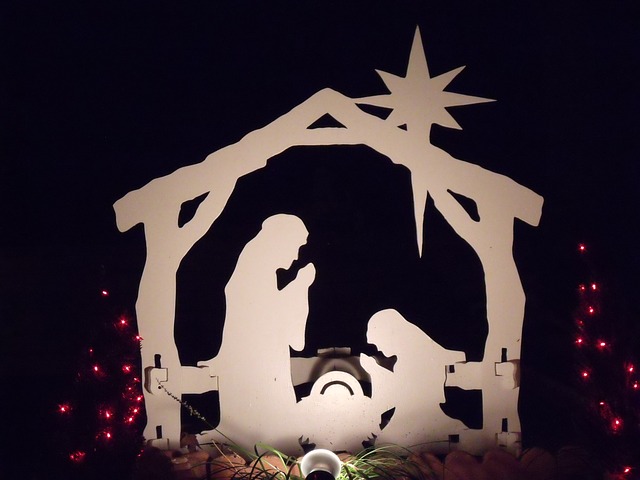
“…we cannot fix our eyes and hearts upon any part of the Incarnation [including the Sacred Infancy at Bethlehem], without the royal spirit of mortification and self-sacrifice passing into us. Jesus, in every shape and under every view, is the doctor of penance and mortification. Whatever else he teaches, that goes along with every lesson. Every lesson presupposes it, and reacts back upon it. Except a man take up his cross daily, and so follow Jesus, he cannot follow Him at all.” (From:The Blessed Sacrament, p.167, by F.W. Faber, comparing the Sacred Infancy of Jesus to adoration of the Blessed Sacrament).From the very beginning at Bethlehem, Jesus “chose a lifestyle” of simplicity, detachment and self-denial. We can thus learn a lot about who Jesus is by looking at the circumstances of his lowly birth, and the following list highlights some of those circumstances and virtues (and here I am drawing directly or indirectly from Father Faber’s book, Bethlehem: The Sacred Infancy of our Most Dear and Blessed Redeemer): 1. Holy Poverty…..The Lord was born in extremely lowly circumstances2. Detachment from things…..The Lord was born in a stable3. Humility…..The Lord let others use the Inn4. Mortification…..The Lord exposed himself to the elements/weather/straw bed5. Simplicity…..Extreme simplicity/animals/shepherds6. Contempt of World…..Jesus born outside of the city of Bethlehem in a stable7. Abandonment…..Jesus has placed himself totally in the Father’s care8. Silence…..An interior spirit/solitudeBethlehem is like a microcosm of the Christian life. It is there in Bethlehem, in the simplicity of a spirit which rejects the values of the world, that adoration of the King of Kings can take place (so “far removed” from the false worship the world gives to the passing things of this world). What a lesson in theology Bethlehem provides! Father Faber says, slightly paraphrased:
LOOK TO GOD (in a manger of straw!)LOVE HIS GLORY (“Oh Come Let us Adore Him”)MORTIFY YOUR SELFISH SELF (which is antithetical to the spirit of the Lord’s nativity)LIVE SIMPLY (imitating the Holy Family, according to your station in life)Faber says: “The secrecy of the saints is akin to their simplicity [and that] simplicity clothes us from head to foot in Christian gracefulness. It gives an unworldly air to all we do…. ” The effect of simplicity is to narrow “the sphere of self-love.” Paraphrasing Faber (and also Saint Louis De Montfort), simplicity is sort of like a hidden key that gently and imperceptibly begins to unlock the chain of self-love as self-love finds it hard to breathe in such an unworldly atmosphere. What a lesson our Lord’s infancy at Bethlehem provides for living the spiritual life! No wonder why we meditate on the mysteries of our Lord’s life, including his birth at Bethlehem.
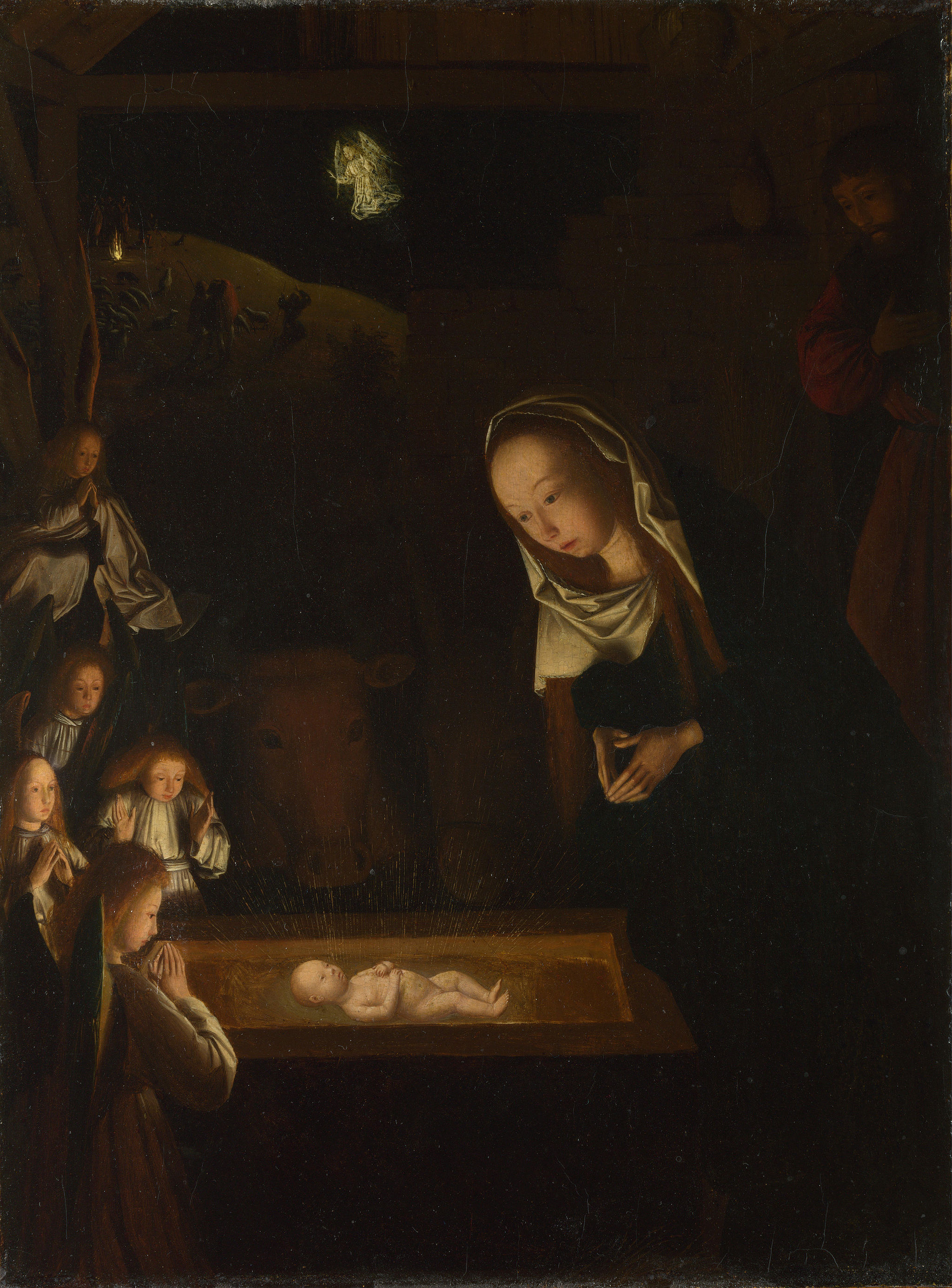
Tom Mulcahy, M.A.Image: According to Wikipedia, Nativity at Night by Geertgen tot Sint Jans, c. 1490, after a composition by Hugo van der Goes of c. 1470, influenced by the visions of Saint Bridget of Sweeden. Sources of light are the infant Jesus, the shepherds’ fire on the hill behind, and the angel who appears to them.” Public Domain, U.S.A. Reference: F.W. Faber, Bethlehem: The Sacred Infancy of our Most Dear and Blessed Redeemer This is a fantastic book for Advent meditations.
To SHARE on SOCIAL MEDIA: click on “Leave a comment” or “Comments” below (and this will bring up social media icons if they are not already present).To LEAVE A COMMENT: click on “Leave a comment” or “Comments” below, and then scroll down to the box which says, “Leave Your Own Comment Here,” which is at the end of any comments already made. If the comment section is already present, merely scroll to the end of any comments already made.All rights reserved. Any ads following this note are by WordPress and not CatholicStrength. |
Author: tomlirish
THE PROPHET PREDICTED THE MESSIAH’S BIRTH IN BETHLEHEM
“The Savior – yes, the Messiah, the Lord – has been born today in Bethlehem, the city of David!” (Luke 2:11)
Micah is not a book in the Bible that gets a lot of attention. Yet, there is in Micah an awesome prophecy about the birthplace of the Messiah. Let me add that the prophet Micah lived some seven hundred years plus before Jesus Christ.
Here is Micah’s prophecy of the birthplace of the Messiah:
“But you, O Bethlehem Ephrathah, who are little to be among the clans of Judah, from you shall come forth for me one who is to be ruler in Israel, whose origin is from old, from ancient days.” (Micah 5:2)
In commenting on this passage from Micah, Walter C. Kaiser, Jr., a distinguished Old Testament scholar, states: “The Messiah is the great Ruler who will come one day. According to his human heritage, he will descend from the family of David who lived in Bethlehem and will be born in that same town, even though he has a divine line of descent that takes him clear back to eternity. He will be both human and divine. What a mystery!” (The Messiah in the Old Testament, p. 154).
Matthew cites this prophecy of Micah as being fulfilled by Jesus’ birth in Bethlehem (see Matthew 2:6). How far back in time is the origin of this great ruler and Messiah? Saint John provides the clearest answer:
“In the beginning was the Word, and the Word was with God, and the Word was God. *** And the Word became flesh and dwelt among us….” (John 1:1; 1:14)
And the prophet Isaiah, a contemporary of Micah, adds his own prediction about the extraordinary credentials of the future Messiah, saying:
“For to us a child is born, to us a son is given, and the government will be on his shoulders. And he will be called Wonderful Counselor, Mighty God, Everlasting Father, Prince of Peace.” (Isaiah 9:6)
Tom Mulcahy, M.A.
To SHARE on SOCIAL MEDIA: click on “Leave a comment” or “Comments” below (and this will bring up social media icons if they are not already present).
To LEAVE A COMMENT: click on “Leave a comment” or “Comments” below, and then scroll down to the box which says, “Leave Your Own Comment Here,” which is at the end of any comments already made. If the comment section is already present, merely scroll to the end of any comments already made.
All rights reserved.
Any ads following this note are by WordPress and not CatholicStrength.
MAINTAINING CONTACT WITH THE BEAUTY OF NATURE DURING THE DEAD OF WINTER
“The aesthetic value of creation cannot be overlooked. Our very contact with nature has a deep restorative power” (Saint Pope John Paul II)
Once again, winter is upon us here in Michigan. The trees are leafless and the amount of sunlight has drastically declined. By dinner time it seems that we are already engulfed in physical darkness. And as it gets colder it seems as if we spend most of our time indoors. Under all of these circumstances it probably is not that unusual that some of us begin to experience a type of mild depression or malaise known as “seasonal affective disorder” (a/k/a the winter blahs).
I believe it is important and helpful under these circumstances to maintain contact with the beauty of nature, and that such contact with God’s creation enhances our mental well-being and outlook. Father Irala, in his popular book, Achieving Peace of Heart, tells us that “we must live beauty.” He maintains that we need to be “reeducated” to “receive the external world.” This priest tells us that we need to learn to let “beauty enter deep into us.” Please refer to my previous post
Contact With Nature is Very Healing and Very Necessary …
Now maintaining this essential and curative contact with nature is fairly easy in spring, summer and fall, but how do we carry it out in the dead of winter? Some people head down to Florida for a while!, but many of us have to endure the cold and dark winter season.
My basic recommendation is that we should become highly cognizant of the fact that we need to maintain contact with the beauty of nature during the dead of winter. Some people ski, or snow-mobile, or do other outside activities that place them directly in the beauty of winter. But many of us look at winter as something to endure, to get through, until finally the weather becomes more bearable. If, like me, you fall into this latter category, then you run the risk of being cut off from the mental well-being contact with nature provides. Thus, it is essential that we hibernating types take positive steps to maintain contact with nature during the winter months. Here are some ideas that may help.
The other day it was dark and only 12 degrees Fahrenheit as I stepped outside at 6 am to get into my car, but I stuck to a ritual I have of momentarily looking up at the sky to glance at the stars. I probably spent less than 25 seconds looking up at the beauty of the firmament (yes, some days there are no stars, but most days there are!), and I then said a short prayer praising God for His Infinite Beauty, and then I got into my car and turned the heat on! But there you go: even though it was very cold I made some minimal contact with the beauty of God’s creation.
Another ritual I utilize in the winter is to open the top half of an upstairs window and to peer out meditatively – as the cold air brushes up against my face – at the sky, or at an evergreen covered with snow, or merely at the breadth of the world outside as it presents itself. The point is that this simple exercise assures me of some contact with the beauty of nature in a palpable, less attenuated, manner. Keep in mind that the sky is an eminent (though frequently overlooked) source of beauty. Today the sun was out, along with a beautiful blue sky and billowing white clouds. The sky – even in winter – can be a source of profound beauty, a reflection of God’s grandeur (and yes, I realize that there are many days when the sky is dreary and depressing, so we must take advantage of the good days!). And since the winter blues seem directly related to a lack of sunlight, be sure to get outside when the sun is shining! Sunshine makes us happy.
But most importantly (even if the sun isn’t shining): get outside! Snow is very beautiful. Look at the snow. Study its beauty. As Father Irala says, train yourself to receive in the influx of nature’s beauty. If you walk a trail in summer, why not give it a try in winter! And when the snow falls and lands like countless ice-cycles on the barren trees, making them shine like a festival of heavenly lights, you can say in those immortal words of the poet: “The world is charged with the grandeur of God.”
Glory be to God for winter!
Tom Mulcahy
P.S. Here is a very helpful link:
5 Reasons to Spend More Time Outside — Even When It’s Cold
To SHARE on SOCIAL MEDIA: click on “Leave a comment” or “Comments” below (and this will bring up social media icons if they are not already present).
To LEAVE A COMMENT: click on “Leave a comment” or “Comments” below, and then scroll down to the box which says, “Leave Your Own Comment Here,” which is at the end of any comments already made. If the comment section is already present, merely scroll to the end of any comments already made.
All rights reserved.
Any ads following this note are by WordPress and not CatholicStrength.
ISAIAH’S PROPHECY OF A DIVINE CHILD AND KING CAME TRUE!
“Look! The virgin will conceive and bear a son, and they will call him Emmanuel,” which means “God with us.” (Matthew 1:23; Isaiah 7:14)
The prophecy of a new born King in Isaiah 9, whose attributes “reveal a mysterious union of divinity and humanity” (Christ in Prophecy, p. 91), is really quite remarkable by way of its ultimate and perfect fulfillment in the person of Jesus Christ. The prophet Isaiah, who lived some 700 years before Christ, wrote the following words:
“The people who walked in darkness have seen a great light; those who dwelt in a land of deep darkness, on them has light shined. You have multiplied the nation; you have increased its joy; they rejoice before you as with joy at the harvest, as they are glad when they divide the spoil. (Isaiah 9:2-3) ***
For to us a child is born, to us a son is given; and the government shall be upon his shoulder, and his name shall be called Wonderful Counselor, Mighty God,Everlasting Father, Prince of Peace. Of the increase of his government and of peace there will be no end, on the throne of David and over his kingdom, to establish it and to uphold it with justice and with righteousness from this time forth and forevermore. The zeal of the LORD of hosts will do this.” (Isaiah 9:6-7, ESV)
On pages 93-94 of Christ in Prophecy, renowned Catholic Bible scholar Dr. Paul Heinisch explains how this prophecy of a child with Divine attributes finds its “perfect understanding” in the “second Person of the Blessed Trinity…become Incarnate.” He states:
“Did the prophet’s oracle come true? St. John [in his Gospel] heralded the incarnate Son of God as ‘the Light that shines in the darkness but which the darkness did not comprehend and as the ‘true Light that enlightens every man’[John 1:5; 1:9]. *** Jesus refers to Himself as ‘the Light of the world’ [John 8:12]. ***
On the plains of Bethlehem angels announced the birth of the Prince of Peace [Luke 2:14]. *** Considered together, the attributes listed in Isaias find their fulfillment in Jesus, and in no other descendant of David. Only Jesus was God and man. Before Pilate he acknowledged being king of the Jews and then added: ‘My Kingdom is not of this world.’ The spiritual character of His kingdom has already been expressed in our oracle, a kingdom not founded or dependent upon the power of arms, but upon justice and righteousness, a kingdom of peace enduring forever. There likewise is a connection between the Light before which ‘darkness and the shadow of death’ must flee and the name ‘Wondrous-Counsellor,’ for in the Messianic kingdom new doctrine and revelations are to be expected. Over this kingdom God is supreme. He rules through the Messiah who accomplishes His commands.”
CONCLUSION: Jesus, true God and true man, is the only possible fulfillment of Isaiah’s magnificent prophecy of a child and king who shall be called Wonderful Counselor, Mighty God, Everlasting Father and Prince of Peace. The child born of the holy Virgin is to be called Emmanuel, “God is with us” (see Is. 7:14; Matthew 1:23). He is “the way, the truth and the life” (John 14:6), and a light of revelation to all the nations (see Luke 2:32).
Tom Mulcahy, M.A.
Source: For a fuller explanation of the fulfillment of this prophecy, see Christ in Prophecy by Dr. Paul Heinisch (The Liturgical Press), wherein he also explains the prophecy’s relevance “to the age and circumstances in which it was composed,” although its perfect fulfillment can only be in the Messiah (see, for example, Matthew 4: 12-17).
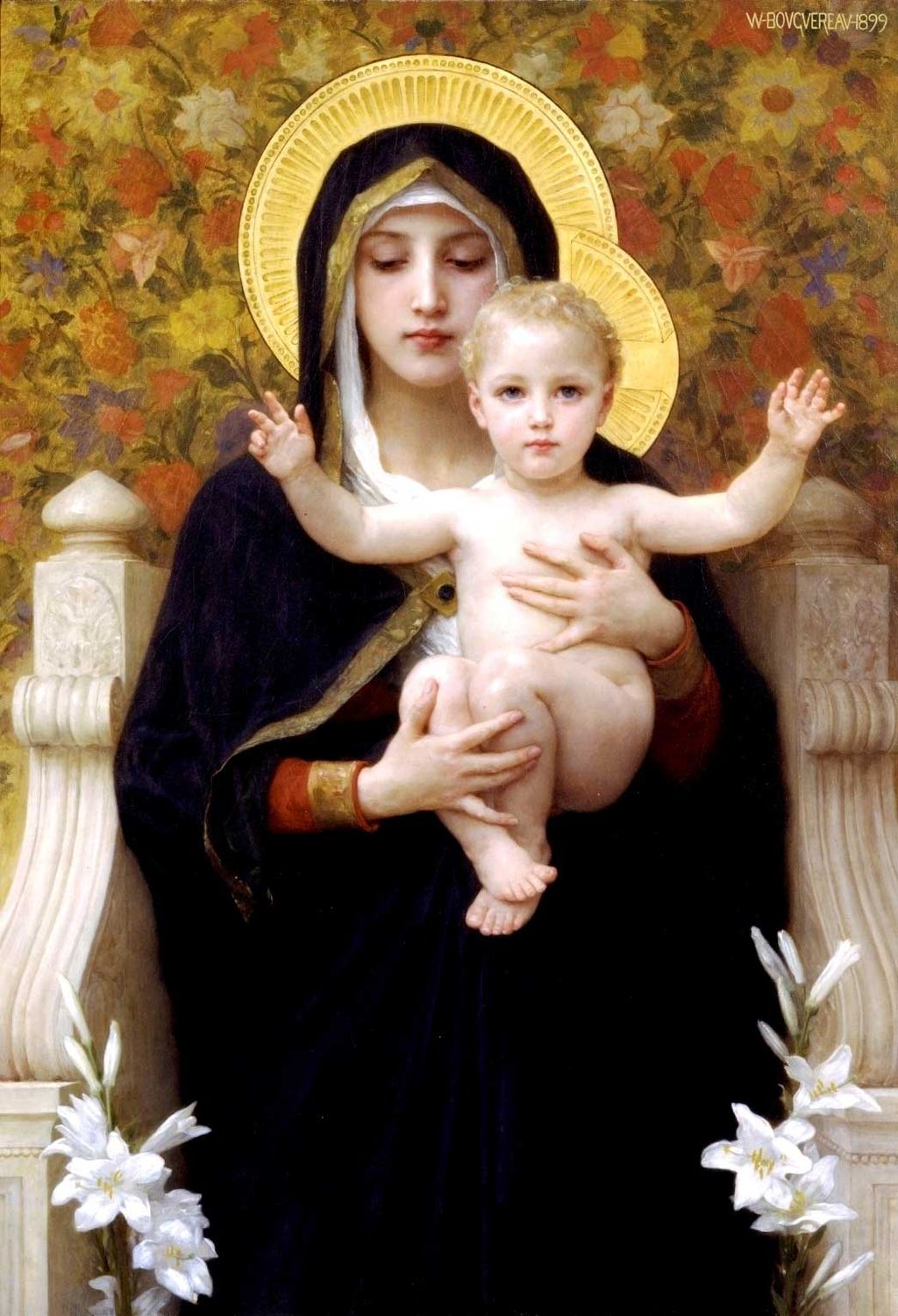
Image: The Virgin of the Lilies by William-Adolphe Bouguereau, 1899, Public Domain, U.S.A. (at Wikipedia).
To SHARE on SOCIAL MEDIA: click on “Leave a comment” or “Comments” below (and this will bring up social media icons if they are not already present).
To LEAVE A COMMENT: click on “Leave a comment” or “Comments” below, and then scroll down to the box which says, “Leave Your Own Comment Here,” which is at the end of any comments already made. If the comment section is already present, merely scroll to the end of any comments already made.
All rights reserved.
Any ads following this note are by WordPress and not CatholicStrength.
IT’S A WONDERFUL LIFE IS ALL ABOUT THE POWER OF PRAYER AND THE COMMUNION OF SAINTS
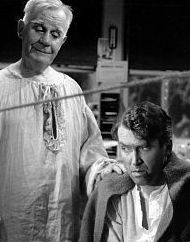
(George Bailey and his guardian angel, Clarence)
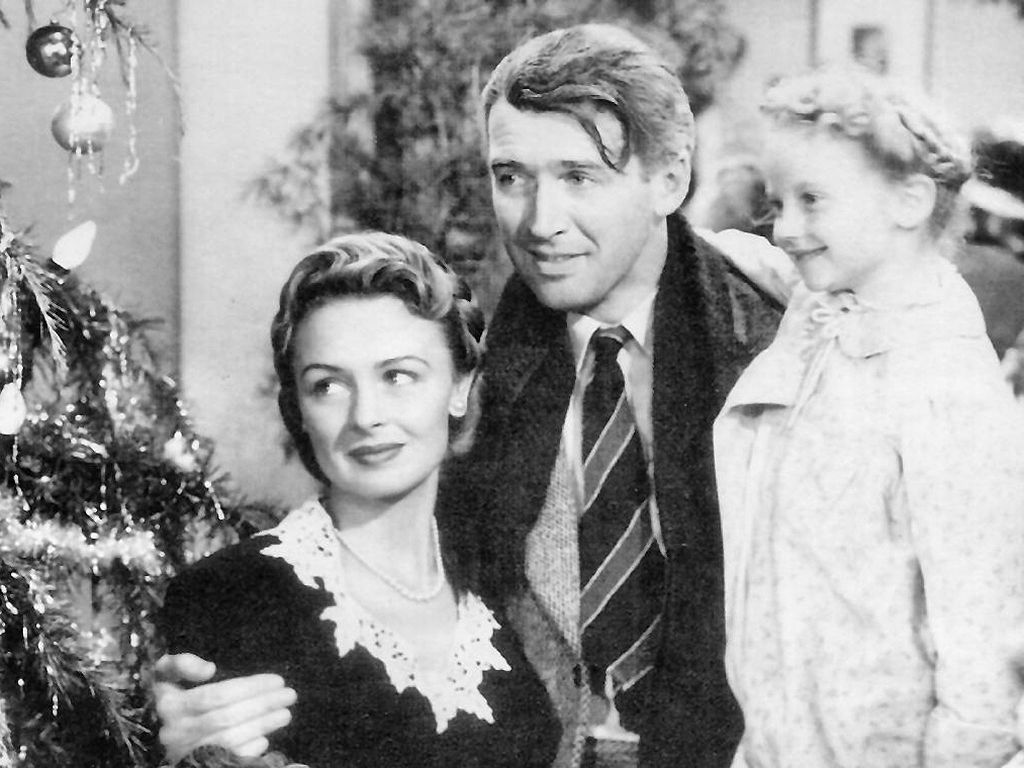
“You see, George, you’ve really had a wonderful life”It’s that time of year again! Time to watch one of the most meaningful movies of all time – a movie which gets more meaningful each time I watch it. I understand Frank Capra made It’s A Wonderful Life after an experience of deepening faith that would ultimately (under the influence of his wife) lead him back to the Catholic church. There is more good theology in this movie than in some theology texts! The movie starts off with people in the town praying for George Bailey – one of the prayers is to Jesus, Mary and Joseph. It is through prayer that God is going to transform George Bailey’ life and show George all the good he has done in the world. In fact, just before George is about to commit suicide, he makes a short prayer to God, saying, “SHOW ME THE WAY.” It’s hard to imagine a more powerful prayer. And God hears George’s prayer and begins to unveil to him (George Bailey) the rich tapestry of his life. Everything is accomplished through PRAYER. The key point in the movie is that every person’s life touches the lives of many others – either for the good or bad. This is all about the solidarity that exists between human beings. Our sin hurts others, but our personal holiness and good works “put into motion powerful spiritual forces” that help out other human beings (and thus help to create a good and just society). If George Bailey hadn’t lived, Bedford Falls would have been Pottersville – a corrupt and immoral town (as George Bailey was allowed to see). When George prays for his life back, the town changes back to Bedford Falls (and the movie theater, as one example, reverts to showing The Bells of St. Mary’s, whereas in Pottersville it was a place to watch 20 show girls). We will never know this side of Heaven how much our good works and love of neighbor help out other people, but we can rest assured that they are helping out many souls. I think the guy who authored #1475 of the Catechism of the Catholic Church must have had It’s a Wonderful Life in mind when he said: “In the communion of saints, ‘a perennial link of charity exists between the faithful who have already reached their heavenly home, those who are expiating their sins in purgatory and those who are still pilgrims on earth. Between them there is, too, an abundant exchange of all good things.’ In this wonderful exchange, the holiness of one profits others, well beyond the harm that the sin of one could cause others. Thus recourse to the communion of saints lets the contrite sinner be more promptly and efficaciously purified of the punishments for sin.” George didn’t realize that through his mundane and hum-drum life in Bedford Falls, God was accomplishing much good. When the veil was lifted from his eyes, and he was allowed to see how different things would have been without him, he was filled with the deepest gratitude for all the great things in his life – most especially his family and friends. Let us rejoice and be thankful for all the good things God has given to us. By the way, The Bells of St. Mary’s is also a powerful movie (and my second favorite Christmas movie is The Bishop’s Wife). Tom Mulcahy Ref. Images at Wikipedia, Public Domain, U.S.A. See “The Catholic Vision of Frank Capra” via Google. “Puts into motion positive spiritual forces” : a phrase borrowed from Cardinal Ciappi he used in the context of Marian consecration (see CCC 1477). In his great spiritual classic, Abandonment to Divine Providence, Father de Caussade wrote something which applies very well to George Bailey:“Faith, piercing the superficialities, disclosed that God was accomplishing very great things [in his life].” Let us pray for a great spirit of faith. To SHARE on SOCIAL MEDIA: click on “Leave a comment” or “Comments” below (and this will bring up social media icons if they are not already present). To LEAVE A COMMENT: click on “Leave a comment” or “Comments” below, and then scroll down to the box which says, “Leave Your Own Comment Here,” which is at the end of any comments already made. If the comment section is already present, merely scroll to the end of any comments already made. All rights reserved. Any ads following this note are by WordPress and not CatholicStrength.
|
THE BIBLICAL BASIS FOR MARY’S IMMACULATE CONCEPTION
“And the angel … said… : ‘Hail, full of grace, the Lord is with thee: blessed art thou among women’.” (Luke 1:28)
1. Mary’s Immaculate Conception is an infallible doctrine of the Catholic Church promulgated by Pope Pius IX , ex cathedra (from the chair of St. Peter) on December 8, 1854. The Papal Bull reads:
“We declare, pronounce and define that the doctrine which asserts that the Blessed Virgin Mary, from the first moment of her conception, by a singular grace and privilege of almighty God, and in view of the merits of Jesus Christ, Savior of the human race, was preserved free from every stain of original sin is a doctrine revealed by God and, for this reason, must be firmly and constantly believed by all the faithful.”
“With these words in 1854, Pope Pius IX in the Papal Bull Ineffabilis Deus, declared Mary’s Immaculate Conception to be dogma. Pius was simply affirming a long-held belief of many Christians East and West before him, that Mary was conceived free of the stain of original sin, on account of Christ’s work, in order to bear God-made-flesh.” (From Saint John Cantius Parish web-site)
2. The dogma is confirmed four years later (in 1858) by the Blessed Virgin Mary herself in the most famous of her apparitions at Lourdes. At Lourdes, when asked her name by St. Bernadette, Mary responded in an extraordinary fashion, saying, “I am the Immaculate Conception.” Since then, Lourdes has been the situs of countless miracles.
Martin Luther, (Sermon: “On the Day of the Conception of the Mother of God,” 1527).
4. Contrary to popular belief, the doctrine has strong scriptural support in that:
A. Gabriel announces that Mary is “full of grace” (Luke 1:28). If Mary is full of grace it follows that she is without sin (note how the angel does not call Mary by her name, but rather by a title, saying:“Hail, full of grace” – and the angel is God’s messenger). The Ignatius Catholic Study Bible defends the traditional translation, “Hail, full of grace,” as against some modern translations, stating: “[The Greek word used by Luke], kecharitomene, indicates that God has already graced Mary previous to this point, making her a vessel who ‘has been’ and ‘is now’ filled with divine life. Alternative translations like ‘favored one’… are possible but inadequate.”
B. Saint Luke (in his Gospel) and Saint John (in the Book of Revelation) identify Mary as the Ark of the New Covenant, thus comparing her to the all-holy Ark of the Covenant in the Old Testament. See “Topical Essay: Mary Ark of the Covenant” in The Ignatius Catholic Bible Study or click the following on-line article from This Rock: Mary, the Ark of the New Covenant | Catholic Answers
C. Mary’s Immaculate Conception is internally consistent with the doctrine of Original Sin (which flows from a number of Old and New Testament passages, especially at Romans 5:12-21). Since original sin is transmitted by physical generation, it follows logically that Jesus, who was born without sin, would have to be born from a spotless womb. Mary is that pure and spotless vessel: the woman who overflows with God’s grace; and
D. John the Baptist was sanctified in his mother’s womb. At Luke 1:15 it states that John the Baptist was filled with the Holy Spirit even from birth. The passage, in context, reads as follows:
Then an angel of the Lord appeared to him, standing at the right side of the altar of incense. When Zechariah saw him, he was startled and was gripped with fear. But the angel said to him: “Do not be afraid, Zechariah; your prayer has been heard. Your wife Elizabeth will bear you a son, and you are to give him the name John. He will be a joy and delight to you, and many will rejoice because of his birth, for he will be great in the sight of the Lord. He is never to take wine or other fermented drink, and he will be filled with the Holy Spirit even from birth. Many of the people of Israel will he bring back to the Lord their God. And he will go on before the Lord, in the spirit and power of Elijah, to turn the hearts of the fathers to their children and the disobedient to the wisdom of the righteous—to make ready a people prepared for the Lord.”(Luke 1:11-17)
Tom Mulcahy, M.A.
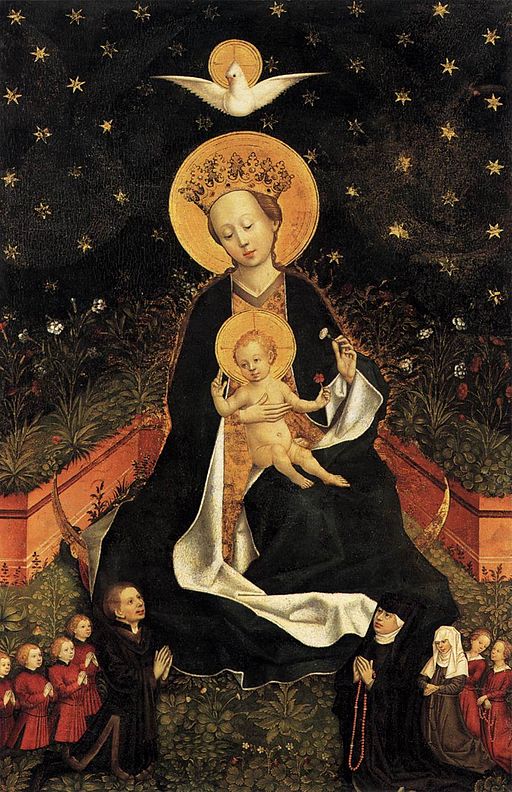
Image: Madonna on a Crescent Moon in Hortus Conclusus by unknown author, 1450s, Germany. Public Domain, U.S.A.
To SHARE on SOCIAL MEDIA: click on “Leave a comment” or “Comments” below (and this will bring up social media icons if they are not already present).
To LEAVE A COMMENT: click on “Leave a comment” or “Comments” below, and then scroll down to the box which says, “Leave Your Own Comment Here,” which is at the end of any comments already made. If the comment section is already present, merely scroll to the end of any comments already made.
All rights reserved.
Any ads following this note are by WordPress and not CatholicStrength.
SAINT JOHN VIANNEY WITNESSED A EUCHARISTIC MIRACLE
“Whoever eats my flesh and drinks my blood remains in me, and I in them.” (John 6:56)
I have a book I bought a while ago entitled, The Little Catechism of The Cure of Ars, by St. John Vianney – one of the greatest of our saints! This man was an amazingly holy priest (he died in 1859 and was canonized in 1925). He holds the lofty honor – conferred by Pope Pius XI – of being the Patron Saint of parish priests.
In the book he tells a story about a parishioner of his who was having trouble believing the host really becomes the body of Jesus Christ at Mass. The parishioner said a sincere prayer to the Blessed Virgin Mary asking her to help him believe. St. John Vianney then relates what happened as he was distributing communion:
“I do not say this happened to someone else, but that it happened to myself. At the moment this man came up to receive Holy Communion, the Sacred Host detached Itself from my fingers while I was still a good way off, and went off Itself and placed Itself upon the tongue of that man.”
See how Mary is so useful. She obtained this Eucharistic miracle from God so that our faith in Jesus would increase (just as she interceded at Cana, where water was changed into wine, a miracle foreshadowing the Eucharist!). She can do nothing but lead us to Jesus – that is her sole mission. What confidence she gives us in the amazing graces we receive at Holy Communion! Our great Pope, Saint John Paul II, reminds us in Ecclesia de Eucharista that our love of the Eucharist deepens by devotion to Mary. He states:
“If we wish to rediscover in all its richness the profound relationship between the Church and the Eucharist, we cannot neglect Mary, Mother and model of the Church. In my Apostolic Letter Rosarium Virginis Mariae, I pointed to the Blessed Virgin Mary as our teacher in contemplating Christ’s face, and among the mysteries of light I included the institution of the Eucharist. Mary can guide us towards this most holy sacrament, because she herself has a profound relationship with it. ***
If the Eucharist is a mystery of faith which so greatly transcends our understanding as to call for sheer abandonment to the word of God, then there can be no one like Mary to act as our support and guide in acquiring this disposition. In repeating what Christ did at the Last Supper in obedience to his command: “Do this in memory of me!” we also accept Mary’s invitation to obey him without hesitation: “Do whatever he tells you” (Jn 2:5). With the same maternal concern which she showed at the wedding feast of Cana, Mary seems to say to us: “Do not waver; trust in the words of my Son. If he was able to change water into wine, he can also turn bread and wine into his body and blood, and through this mystery bestow on believers the living memorial of his passover, thus becoming the ‘bread of life’.” (Encyclical Ecclesia de Eucharistia, “Church of the Eucharist,” from nos. 53 and 54)
All of the wisdom and prudence in the Church tells us unhesitatingly that increased devotion to Mary, the mother, leads to increased love of Jesus, the son. And what can be more important in life than increasing our love for Jesus.
Tom Mulcahy, M.A.
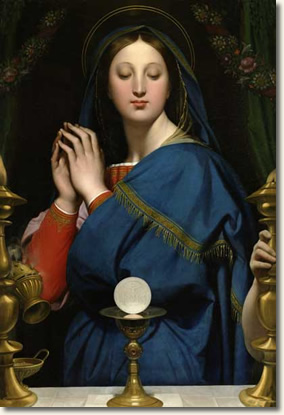
Image: Virgin by the Host, 1852, by Jean-Auguste-Dominique Ingres (a public domain work of art in the U.S.A.)
All rights reserved.
To SHARE on SOCIAL MEDIA: click on “Leave a comment” or “Comments” below (and this will bring up social media icons if they are not already present).
To LEAVE A COMMENT: click on “Leave a comment” or “Comments” below, and then scroll down to the box which says, “Leave Your Own Comment Here,” which is at the end of any comments already made. If the comment section is already present, merely scroll to the end of any comments already made.
Any ads following this note are by WordPress and not CatholicStrength.
THIS FUTURE PRIEST ENCOUNTERED JESUS IN HIS CAR WHILE DRIVING TO ANN ARBOR
“When thou didst pray with tears, I offered thy prayer to the Lord” (Tobit 12:12).
The Christmas season must be upon us because everywhere I go I hear Christmas music! The secular culture doesn’t celebrate Advent; it simply celebrates Christmas, starting a week before Thanksgiving until the last package is bought on Christmas Eve. So in the spirit of the Christmas season Catholic Strength is putting up its first Christmas post for 2016. The post touches upon what theologians call “the scandal of the particular,” as it involves a car, a road, and a young man – and the sudden invasion of the supernatural into these particular facts. In the Christmas spirit, we dare to call the post: –
MIRACLE ON M-14TH STREET!
There is power in tears. The shortest verse in the Bible merely states that “Jesus wept” (John 11:35). Shortly thereafter, Jesus performed one of his greatest miracles – raising his friend Lazarus from the dead (John 14: 3-44).
Saint Catherine of Siena devoted an entire chapter to the spiritual significance of tears in her great masterpiece, The Dialogue.
There is a fascinating discussion of the devotional value of tears in Father Faber’s book, Growth in Holiness (chapter 22), and therein Faber quotes the angel Raphael, who moved by the tears of Tobias, said: “When thou didst pray with tears, I offered thy prayer to the Lord” (Tobit 12:12).
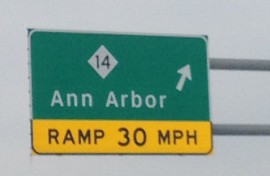
With these introductory comments in mind, I take you now to a young man, then 21 years old, who was driving his car westbound on M-14 on his way back to the Ann Arbor area. Prior to leaving his family home in Birmingham that day, he had been involved in a discussion with his father about what he planned to do with his life. His father told him that he would bless the work his son chose to do, even if he were to choose the priesthood!
With these thoughts on his mind, our young protagonist was driving on M-14, wondering what to do with his life, praying, and listening to Christian music. He was listening to a song by Michael Card and these words from the song jumped out at him and touched his heart:
“So come lose your life for a carpenter’s son
For a madman who died for a dream
And you’ll have the faith His first followers had
And you’ll feel the weight of the beam”
This young man began to cry, or rather “to ball.” Although he was alone in the car, he then saw a man in the front passenger seat – as real as if you or me had been sitting there – who was “obviously Jesus.” Jesus then reached over and stuck his hand into this man’s chest and said to the man: “these are all your dreams, all your goals, all your desires and everything that you want to do with your life; I am going to give you my dream, my goal, my desire and what I want you to do with your life.” Moments later, Jesus was gone. And one person’s life was dramatically changed.
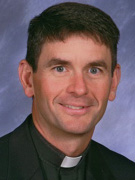
Ultimately, after additional searching and discernment, this young man entered Sacred Heart Seminary in Detroit and was ordained a priest. You may know him as Father John Riccardo.
Imagine that! Jesus riding in a Chrysler (I presume it was a Chrysler) in order to respond to the tears of a young man praying for guidance. Who knows: perhaps some old and forgotten woman, praying endless rosaries in her rocking chair, merited this grace for him? This I do know: I’ve been judging the credibility of witnesses for many years, and although I’ve never deposed Father Riccardo (pictured above), I have the strongest conviction that his integrity is of the highest order.
Moreover, our Lord is no stranger to car rides! Every day he is taken by car to those who are sick, or old, or in the hospital, so that they may receive Him sacramentally.
And is not our Lord’s sacramental presence a greater miracle than the one experienced by John Riccardo out on M-14?
“Jesus Christ is the same yesterday and today and forever” (Hebrews 13:8). Our Lord is alive and well, working diligently for the welfare of the church and for the salvation of souls.
Merry Christmas!
Tom Mulcahy
Sources: To hear this true story in Father Riccardo’s own words, Google: “Common Ground: What Protestants and Catholics Can Learn From Each Other” – and a number of websites from which the talk can be purchased will appear. Photo of M-14 sign by Molly Mulcahy on 11/24/2015. I presume Father Riccardo was driving a Chrysler because his Dad was once the President of Chrysler! Picture of Father Riccardo, with permission, at avemariaradio.net https://avemariaradio.net/hosts/fr-john-riccardo/). Father John Riccardo is currently the Pastor at Our Lady of Good Counsel in Plymouth, Michigan. I was once in a prayer group and Father Riccardo was our adviser. I have heard many people talk highly of his podcasts which you find in a Google search (or click on the avemariaradio link above).
To SHARE on SOCIAL MEDIA: click on “Leave a comment” or “Comments” below (and this will bring up social media icons if they are not already present).
To LEAVE A COMMENT: click on “Leave a comment” or “Comments” below, and then scroll down to the box which says, “Leave Your Own Comment Here,” which is at the end of any comments already made. If the comment section is already present, merely scroll to the end of any comments already made.
All rights reserved.
Any ads following this note are by WordPress and not CatholicStrength.
THE BIBLE SAYS TO CONFESS YOUR SINS TO ONE ANOTHER
“Confess your sins to one another” (James 5:16)
The Bible says “confess your sins to one another” (James 5:16). The precise context of this verse from James is a priest (an elder) coming to the home of a sick man to administer the sacrament of anointing (James 5: 14-15), so the strong context of James 5:16 is a sick man, being anointed, and confessing his sins to a priest.
The well-regarded Protestant Bible commentary, Pulpit Commentary, confirms that James 5:16 leans towards the confession of sins to an ordained minister:
…on the other hand, it is unfair to lose sight of the fact that it [James 5:16] is directly connected with the charge to send for the elders of the Church. Marshall, in his’ Penitential Discipline,’ is perfectly justified in saying that St. James “hath plainly supposed the presence of the elders of the Church, and their intercession to God for the sick penitent, and then recommended the confession of his faults in that presence, where two or three assembled together in the Name of Christ might constitute a Church for that purpose” (‘Penit. Discipline,’ p. 80). We may, perhaps, be content with saying, with Bishop Jeremy Taylor, “When St. James exhorts all Christians to confess their sins one to another, certainly it is more agreeable to all spiritual ends that this be done rather to the curate of souls than to the ordinary brethren”
The Ignatius Catholic Study Bible states that the “command” to confess your sins to one another in James 5:16 “must be interpreted within the context of the anointing rite where the elders (i.e., priests) presumably hear the confession of the sick person before his sins are remitted through the sacrament (James 5: 14-15). Such confession…is implicitly mandated by the teaching of Jesus (John 20:23).”
The Catholic practice of confessing our sins to a priest is, therefore, very Biblical. When you consider, as well, that Jesus specifically empowered his priests to forgive sins when he breathed on the apostles at John 20: 21-23 (“Receive the Holy Spirit. If you forgive the sins of any, they are forgiven”), it becomes quite evident that confessing one’s sins to a priest is the Biblical model. Could it be that Jesus – whose own ministry involved the forgiveness of sins in a very personal manner – knew that the spiritual and psycho-therapeutic effects of confessing our sins to an ordained spiritual guide (a priest) could be quite liberating?
Tom Mulcahy, M.A.
Note: According to Catholic Answers, “The English word “priest” is derived from the Greek word presbuteros, which is commonly rendered into Bible English as “elder” or “presbyter.”
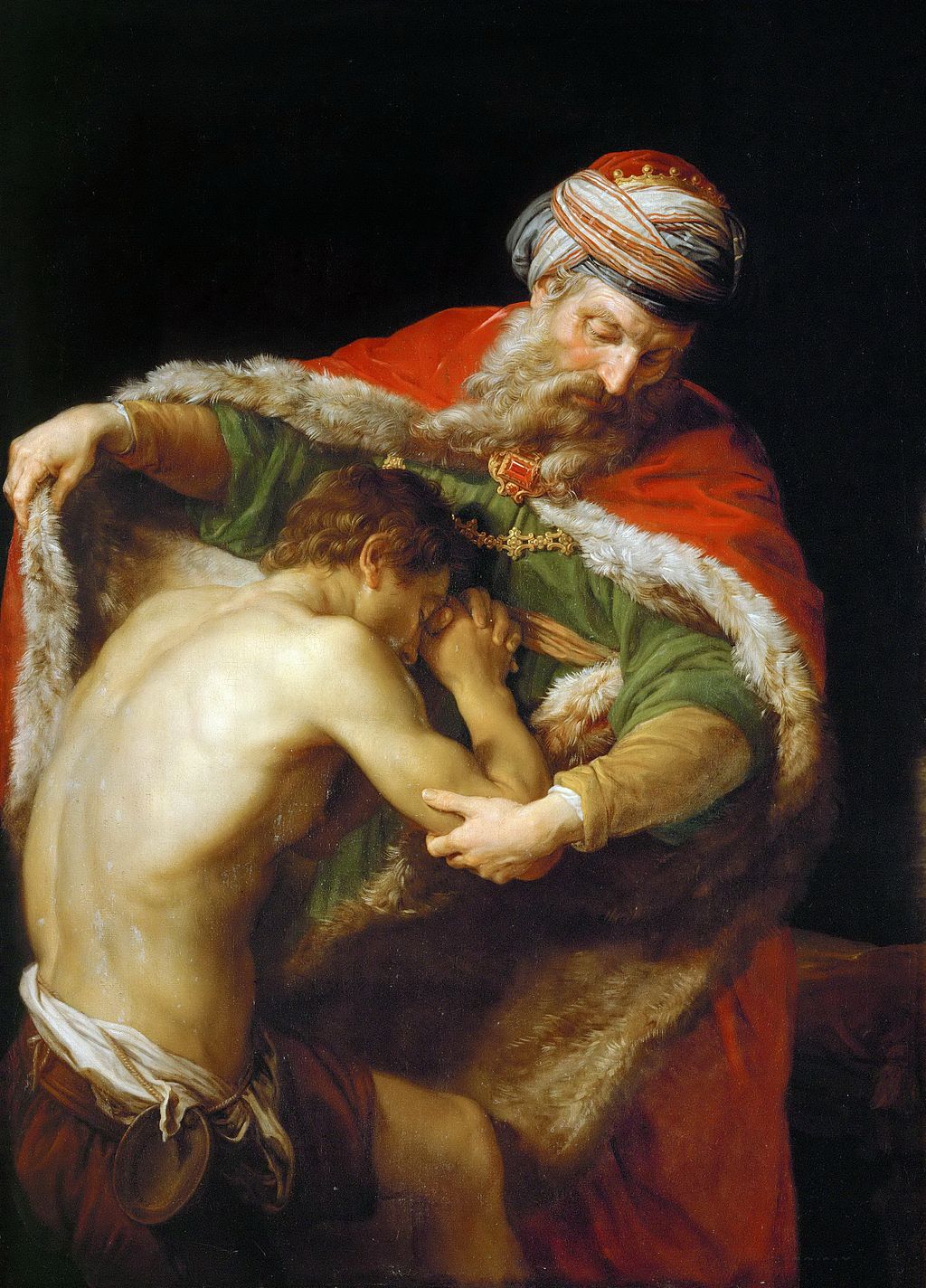
Image: The Return of the Prodigal Son by Pompeo Batoni, 1773. Public Domain, U.S.A.
To SHARE on SOCIAL MEDIA: click on “Leave a comment” or “Comments” below (and this will bring up social media icons if they are not already present).
To LEAVE A COMMENT: click on “Leave a comment” or “Comments” below, and then scroll down to the box which says, “Leave Your Own Comment Here,” which is at the end of any comments already made. If the comment section is already present, merely scroll to the end of any comments already made.
All rights reserved.
Any ads following this note are by WordPress and not CatholicStrength.
HOLD MY HEART UP TO THE LIGHT: PRACTICING PURITY OF HEART
“Create in me a clean heart, O God, and renew a right spirit within me.” (Psalm 51:10)
The Catholic spiritual practice of Purity of Heart is one of the most important spiritual disciplines we can and should make use of.
By the practice of purity of heart we keep a very careful watch over all the thoughts being presented to our mind and over all the affections and passions being presented to our heart. By this careful watch, we almost immediately intercept and delete the thoughts and affections which violate purity of heart. Thus, as a very simple example, should I suddenly feel the desire to gossip about someone, I check out this movement of my heart, examine it, and ultimately suppress or delete it since it violates purity of heart. Or, as another example, should I suddenly feel swelling up in my heart ill-will towards a certain person, the practice of purity of heart obligates me to take a close look at this movement of my heart, and to mortify it, and to replace it with Christian charity and forgiveness. Gradually, by steadfastly and diligently practicing purity of heart, our heart becomes cleaner and cleaner. What do we want more in our lives than purity of heart?
Purity of heart is a mechanism of introspection whereby we carefully look at our thoughts and affections, even moment by moment, to place them under Christ’s law of charity. As soon as we observe that our mind or affections are tending in a sinful direction, we immediately mortify such thoughts or affections, giving them no chance of growth within our souls. Its sort of like we’ve installed security software in our brain that immediately detects and deletes bad stuff (God’s given us the software and all we have to do is learn how to use it!!).
Father Jacques Philippe, the well known spiritual writer, recommends the practice of purity of heart in his very worthwhile book, In the School of the Holy Spirit (see Appendix II beginning on page 70, and pages 40-42 ). But the two giants of our Catholic spiritual heritage who speak so highly of practicing purity of heart are Father Lallemant (in his classic The Spiritual Doctrine), and Father Grou (in Manual for Interior Souls). Both Fathers Lallemant and Grou were French and Jesuit.
Father Lallemant recommends the practice of purity of heart in conjunction with regular, sacramental confession. He states:
“For the oftener we confess, the more we purify ourselves, the grace proper to this sacrament being purity of conscience. Thus, every confession, besides the increase of habitual grace and of the gifts, imparts also a fresh sacramental grace, that is to say, a new title to receive from God both actual graces and the aids necessary for emancipating ourselves more and more from sin.” (Father Lallemant, The Spiritual Doctrine, II, Chapter 6, as cited in The Mystical Evolution, pages 99-100).
What an amazing purifying tool at your immediate disposal for growth in holiness: the practice of purity of heart! Its like an ongoing, perpetual examination of conscience that keeps all the junk out out of our hearts and mind. And when the junk is gone, we become, as Father Lallemant insists, more docile to the whispers of the Holy Spirit, which we previously could not hear. This is why Father Lallemant says that “purity of heart accomplishes so much” in the spiritual life.
Tom Mulcahy, M.A.
Sources: Father Lallemant, The Spiritual Doctrine...purity of heart is one of his main doctrines for growth in holiness, and he formed saints!!! Saints Isaac Jogues and Jean de Brebeuf were his students. And also Father Grou as mentioned above. Matt Maher sings, “Hold my heart up to the light” in one of his songs. That is what the practice of purity of heart is: holding our heart up to the light!
To SHARE on SOCIAL MEDIA: click on “Leave a comment” or “Comments” below (and this will bring up social media icons if they are not already present).
To LEAVE A COMMENT: click on “Leave a comment” or “Comments” below, and then scroll down to the box which says, “Leave Your Own Comment Here,” which is at the end of any comments already made. If the comment section is already present, merely scroll to the end of any comments already made.
All rights reserved.
Any ads following this note are by WordPress and not CatholicStrength.