Jesus

THE PROFOUND SPIRITUAL EXPERIENCE SAINT THERESE UNDERWENT AFTER MAKING HER OBLATION TO THE DIVINE MERCY

“I’m going to be doing only one thing: I shall begin to sing what I must sing eternally: ‘The Mercies of the Lord’ ” (St. Therese of Lisieux)

What I specifically intend to focus in on in this note is what happened to St. Therese AFTER she made her Act of Oblation to Merciful Love, the facts of which are less known and which highlight important aspects or elements of Therese’s mystical life and spiritual progress towards union with God.

Saint Therese wrote her famous Act of Oblation to Merciful Love on June 9, 1895 (link to the full text at the end of this note) in which she offered herself as a “Victim of Holocaust to God’s Merciful Love.” As she explains in her autobiography she received a special grace that day to make her offering to God’s Divine Mercy:

“This year June 9, [1895] the feast of the Most Holy Trinity, I received the grace to understand more than ever beforhow much Jesus desires to be loved.

I was thinking about the souls who offer themselves as victims of God’s Justice in order to turn away the punishments reserved to sinners, drawing them upon themselves. This offering seemed great and very generous to me, but I was far from feeling attracted to making it. From the depths of my heart, I cried out:

‘O my God! Will Your Justice alone find souls willing to immolate themselves as victims? Does not Your Merciful Love need them too? On every side this love is unknown, rejected; those hearts upon whom You would lavish it turn to creatures, seeking happiness from them with their miserable affection; they do this instead of throwing themselves into Your arms and of accepting Your infinite Love. O my God! Is Your disdained Love going to remain closed up within Your Heart? It seems to me that if You were to find souls offering themselves as victims of holocaust to Your Love, You would consume them rapidly; it seems to me, too, that You would be happy not to hold back the waves of infinite tenderness within You. If Your Justice loves to release itself, this Justice which extends only over the earth, how much more does Your Merciful Love desire to set souls on fire, since Your Mercy reaches to the heavens. O my Jesus, let me be this happy victim; consume Your holocaust with the fire of Your Divine Love.’”

You permitted me, dear Mother, to offer myself in this way to God, and you know the rivers or rather the oceans of graces that flooded my soul. Ah! since the happy day, it seems to me that Love penetrates and surrounds me, that at each moment this Merciful Love renews me, purifying my soul and leaving no trace of sin within it….” ((Story of a Soul, ICS Publications, 3rd Ed., pp. 181).

So we come now to the profound mystical experience Therese subsequently underwent, which might be called in mystical terminology “the spiritual wounding of the heart,” or transverberation. In the quote below Therese explains how her heart was mystically wounded by a dart of love a few days after she finished her Act of Oblation to Merciful Love:

“I had commenced the Stations of the Cross in Choir, then all at once I felt myself wounded by a dart of fire so ardent that I thought I must die. I do not know how to explain it; it was as if an invisible hand had plunged me wholly into fire. Oh, what fire, and what sweetness at the same time! I was burning with love, and I thought one minute, nay, one second more, and I shall not be able to support such ardour without dying. I understood then what the Saints have said of those states which  they had experienced so often. For me I have but experienced it that once, only for an instant, and afterwards I fell back again into my habitual dryness. From the age of fourteen I have also experienced the assaults of love. Ah! how much I love God! But it was not at all to be compared to what I experienced after my offering to Love….” (Cruz, p.68; see References below).

Therese tells us elsewhere that:

“I have had several transports of love, and one in particular during my Novitiate when I remained for a whole week far removed from this world. It seemes as though a veil were thrown over all earthly things. But, I was not then consumed by a real fire. I was able to bear those transports of love without expecting to see the ties that bound me to earth give way; whilst, on the day of which I mentioned (the dart of fire), one minute, one second more and my soul must have been set free…. True, the Divine Hand had withdrawn the fiery dart – but the wound was unto death!” (Cruz, pp. 68-69; see References below).

A core feature of Carmelite spirituality is contemplation or contemplative prayer (Saint John of the Cross and Saint Teresa of Avila, both Carmelites, were great mystics and contemplatives). It is sometimes thought that Saint Therese was less graced with the gift of mystical contemplation but certainly the examples just given help to shed light on Therese’s mystical journey, and as Father Garrigou-LaGrange points out:

“Truly St. Teresa of Lisieux traced for us the simple road which leads to great heights. In her teaching, as it pleased Pope Pius XI to point out, the gift of wisdom appears in a lofty degree for the direction of souls thirsting for the truth and wishing, above all human conceptions, to live by the word of God….The way of childhood thus understood, especially as we see it toward the end of the life of St. Teresa of the Child Jesus, is very elevated in its simplicity. Its lofty simplicity comes home to us because the saint certainly passed through the night of the spirit (which corresponds to the sixth mansion of St. Teresa of Avila), as may be seen on reading chapter nine of the Histoire d’une ame. It was the reading of this chapter, some thirty years ago, that gave us the idea of explaining the night of the spirit by a profound and intense influence of the gift of understanding, which brings out in powerful relief the formal motive of humility and of each of the three theological virtues. Thereby these infused virtues are purified of all alloy or attachment to secondary and accessory motives on which until then the soul had dwelt excessively” (The Three Ages of the Interior Life, Chapter 41, regarding the way of spiritual childhood, emphasis added).

I do not have time in this short note to trace out St. Therese’s dark night of the soul and trial of faith that began around ten months after she composed her Act of Oblation to Merciful Love, but as Father Frederick L. Miller points out: “In her harrowing trial of faith that lasted with hardly any relief for a year and a halfTherese experienced an inexplicable grace, a mystical, infused sharing in Christ’s passion. She felt as her own the thirst of the Crucified for all those people who reject his love. The words of St. Paul offered her light in her darkness: ‘For our sake, God made him to be sin who knew no sin, so that in him we might become the righteousness of God ‘(2 Cor 5:22).

The core of Saint Therese’s message, says Saint John Paul II, is the merciful love of God.  In his Apostolic Letter Proclaiming Saint Therese of Lisieux a Doctor of the Church, Pope John Paul II made the following observation regarding the core of Saint Therese’s message:

“The core of her message is actually the mystery itself of God-Love, of the triune God infinitely perfect in himself. If genuine Christian spiritual experience should conform to the revealed truths in which God communicates himself and the mystery of his will (cf. Dei Verbum, 2), it must be said that Therese experienced divine revelation, going so far as to contemplate the fundamental truths of our faith united in the mystery of Trinitarian life. At the summit, as the source and goal, is the merciful love of the three divine Persons, as she expresses it, especially in her “Act of Oblation to Merciful Love.”  At the root, on the subject’s part, is the experience of being the Father’s adoptive children in Jesus; this is the most authentic meaning of spiritual childhood, that is, the experience of divine filiation, under the movement of the Holy Spirit. At the root again, and standing  before us, is our neighbor, others for whose salvation we must collaborate with and in Jesus, with the same merciful love as his.” (no. 8)

Therese’s last words moments before she died in Carmel were: “Oh! I love Him…My God…I love You.” She died on September 30, 1897. 

Thomas L. Mulcahy, M.A.

References: For this note I am relying primarily on Joan Carroll Cruz’ book, Mysteries, Marvels, Miracles (TAN books), pp. 68-69. She references the quote about the dart of fire as follows: Sister Agnes of Jesus, Novissima Verba: The Last Conversations of St. Therese of the Child Jesus May-September 1897 (London: Burns, Oates & Washbourne, Ltd., 1929), pp. 43-44. The subsequent quote about transports of love is referenced by Cruz as follows: Soeur Therese of Lisieux, The Little Flower of Jesus (Story of a Soul), T.N. Taylor, editor. (New York: P.J. Kennedy and Sons, 1912), p.195. The quote from Father Frederick L. Miller is from his article, “Saint Therese of Lisieux: Doctor of Divine Love” (September 22, 2020), available online.

Link: https://stpaulcenter.com/the-act-of-oblation-to-merciful-love/#:~:text=I%20offer%20myself%20as%20a,your%20Love%2C%20O%20my%20God!

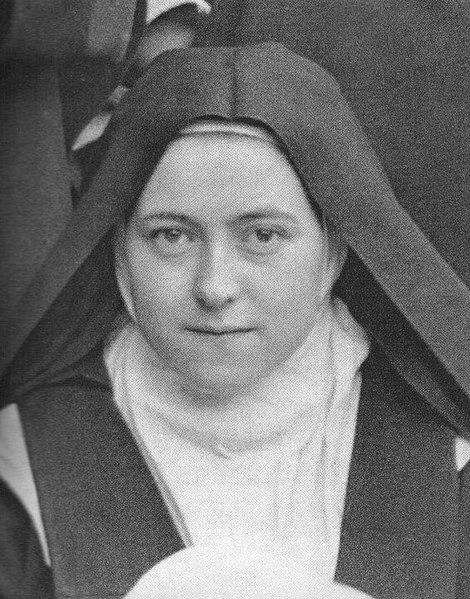
Image: St. Therese of the Child Jesus in the photograph taken in the courtyard of the monastery of Lisieux Easter Monday, April 15, 1894.

All rights reserved.

Any ads in this note are by WordPress and not CatholicStrength.

THE PRACTICE OF PURITY OF HEART ACCOMPLISHES SO MUCH IN THE SPIRITUAL LIFE!

“Create in me a clean heart, O God, and renew a right spirit within me.” (Psalm 51:10)

“We take captive every thought to make it obedient to Christ” (2 Corinthians 10:5)

Father Grou, a great spiritual writer, tells us that one of the means by which we attain to “true and solid virtue” is through the “mortification of the heart.” He states: “We cannot watch too much over our own heart, and all that passes there.” Grou says that to “watch carefully over the heart, to restrain its first motions,” is a “great means” to overcome our fallen human nature and its attendant evil – or at least misguided –  inclinations, and thus to keep ourselves in “peace and self-possession.” Grou advises that this “constant attention” to what is passing in our hearts “is not so difficult as we might think,” and clearly he is suggesting that there are great spiritual dividends to be obtained through this practice of purity of heart.

The Catholic spiritual practice of Purity of Heart is one of the most important spiritual disciplines we can and should make use of. The Catholic cognitive discipline of purity of heart monitors and detects disordered and evil thoughts, capturing them and deleting them as hostile to growth in holiness. Saint Paul says: “We take captive every thought and make it obedient to Christ” -that is, obedient to the Christian law of charity (see 2 Cor. 10:5). Our goal, then, is to detect and weed out thoughts (movements of our heart) that are opposed to growth in holiness.

By the practice of purity of heart we keep a very careful watch over all the thoughts being presented to our mind and over all the affections and passions being presented to our heart. By this careful watch, we almost immediately intercept and delete the thoughts and affections which violate purity of heart. Thus, as a very simple example, should I suddenly feel the desire to gossip about someone, I check out this movement of my heart, examine it, and ultimately suppress or delete it since it violates purity of heart. Or, as another example, should I suddenly feel swelling up in my heart ill-will towards a certain person, the practice of purity of heart obligates me to take a close look at this movement of my heart, and to mortify it, and to replace it with Christian charity and forgiveness. Gradually, by steadfastly and diligently practicing purity of heart, our heart becomes cleaner and cleaner. What do we want more in our lives than purity of heart? 

Purity of heart is a mechanism of introspection whereby we carefully look at our thoughts and affections, even moment by moment, to place them under Christ’s law of charity. As soon as we observe that our mind or affections are tending in a sinful direction, we immediately mortify such thoughts or affections, giving them no chance of growth within our souls.  Its sort of like we’ve installed security software in our brain that immediately detects and deletes bad stuff (God’s given us the software and all we have to do is learn how to use it!!). 

Father Jacques Philippe, the well known spiritual writer, recommends the practice of purity of heart in his very worthwhile book, In the School of the Holy Spirit (see Appendix II beginning on page 70, and pages 40-42 ). But the two giants of our Catholic spiritual heritage who speak so highly of practicing purity of heart are Father Lallemant (in his classic The Spiritual Doctrine), and Father Grou (in Manual for Interior Souls). Both Fathers Lallemant and Grou were French and Jesuit.

Father Lallemant recommends the practice of purity of heart in conjunction with regular, sacramental confession. He states:

“For the oftener we confess, the more we purify ourselves, the grace proper to this sacrament being purity of conscience. Thus, every confession, besides the increase of habitual grace and of the gifts, imparts also a fresh sacramental grace, that is to say, a new title to receive from God  both actual  graces and the aids necessary for emancipating ourselves more and more from sin.” (Father Lallemant, The Spiritual Doctrine, II,  Chapter 6, as cited in The Mystical Evolution, pages 99-100).

What an amazing purifying tool at your immediate disposal for growth in holiness: the practice of purity of heart! Its like an ongoing, perpetual examination of conscience that keeps all the junk out of our hearts and mind. And when the junk is gone, we become, as Father Lallemant insists, more docile to the whispers of the Holy Spirit, which we previously could not hear. This is why Father Lallemant says that “purity of heart accomplishes so much” in the spiritual life.

Dear friend, take captive every thought in obedience to the Gospel (see 2 Corinthians 10:5). “Blessed are the pure in heart, for they will see God” (Matthew 5:8).

We should practice purity of heart calmy, peacefully, without any panic and with appropriate perspective, with the ultimate goal of keeping ourselves in the peaceful presence of God as much as possible (not being too shocked that from time to time we experience some very disconcerting thoughts).

With respect to the purification of the heart from lust and unchastity, see Catechism of the Catholic Church, nos. 2514 to 2533, which is quite good.

Tom Mulcahy, M.A.

Sources: Father Lallemant, The Spiritual Doctrine...purity of heart is one of his main doctrines for growth in holiness, and he formed saints!!! Saints Isaac Jogues and Jean de Brebeuf were his students. And also Father Grou as mentioned above. Matt Maher sings, “Hold my heart up to the light” in one of his songs. That is what the practice of purity of heart is: holding our heart up to the light!

All rights reserved.

Any ads in this note are by WordPress and not CatholicStrength.
CONTINUAL DEVOTION TO THE HOLY NAME OF JESUS

“Therefore God exalted [Jesus] to the highest place and gave him the name that is above every name, that at the name of Jesus every knee should bow, in heaven and on earth and under the earth” (Phil. 2: 9-10)

“Jesus” literally means “he saves.” It is thus a saving name, or rather a name full of saving power.

Why is Jesus’ name more powerful than all other names (indeed, more powerful than all other names combined)? – because Jesus has been resurrected, because Jesus has ascended into Heaven, because Jesus has been crowned Lord of all creation, and because, enthroned in Heaven, Jesus always lives to make intercession for you (Hebrews 7:25). This is power. This is the power of invoking Jesus’ name!

The Catechism of the Catholic Church states (at 519):

All Christ’s riches “are for every individual and are everybody’s property.” Christ did not live his life for himself but for us, from his Incarnation “for us men and for our salvation” to his death “for our sins” and Resurrection “for our justification”. He is still “our advocate with the Father”, who “always lives to make intercession” for us (Hebrews 7:25). He remains ever “in the presence of God on our behalf, bringing before him all that he lived and suffered for us” (Hebrews 9:25).

Therefore, an easy yet powerful way to grow closer to Jesus is to simply hold His name in great reverence. The basic assumption for this devotion is that Jesus’ name is full of power and grace. The Church apparently agrees with this assessment because it sets aside January 3 as the Feast of the Most Holy Name of Jesus. It is a reminder to us to greatly reverence Jesus’ name the rest of the year. What an awesome New Year’s resolution that would be! Imagine the growth in holiness you would experience if you kept that resolution.

Father Paul O’Sullivan writes that the “Holy Name of Jesus fills our souls with a peace and a joy we never had before.” He adds that the “Name of Jesus is the shortest, the easiest and the most powerful of prayers. Everyone can say it, even in the midst of his daily work. God cannot refuse to hear it.”

“The frequent repetition of this Divine name [Jesus],” says Father O’Sullivan, will save you from much suffering and great dangers.” It seems to me the key to this devotion is to say Jesus’ name with great reverence and love, calling to mind – without even having to think about it – all that Jesus is and means to us. This is a formula which will clearly increase our love for Jesus and will maintain us in a spirit of faith. We should never forget that faith is one of the most important virtues in the spiritual life (it is a theological virtue, literally meaning “God-directed”).

Father O’Sullivan encourages us to “understand clearly the meaning and value of the Name of Jesus.” He adds that the “Holy Name of Jesus saves us from innumerable evils and delivers us especially from the power of the devil, who is constantly seeking to do us harm.” He says that “every time we say ‘Jesus,’ we are saying a fervent prayer for…all that we need.”

If you are looking for a simple devotion, filled with power, this is it! Father O’Sullivan assures us that the simple devotion of reverently saying Jesus’ name throughout the day has amazing power. And, as Father Faber states, what do we need more in the spiritual life than “power” to overcome our tepidity and weakness.

“[Mary] will bear a son, and you shall call his name Jesus, for he will save his people from their sins” (Matthew 1:21). May the most holy name of Jesus be on your lips and in your heart throughout the upcoming year. And remember Jesus himself said: “Truly, truly, I say to you, whatever you ask of the Father in my name, he will give it to you” (John 16:23).

Thomas L. Mulcahy, M.A.

References: The Wonders of the Holy Name by Father Paul O’Sullivan (TAN). “With the release of the revised Roman Missal in March 2002, the feast [of the Most Holy Name of Jesus] was restored as an optional memorial in the Ordinary Form on January 3” (from catholicculture.org).

All rights reserved.

Any ads in this note are by WordPress and not CatholicStrength.
Advertisements

JESUS’ INCARNATION STARTED AN AMAZING PURITY REVOLUTION!

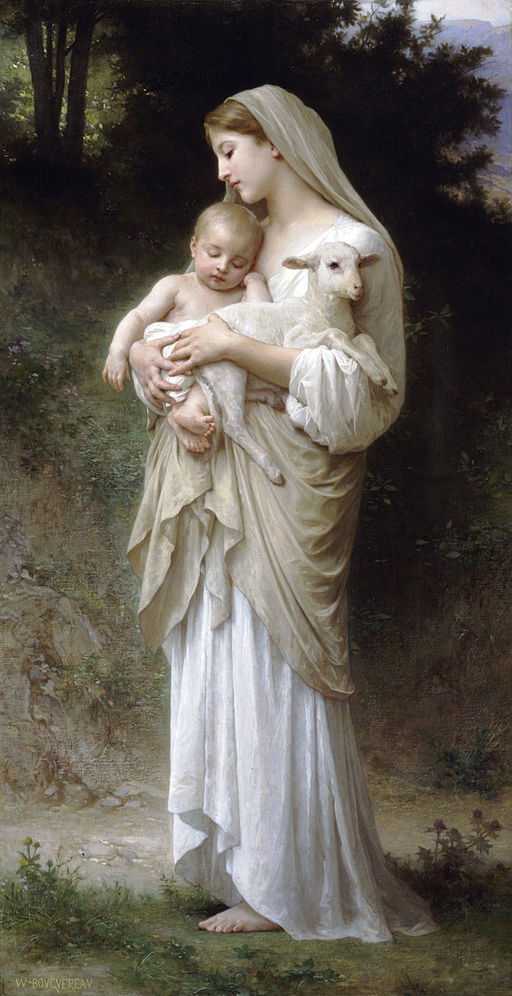
 512px-Bouguereau-Linnocence (1)

               “Blessed are the pure in heartfor they shall see God”  (Matt 5: 8)

The Kingdom of the Incarnation is built on purity. “Since all God’s works are a disclosure of Himself,” we can look  backwards to the commencement of the Kingdom of the Incarnation to see that, by the overwhelming weight of the evidence, Christ’s Kingdom is built on purity (we cannot deny that God’s love is an even deeper foundation for this Kingdom, but love and purity go hand in hand).

The evidence for our conclusion is simply the overwhelming purity of the four main members of Christ’s Kingdom at its very inception:

FIRST, we have the Blessed Virgin Mary, whose Immaculate Conception is, in essence, the hidden beginning of Christ’s Kingdom. Jesus chose to enter humanity through the Immaculate one, who is both Virgin and mother.

SECOND, we have our Lord himself, the “Celibate Bridegroom,” who is nothing short of INFINITE PURITY.

THIRD, we have Saint John the Baptist,  Jesus’ forerunner, who is a man of “mighty mortifications” and consecrated to celibacy.

FOURTH, we have Saint Joseph, a preeminent model of purity in the church (often depicted in art holding a lily of purity).

From these telling facts, we can see very clearly that not only was the Kingdom of the Incarnation built on purity, but that, in fact, this new Kingdom ushered in a monumental purity revolution. From these providential works of God (namely, the persons Mary, Jesus, John the Baptist and Joseph), which came at the very beginning of the Kingdom of the Incarnation, we reach the very important conclusion that the Eternal Father has the highest regard for purity (and thus that purity and holiness are inseparable). Stated differently, God’s Eternal and Infinite Purity shines forth at the commencement of Jesus’ Kingdom (“…God’s works are so many mirrors in which He allows His creatures to behold the reflection of His invisible perfections and hidden beauty….” F.W. Faber).

Now, Jesus Christ is the Lord of purity, and he preaches mightily and dramatically about the importance of purity in his Sermon on the Mount. As the Lord of purity it follows that Jesus is also the Lord of Marriage. Jesus demonstrates his supreme jurisdiction over marriage by declaring null and void the limited Mosaic permission of divorce. Moreover, Jesus raises the union of a man and woman in marriage to a sacrament. And any Catholic who understands what a sacrament is thus also understands the surpassing dignity and holiness of the married state!

For many of us men, impurity has sometimes proven to be a formidable obstacle to growth in holiness. Temptations to impurity test our worth and power of perseverance. In his short reflection entitled, “Do I Love God?,” Father Eymard (Saint Peter Julian Eymard, 1811-1868), the founder of the Blessed Sacrament Fathers, urges us to consider that our faithfulness to purity is a demonstration of our love for God. He states: “Purity is born spontaneously of love. It cannot be taught like a science: it is inspired, we sense it. Love creates it like a pure white flame…. The state of grace is nothing other than purity.”

God loves purity (or we might say that God is purity). God’s love of purity is revealed in a dramatic way at the beginning of Jesus’ Kingdom in the persons of Mary, Jesus, John the Baptist and Joseph. Your desire to be pure, despite so many obstacles patent in our culture, is a wonderful sign of your love for God. And if the road to greater purity proves difficult, rest assured that through prayer, devout use of the sacraments of Reconciliation and the Eucharist, and loving devotion to Mary, you will make progress.

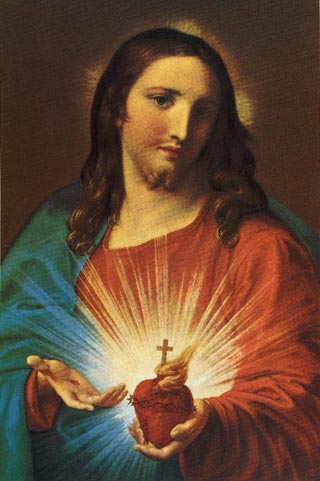
Batoni_sacred_heart

Tom Mulcahy, M.A. (on the vigil of the Feast of the Sacred Heart of Jesus)


Sources: The Blessed Sacrament by Father Faber, wherein he discusses how God’s works are a disclosure of who God is (see pages 33-56). It is Father Faber who uses (somewhere) the expression “Kingdom of the Incarnation.” The tone, content and style of this note draws heavily on Father Faber!; and The Eucharist and Christian Perfection (Volume I) by Saint Peter Julian Eymard (Emmanuel Publications), which is actually a series of retreat reflections he made to the Brothers of Saint Vincent de Paul, but certainly applicable to the laity as well.

Images: Innocence by William-Adolphe Bouguereau, 1893, (Public Domain, U.S.A.); Sacred Heart of Jesus, in the side chapel of Gesu in Rome, 1867, by Pompeo Batoni (Public Domain, U.S.A.)

To SHARE on SOCIAL MEDIA: click on “Leave a comment” or “Comments” below (and this will bring up social media icons if they are not already present).

To LEAVE A COMMENT: click on “Leave a comment” or “Comments” below, and then scroll down to the box which says, “Leave Your Own Comment Here,” which is at the end of any comments already made. If the comment section is already present, merely scroll to the end of any comments already made.

All rights reserved.

Any ads following this note are by WordPress and not CatholicStrength.