God

THE PROFOUND SPIRITUAL EXPERIENCE SAINT THERESE UNDERWENT AFTER MAKING HER OBLATION TO THE DIVINE MERCY

“I’m going to be doing only one thing: I shall begin to sing what I must sing eternally: ‘The Mercies of the Lord’ ” (St. Therese of Lisieux)

What I specifically intend to focus in on in this note is what happened to St. Therese AFTER she made her Act of Oblation to Merciful Love, the facts of which are less known and which highlight important aspects or elements of Therese’s mystical life and spiritual progress towards union with God.

Saint Therese wrote her famous Act of Oblation to Merciful Love on June 9, 1895 (link to the full text at the end of this note) in which she offered herself as a “Victim of Holocaust to God’s Merciful Love.” As she explains in her autobiography she received a special grace that day to make her offering to God’s Divine Mercy:

“This year June 9, [1895] the feast of the Most Holy Trinity, I received the grace to understand more than ever beforhow much Jesus desires to be loved.

I was thinking about the souls who offer themselves as victims of God’s Justice in order to turn away the punishments reserved to sinners, drawing them upon themselves. This offering seemed great and very generous to me, but I was far from feeling attracted to making it. From the depths of my heart, I cried out:

‘O my God! Will Your Justice alone find souls willing to immolate themselves as victims? Does not Your Merciful Love need them too? On every side this love is unknown, rejected; those hearts upon whom You would lavish it turn to creatures, seeking happiness from them with their miserable affection; they do this instead of throwing themselves into Your arms and of accepting Your infinite Love. O my God! Is Your disdained Love going to remain closed up within Your Heart? It seems to me that if You were to find souls offering themselves as victims of holocaust to Your Love, You would consume them rapidly; it seems to me, too, that You would be happy not to hold back the waves of infinite tenderness within You. If Your Justice loves to release itself, this Justice which extends only over the earth, how much more does Your Merciful Love desire to set souls on fire, since Your Mercy reaches to the heavens. O my Jesus, let me be this happy victim; consume Your holocaust with the fire of Your Divine Love.’”

You permitted me, dear Mother, to offer myself in this way to God, and you know the rivers or rather the oceans of graces that flooded my soul. Ah! since the happy day, it seems to me that Love penetrates and surrounds me, that at each moment this Merciful Love renews me, purifying my soul and leaving no trace of sin within it….” ((Story of a Soul, ICS Publications, 3rd Ed., pp. 181).

So we come now to the profound mystical experience Therese subsequently underwent, which might be called in mystical terminology “the spiritual wounding of the heart,” or transverberation. In the quote below Therese explains how her heart was mystically wounded by a dart of love a few days after she finished her Act of Oblation to Merciful Love:

“I had commenced the Stations of the Cross in Choir, then all at once I felt myself wounded by a dart of fire so ardent that I thought I must die. I do not know how to explain it; it was as if an invisible hand had plunged me wholly into fire. Oh, what fire, and what sweetness at the same time! I was burning with love, and I thought one minute, nay, one second more, and I shall not be able to support such ardour without dying. I understood then what the Saints have said of those states which  they had experienced so often. For me I have but experienced it that once, only for an instant, and afterwards I fell back again into my habitual dryness. From the age of fourteen I have also experienced the assaults of love. Ah! how much I love God! But it was not at all to be compared to what I experienced after my offering to Love….” (Cruz, p.68; see References below).

Therese tells us elsewhere that:

“I have had several transports of love, and one in particular during my Novitiate when I remained for a whole week far removed from this world. It seemes as though a veil were thrown over all earthly things. But, I was not then consumed by a real fire. I was able to bear those transports of love without expecting to see the ties that bound me to earth give way; whilst, on the day of which I mentioned (the dart of fire), one minute, one second more and my soul must have been set free…. True, the Divine Hand had withdrawn the fiery dart – but the wound was unto death!” (Cruz, pp. 68-69; see References below).

A core feature of Carmelite spirituality is contemplation or contemplative prayer (Saint John of the Cross and Saint Teresa of Avila, both Carmelites, were great mystics and contemplatives). It is sometimes thought that Saint Therese was less graced with the gift of mystical contemplation but certainly the examples just given help to shed light on Therese’s mystical journey, and as Father Garrigou-LaGrange points out:

“Truly St. Teresa of Lisieux traced for us the simple road which leads to great heights. In her teaching, as it pleased Pope Pius XI to point out, the gift of wisdom appears in a lofty degree for the direction of souls thirsting for the truth and wishing, above all human conceptions, to live by the word of God….The way of childhood thus understood, especially as we see it toward the end of the life of St. Teresa of the Child Jesus, is very elevated in its simplicity. Its lofty simplicity comes home to us because the saint certainly passed through the night of the spirit (which corresponds to the sixth mansion of St. Teresa of Avila), as may be seen on reading chapter nine of the Histoire d’une ame. It was the reading of this chapter, some thirty years ago, that gave us the idea of explaining the night of the spirit by a profound and intense influence of the gift of understanding, which brings out in powerful relief the formal motive of humility and of each of the three theological virtues. Thereby these infused virtues are purified of all alloy or attachment to secondary and accessory motives on which until then the soul had dwelt excessively” (The Three Ages of the Interior Life, Chapter 41, regarding the way of spiritual childhood, emphasis added).

I do not have time in this short note to trace out St. Therese’s dark night of the soul and trial of faith that began around ten months after she composed her Act of Oblation to Merciful Love, but as Father Frederick L. Miller points out: “In her harrowing trial of faith that lasted with hardly any relief for a year and a halfTherese experienced an inexplicable grace, a mystical, infused sharing in Christ’s passion. She felt as her own the thirst of the Crucified for all those people who reject his love. The words of St. Paul offered her light in her darkness: ‘For our sake, God made him to be sin who knew no sin, so that in him we might become the righteousness of God ‘(2 Cor 5:22).

The core of Saint Therese’s message, says Saint John Paul II, is the merciful love of God.  In his Apostolic Letter Proclaiming Saint Therese of Lisieux a Doctor of the Church, Pope John Paul II made the following observation regarding the core of Saint Therese’s message:

“The core of her message is actually the mystery itself of God-Love, of the triune God infinitely perfect in himself. If genuine Christian spiritual experience should conform to the revealed truths in which God communicates himself and the mystery of his will (cf. Dei Verbum, 2), it must be said that Therese experienced divine revelation, going so far as to contemplate the fundamental truths of our faith united in the mystery of Trinitarian life. At the summit, as the source and goal, is the merciful love of the three divine Persons, as she expresses it, especially in her “Act of Oblation to Merciful Love.”  At the root, on the subject’s part, is the experience of being the Father’s adoptive children in Jesus; this is the most authentic meaning of spiritual childhood, that is, the experience of divine filiation, under the movement of the Holy Spirit. At the root again, and standing  before us, is our neighbor, others for whose salvation we must collaborate with and in Jesus, with the same merciful love as his.” (no. 8)

Therese’s last words moments before she died in Carmel were: “Oh! I love Him…My God…I love You.” She died on September 30, 1897. 

Thomas L. Mulcahy, M.A.

References: For this note I am relying primarily on Joan Carroll Cruz’ book, Mysteries, Marvels, Miracles (TAN books), pp. 68-69. She references the quote about the dart of fire as follows: Sister Agnes of Jesus, Novissima Verba: The Last Conversations of St. Therese of the Child Jesus May-September 1897 (London: Burns, Oates & Washbourne, Ltd., 1929), pp. 43-44. The subsequent quote about transports of love is referenced by Cruz as follows: Soeur Therese of Lisieux, The Little Flower of Jesus (Story of a Soul), T.N. Taylor, editor. (New York: P.J. Kennedy and Sons, 1912), p.195. The quote from Father Frederick L. Miller is from his article, “Saint Therese of Lisieux: Doctor of Divine Love” (September 22, 2020), available online.

Link: https://stpaulcenter.com/the-act-of-oblation-to-merciful-love/#:~:text=I%20offer%20myself%20as%20a,your%20Love%2C%20O%20my%20God!

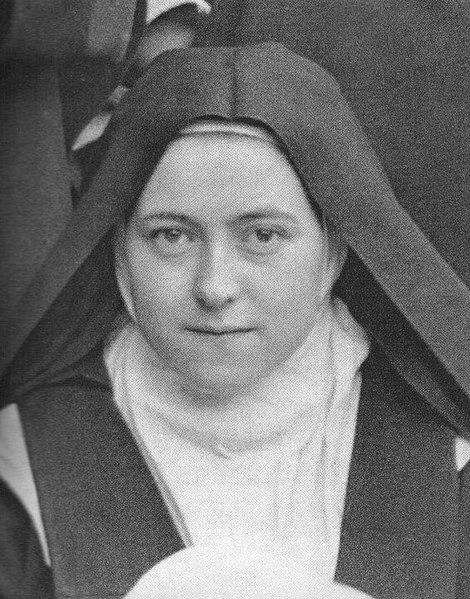
Image: St. Therese of the Child Jesus in the photograph taken in the courtyard of the monastery of Lisieux Easter Monday, April 15, 1894.

All rights reserved.

Any ads in this note are by WordPress and not CatholicStrength.
THE AWESOME PRIVILEGE AND POWER WE HAVE TO PRAY FOR OTHER PEOPLE!

“More things are wrought by prayer than this world dreams of”  (Alfred Lord Tennyson)


It is truly an amazing thing that God grants us the power to change the course of other people’s lives through intercessory prayer. We take this form of prayer for granted, but when you think about it intercessory prayer is one of the greatest powers God has granted to a creature. Literally, within seconds, we can petition God for the good of other human beings. Now that’s power, and God allows us to do it all life-long. The very justification (or at least one of them) for cloistered religious communities must be the incredible value of intercessory prayer.

Given the foregoing considerations, the question then arises: – Do we value intercessory prayer? Do we use it for our neighbor’s good? Have we taken the time to consider just how important intercessory prayer is?  We are commanded to be charitable to our neighbors. Intercessory prayer can help us to fulfill this duty in a wonderful and mysterious way. Saint Paul is adamant that Christians should pray for each other (1 Timothy 2:1). Since God has given us this great gift of intercessory prayer, it follows that He expects us to use it. Sometimes we feel there is very little we can do in the service of Jesus, but all of us can become more devoted to intercessory prayer. To pray for others is an important responsibility. Our prayers have the power to change lives and save souls who are precious to Jesus and Mary.

Devotion to intercessory prayer will, no doubt, increase our good-will towards others, especially those whom we don’t care for. It is also an exercise of the theological virtues of faith, hope and love which are of the essence of being Christian. And finally, per Father Faber, joy is a wonderful effect of this devotion seeing that it involves an unselfish act of seeking the good of others.

Why not make a list of the people you are going to pray for this week? Pray for those who need a job, pray for those who have left the church, pray for those who have hurt you, pray for those undergoing trials, pray for someone who is in mortal sin, pray for someone to grow in holiness and draw closer to the Lord. There are so many good things we can pray for. When you pass a hospital, pray for the person in the hospital who is closest to death. One thing is for sure: people need your prayers. I need your prayers. We should all be, in the power of the Holy Spirit, mighty apostolates of intercessory prayer, for the good of our neighbor and the glory of God.    

Now if we who are on the road to salvation have been granted such an immense power to pray for others, imagine then how much more the saints in Heaven (fully and forever united to God) are qualified to pray for us!  “We are one body.”

Tom Mulcahy, M.A.

Reference: I am relying entirely on Chapter Four of All for Jesus by the great F.W. Faber, and this note is merely a paraphrase or a summary or a condensing of parts of that chapter.

 All rights reserved.

Any ads in this note are by WordPress and not CatholicStrength.
CONTINUAL DEVOTION TO THE HOLY NAME OF JESUS

“Therefore God exalted [Jesus] to the highest place and gave him the name that is above every name, that at the name of Jesus every knee should bow, in heaven and on earth and under the earth” (Phil. 2: 9-10)

“Jesus” literally means “he saves.” It is thus a saving name, or rather a name full of saving power.

Why is Jesus’ name more powerful than all other names (indeed, more powerful than all other names combined)? – because Jesus has been resurrected, because Jesus has ascended into Heaven, because Jesus has been crowned Lord of all creation, and because, enthroned in Heaven, Jesus always lives to make intercession for you (Hebrews 7:25). This is power. This is the power of invoking Jesus’ name!

The Catechism of the Catholic Church states (at 519):

All Christ’s riches “are for every individual and are everybody’s property.” Christ did not live his life for himself but for us, from his Incarnation “for us men and for our salvation” to his death “for our sins” and Resurrection “for our justification”. He is still “our advocate with the Father”, who “always lives to make intercession” for us (Hebrews 7:25). He remains ever “in the presence of God on our behalf, bringing before him all that he lived and suffered for us” (Hebrews 9:25).

Therefore, an easy yet powerful way to grow closer to Jesus is to simply hold His name in great reverence. The basic assumption for this devotion is that Jesus’ name is full of power and grace. The Church apparently agrees with this assessment because it sets aside January 3 as the Feast of the Most Holy Name of Jesus. It is a reminder to us to greatly reverence Jesus’ name the rest of the year. What an awesome New Year’s resolution that would be! Imagine the growth in holiness you would experience if you kept that resolution.

Father Paul O’Sullivan writes that the “Holy Name of Jesus fills our souls with a peace and a joy we never had before.” He adds that the “Name of Jesus is the shortest, the easiest and the most powerful of prayers. Everyone can say it, even in the midst of his daily work. God cannot refuse to hear it.”

“The frequent repetition of this Divine name [Jesus],” says Father O’Sullivan, will save you from much suffering and great dangers.” It seems to me the key to this devotion is to say Jesus’ name with great reverence and love, calling to mind – without even having to think about it – all that Jesus is and means to us. This is a formula which will clearly increase our love for Jesus and will maintain us in a spirit of faith. We should never forget that faith is one of the most important virtues in the spiritual life (it is a theological virtue, literally meaning “God-directed”).

Father O’Sullivan encourages us to “understand clearly the meaning and value of the Name of Jesus.” He adds that the “Holy Name of Jesus saves us from innumerable evils and delivers us especially from the power of the devil, who is constantly seeking to do us harm.” He says that “every time we say ‘Jesus,’ we are saying a fervent prayer for…all that we need.”

If you are looking for a simple devotion, filled with power, this is it! Father O’Sullivan assures us that the simple devotion of reverently saying Jesus’ name throughout the day has amazing power. And, as Father Faber states, what do we need more in the spiritual life than “power” to overcome our tepidity and weakness.

“[Mary] will bear a son, and you shall call his name Jesus, for he will save his people from their sins” (Matthew 1:21). May the most holy name of Jesus be on your lips and in your heart throughout the upcoming year. And remember Jesus himself said: “Truly, truly, I say to you, whatever you ask of the Father in my name, he will give it to you” (John 16:23).

Thomas L. Mulcahy, M.A.

References: The Wonders of the Holy Name by Father Paul O’Sullivan (TAN). “With the release of the revised Roman Missal in March 2002, the feast [of the Most Holy Name of Jesus] was restored as an optional memorial in the Ordinary Form on January 3” (from catholicculture.org).

All rights reserved.

Any ads in this note are by WordPress and not CatholicStrength.

Advertisements

Returning College Students: The New Atheism has Serious Flaws

studying-703002_640

“The Big Bang, which nowadays is posited as the origin of the world, does not contradict the divine act of creating, but rather requires it”  (Pope Francis)

     The so called “New Atheism,” which even refers to itself as a venture in improbability, is permanently flawed (for as the genius of G.K.  Chesterton points out, “if there was no God, there would be no atheists!”).  As far as I’m concerned, the only thing different about the new atheism, when compared to the old atheism, is that the new atheism is newer than the old atheism! In fact, David Hart (who wrote a book on this subject) is of the opinion that the old atheists were actually better atheists than the new ones. He laments:

 “The principal source of my melancholy, however, is my firm conviction that today’s most obstreperous infidels lack the courage, moral intelligence, and thoughtfulness of their forefathers in faithlessness.”  (“Believe it or Not” www.firstthings.com)

     The real appeal of atheism is not its intellectual prowess (atheism requires a positively irrational faith in blind chance); no, the real appeal of atheism is moral autonomy so that God can be conveniently pushed aside. “The fool says in his heart, ‘There is no God'” (Psalm 14:1).

     Frankly, these new atheists need to show a little more humility. It’s not like they’ve suddenly discovered the answer to the age old question: “Why is there something rather than nothing?” Point in fact: the well known physicist, Stephen Hawking, who responded to the question, “Why does the universe bother to exist?,” by saying: “I don’t know the answer to that.”

     I have to admit that it is always a little amusing to me when a mere creature, who has only been alive no more than a handful of decades, proclaims with noticeable hubris that his mind has reached the conclusion that the universe – and human beings – are nothing but an accident. I have greater respect for the deist who sees the implausibility of denying a creator, but has a great distaste for actually having any sort of relationship with such a being. In any event, if the computer I am typing on was to suddenly start shouting at me that it had no ultimate designer, and that it came about by mere chance, I would have to tell it to, well, shut-up!

       Recently I had the idea of pretending to be an atheist. I wanted to see what it felt like to be an atheist (to believe somehow that all that we see, hear, feel and touch is nothing but an accident). I even thought of praying to the ungod of the accidental universe to see how he managed to bring it all together by accident (although here I could be accused of reverting to primitive religious superstition). But I prayed to this ungod anyways.  And as I prayed my lovely wife walked into the room: and I said, “ungod, you are truly amazing.”    

     There’s my wife, and she is sort of like a perfect partner to me! She’s all so feminine (thanks for those gentle curves), and I’m masculine (I played football in seventh grade). I must be insane to think that you pulled off this amazing complementarity between my wife and I by accident, and so hats off to you, ungod, because the chances of this happening by accident must have been, well, zero.” I paused then to see if ungod would say anything back to me, but he didn’t, and the whole thing actually backfired on me as I began to see the complementarity between my wife and I as a rather obvious revelation that I did have a creator. Then I remembered that quote by C.S. Lewis: “A young man who wishes to remain a sound atheist cannot be too careful of his reading.” In my case, it simply wasn’t a good idea to pray to ungod.     

     Years ago Carl Sagan (the astronomer) was the unofficial High Priest of atheistic scientism. Sagan helped to popularize Haeckel’s theory of recapitulation, a theory that maintains that human embryonic development recapitulates in miniature the grand course of human biological evolution. It is well known, now, that Haeckel forged some of his well known drawings of human embryonic development (ones that were standard for years in biology texts and tended to dehumanize the fetus), and the theory is now generally regarded as defunct. We therefore need to be careful not to grant to scientific theory an aura of infallibility that ultimately serves merely as a disservice to science. Even scientists need to distinguish carefully between scientific fact and scientific theory. Thus, in the current debate over evolution, it is important to know that the two leading proponents of the theory – Dawkins and Gould – have seemingly diametrically opposing views as to how evolution happened , i.e., the dispute between gradualism and punctuated equilibrium. Gould opted for punctuated equilibrium due to the paucity of the fossil record. We still have a lot to learn about the “mechanics and pace” of biological evolution. Pope Francis points us in the right direction, having said: “The evolution of nature does not contrast with the notion of creation, as evolution presupposes the creation of beings that evolve.”

      Dawkins’ book, The Blind Watchmaker, shows just how unscientific scientists can be. Frankly,  Dawkins (one of the top “new atheists”) must be embarrassed for having said what he said. In his book, Dawkins maintains that if one was to see a statue of the Virgin Mary wave its hand, such an occurrence, although improbable, could be explained by the laws of physics and chemistry. Here are Dawkins own words from the book:

“In the case of the marble statue, molecules in solid marble are continuously jostling against one another in random directions. The jostlings of the different molecules cancel one another out, so the whole hand of the statue stays still. But if, by sheer coincidence, all the molecules just happened to move in the same direction at the same moment, the hand would move. If they then all reversed direction at the same moment the hand would move back. In this way it is possible for a marble statue to wave at us. It could happen. The odds against such a coincidence are unimaginably great but they are not incalculably great. A physicist colleague has kindly calculated them for me. The number is so large that the entire age of the universe so far is too short a time to write out all the noughts! It is theoretically possible for a cow to jump over the moon with something [[171]] like the same improbability. The conclusion to this part of the argument is that we can calculate our way into regions of miraculous improbability far greater than we can imagine as plausible.”

Let’s give Dawkins a break. Perhaps he was having a bad day when he wrote this rubbish. But how can I trust anything he says in light of the scientific foolishness employed by him in the just cited quotation.

      Michael Corey, in discussing the possibility whether our “wondrous universe could have evolved by blind chance” quotes the distinguished University of Montreal psychiatrist Karl Stern as  labeling such a view of the universe as “crazy.” He further quotes Stern as saying: “And I do not at all mean crazy in the sense of a slangy invective but rather in the technical meaning of psychotic. Indeed such a view has much in common with certain aspects of schizophrenic thinking” (God and the New Cosmology, p.220). Stern is basically maintaining that it is flat out irrational to believe the universe came about by chance or accident.

     Theism – belief in God –  is grounded in common sense. It need not be intimidated by the “bio-mythology” of an accidental universe. College is not the place to stop praying: it is rather a great place to deepen your prayer life and trust in God. If you make the effort to advance in prayer, the reality of God will become more and more an experiential reality to you. You will “taste and see that the Lord is good” (Psalm 34:8).

Tom Mulcahy, M.A.

Ref. Answering the New Atheism (Wiker and Hahn). Concerning the complementary relationship between faith and science, see Catechism of the Catholic Church, sections 159, 283 and 284. In October of 2014, Pope Francis stated the following: “The Big Bang, which nowadays is posited as the origin of the world, does not contradict the divine act of creating, but rather requires it. The evolution of nature does not contrast with the notion of creation, as evolution presupposes the creation of beings that evolve.”