Author: tomlirish

A SHORT MEDITATION ON GOD

 sunset-585334_1280

         “My soul proclaims the greatness of the Lord”  ( Luke 1:46)

      I think it is probably true to say that we don’t spend enough time meditating on who God is, even though meditating on God’s attributes has a special capacity to fill our hearts with love for God. I’m in the process of reading Saint Aloysius Gonzaga’s biography by Father Meschler, and the author states on page 150, concerning the saint’s prayer lifethat Aloysius “often seemed to be rapt into another world, especially when meditating on the infinite attributes of God….” There is so much to be learned from the saints.
     Lately, I’ve been meditating on two of God’s attributes, to wit: that God is UNCREATED and INFINITE.
     God’s “unimaginable glory” is such that He has always existed and never has not been. He is uncreated because His very essence is to exist. In John’s Gospel, Jesus testified that “before Abraham was, I am” (8:56). Our beautiful God’s life is eternal, limitless and self-sufficient. There is simply nothing to compare to the greatness of God’s unbeginning, never-ending Blessed life. When we meditate on this wonderful mystery it fills our hearts with awe.
     God’s life is also INFINITE. As large and big and majestic as you can imagine God to be, He is still infinitely larger, bigger and more majestic than that. The immensity of His Infinite existence is simply inexplicable. It blows our minds to try and comprehend just how infinite God’s life is: but whatever your answer may be, His infinite existence is infinitely greater than what you are able to imagine (these human images fall hopelessly short of the spiritual reality).  God’s infinity is simply breathtaking. He is boundless beyond anything we can comprehend. He transcends space and time.The “infinite sea” of His being cannot be measured or quantified.
     OK. Stop for a moment. Take a breath. Take note: the Uncreated, Infinite God created you. And He loves you! – so much so that He entered into human history to save us from ourselves by suffering a  cruel and brutal death, and even now, out of love, abases Himself to be our very eternal life-giving food under the appearance of bread and wine. What kind of God is this?
     My heart is beating faster! I was created by this God. I am loved by this God!  And this God can only love with the immensity of His Infinite love. Who has words to describe the immensity of God’s love? To contemplate God’s love fills our hearts with a holy awe and an ardent desire forms deep within our souls to seek after Him with greater intensity and with a more fervent love. 
     Oh wonderful, glorious God! Thou art truly amazing; and thou art my God and Father.

Tom Mulcahy

Inspiration: I am completely indebted in this note to the style and content of Father F.W. Faber’s great book, The Creator and the Creature, and I have carved this short note out of his many reflections therein on the attributes of God (see especially the chapter, “Why God Wishes Us to Love Him”).

All rights reserved.

 To SHARE on SOCIAL MEDIA: click on “Leave a comment” or “Comments” below (and this will bring up social media icons if they are not already present).

To LEAVE A COMMENT: click on “Leave a comment” or “Comments” below, and then scroll down to the box which says, “Leave Your Own Comment Here,” which is at the end of any comments already made. If the comment section is already present, merely scroll to the end of any comments already made.

Any ads following this note are by WordPress and not CatholicStrength.


THE HUMANITY OF THE UNBORN CHILD IN THE OLD TESTAMENT: A REMARKABLE PHENOMENON

 IMG_1925
     

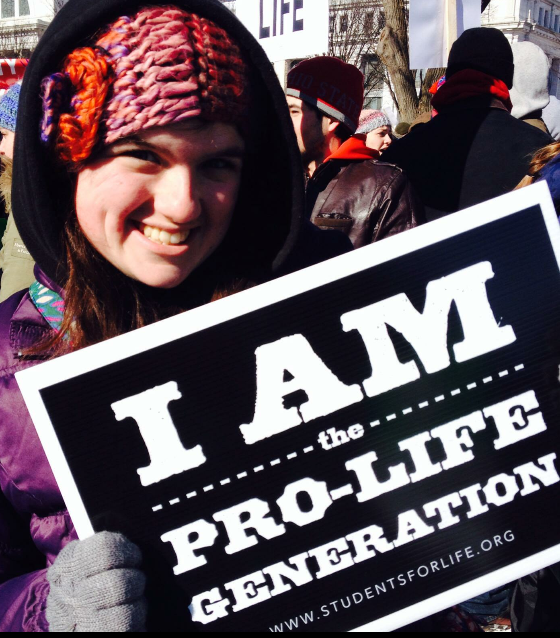
 “…the mere possibility of harming [life not yet born] is completely foreign to the religious and cultural way of thinking of the [Old Testament] People of God.”  (Saint Pope John Paul II, The Gospel of Life, no.44)

       I am looking at the Old Testament – the Hebrew Bible – and I am reflecting on a remarkable phenomenon: that amidst pagan and even demonic cultures the Hebrew people affirmed in a most remarkable way the humanity of the unborn child. Illustrative verses include:

“Then the word of the LORD came to me, saying: “Before I formed you in the womb I knew you; before you were born I sanctified you; I ordained you a prophet to the nations.” (Jeremiah 1:4-5)

“What then shall I do when God rises up? When He punishes, how shall I answer Him? Did not He who made me in the womb make them? Did not the same One fashion us in the womb?” (Job 31:14-15)

“For You formed my inward parts; you covered me in my mother’s womb. I will praise You, for I am fearfully and wonderfully made; marvelous are Your works, and that my soul knows very well.” (Psalm 139:13-14) 

“Behold, children are a gift of the LORD, The fruit of the womb is a reward.” (Psalm 127:3)

     Pope John Paul II, commenting on the Old Testament affirmation of life from its very inception in the womb, states:

“How can anyone think that even a single moment of this marvelous process of the unfolding of life could be separated from the wise and loving work of the Creator, and left prey to human caprice? Certainly the mother of the seven brothers did not think so; she professes her faith in God, both the source and guarantee of life from its very conception, and the foundation of the hope of new life beyond death: “I do not know how you came into being in my womb. It was not I who gave you life and breath, nor I who set in order the elements within each of you. Therefore the Creator of the world, who shaped the beginning of man and devised the origin of all things, will in his mercy give life and breath back to you again, since you now forget yourselves for the sake of his laws” (2 Mac 7:22-23).”  (The Gospel of Life, no. 44)

     The magnificent revelation in the Old Testament that both man and woman are created in the image and likeness of God (Genesis 1:27) was the foundation of a unique culture of life for the Hebrew people, from which would one day come a Savior safely hidden away in the womb of the Virgin before that first Christmas day.

Tom Mulcahy, M.A.

Ref. The photo is from the 2014 March for Life in Washington D.C.

All rights reserved.

To SHARE on SOCIAL MEDIA: click on “Leave a comment” or “Comments” below (and this will bring up social media icons if they are not already present).

To LEAVE A COMMENT: click on “Leave a comment” or “Comments” below, and then scroll down to the box which says, “Leave Your Own Comment Here,” which is at the end of any comments already made. If the comment section is already present, merely scroll to the end of any comments already made.

Any ads following this note are by WordPress and not CatholicStrength.


A TAPESTRY OF MARY’S POWERFUL PRESENCE IN THE NEW TESTAMENT

Sassoferrato_-_Jungfrun_i_bön

 “I am the Lord’s servant. May everything you have said about me come true” (Luke 1:38)

If God’s own messenger, the Archangel Gabriel, hadn’t called her by the descriptive title, “Hail, Full of Grace” (Luke 1: 28); and if she had not been covered by the Holy Spirit’s “unspeakable shadow” (see Luke 1:42); and if St. Luke, in describing Mary’s visitation to Elizabeth, hadn’t drawn a stunning comparison between the Virgin Mary and the all-holy Ark of the Covenant (see link below); and if Mary’s visit (with Jesus in utero) to Elizabeth hadn’t unleashed a veritable explosion of grace; and if, at the sound of Mary’s voice, Elizabeth had not been filled with the Holy Spirit and boldly proclaimed Mary to be “the Mother of my Lord” (Luke 1:41-45); and if Simeon the prophet had not peered down through the decades to see that Mary, who had brought the baby Jesus to the Temple, was predestined to share closely in Jesus’ passion, saying to Mary, “And a sword will pierce your own soul too” (Luke 2: 35); and if Mary’s role as a powerful intercessor hadn’t been so clearly manifested at Cana when she moved her Son to work His first public miracle against His own will since His “hour had not yet come” (John 2:1-12); and if the Lord Jesus Himself hadn’t bequeathed her to us (from the cross) as our Spiritual Mother as He was meriting our very salvation, saying, “Behold, your Mother” (John 19: 25-27) as she stood faithfully at the foot of the cross in fulfillment of Simeon’s prophecy; and if Saint Luke hadn’t specifically pointed out that she was present with the Apostles in the Cenacle in preparation for Pentecost” and the “birth of the Church” (quotations from Pope John Paul II; see Acts 1:14); and if Saint John hadn’t seen her in a vision of heaven, “clothed with the sun” and wearing her Queenly crown of twelve stars (Revelation 12:1-2); and if Old Testament typology and New Testament fulfillment didn’t point to her as the New Eve and Queen Mother (see especially Scott Hahn’s masterful book, Hail Holy Queen); and if the testimony of the Catholic saints didn’t overwhelmingly verify beyond all peradventure the amazing assistance she provides to those who accept her spiritual motherhood (which Jesus merited for us), leading them to greater union with Jesus, perhaps then you could persuade me not to accept all of the beautiful and sublime teachings about her by the Roman Catholic Church, the only church in Christendom which can trace its origin directly back to Jesus and the apostles (and thus to Mary herself, Mother of the Savior).

Tom Mulcahy, M.A.

Sources:
Various Scott Hahn tapes including “Mary: Holy Mother,” and his book, Hail Holy Queen; various Father Faber books (I believe he used the beautiful phrase, “unspeakable shadow,” quoted above); internet article Mary, the Ark of the New Covenant (This Rock: October 2005); and other Catholic apologetic materials. See also, Ignatius Catholic Study Bible; Dictionary of Mary; and by Pope John Paul II (click on link ): Mary’s Presence in the Upper Room at Jerusalem
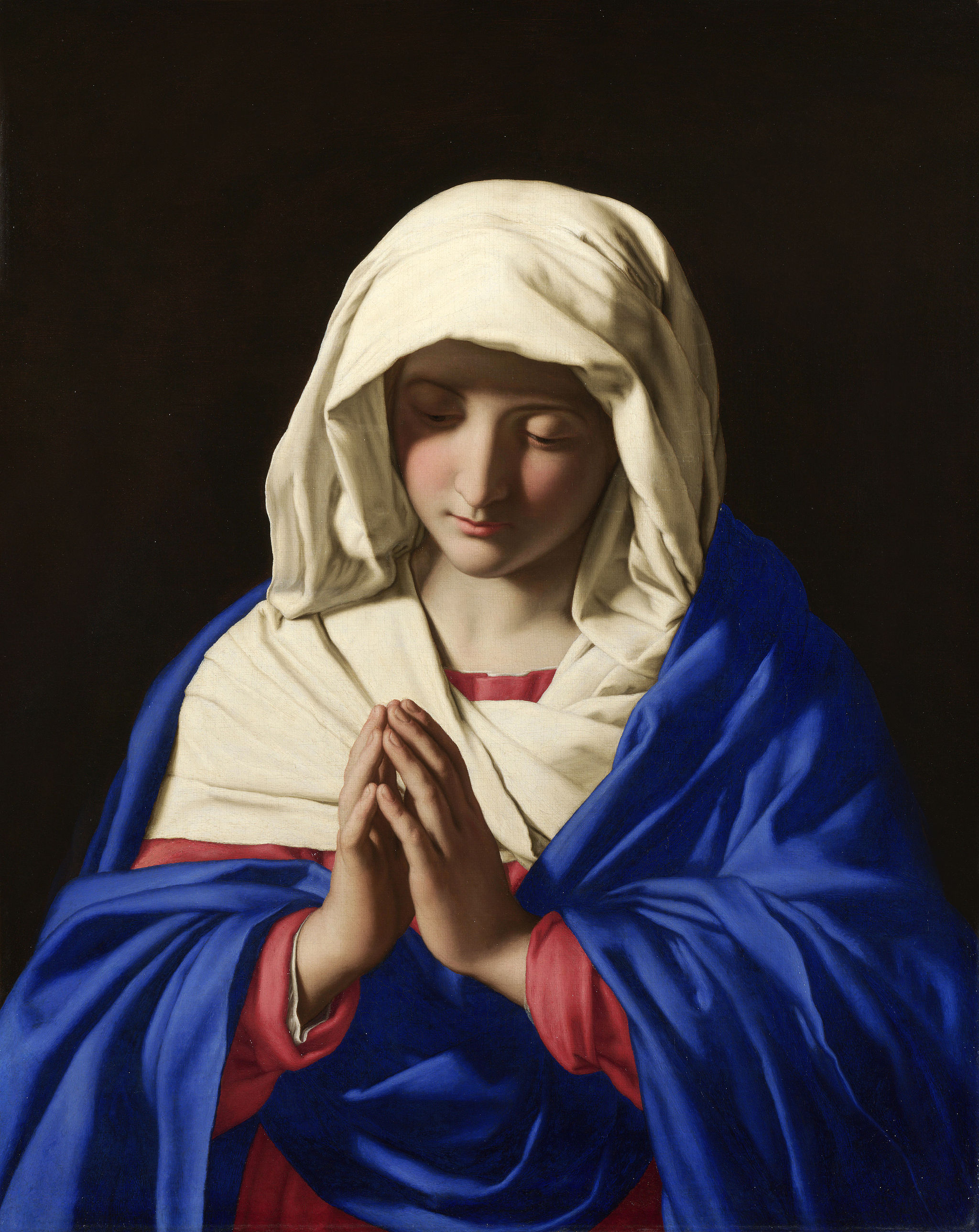
Image: The Virgin in Prayer by Giovanni Battista Salvi da Sassoferrato (1609-1685), a Public Domain work in the U.S. A. per Wikipedia.

All rights reserved.

To SHARE on SOCIAL MEDIA: click on “Leave a comment” or “Comments” below (and this will bring up social media icons if they are not already present).

To LEAVE A COMMENT: click on “Leave a comment” or “Comments” below, and then scroll down to the box which says, “Leave Your Own Comment Here,” which is at the end of any comments already made. If the comment section is already present, merely scroll to the end of any comments already made.

Any ads following this note are by WordPress and not CatholicStrength.

THE EUCHARIST, JOHN 6 AND JUDAS

Ref. The Gospel of John (audio series) by Dr. Scott Hahn

Photo Attribution

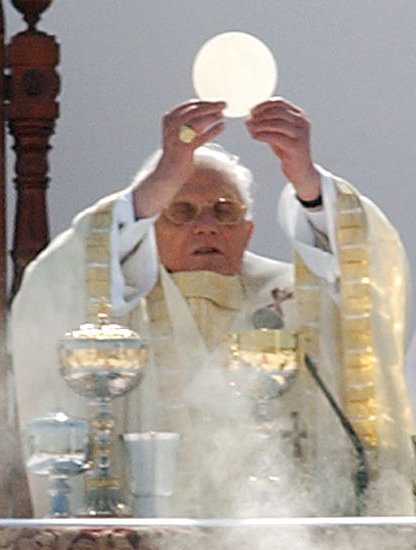
This photo of Pope Benedict XVI celebrating Mass on May 11, 2007 was taken by Fabio Pozzebom/ABr and produced by Agência Brasil, a public Brazilian news agency. This file is licensed under the Creative CommonsAttribution 3.0 Brazil license (per Wikipedia).

All rights reserved.
To SHARE on SOCIAL MEDIA: click on “Leave a comment” or “Comments” below (and this will bring up social media icons if they are not already present).
To LEAVE A COMMENT: click on “Leave a comment” or “Comments” below, and then scroll down to the box which says, “Leave Your Own Comment Here,” which is at the end of any comments already made. If the comment section is already present, merely scroll to the end of any comments already made.
Any ads following this note are by WordPress and not CatholicStrength.

THE IGNATIAN CALL TO SERVICE: LOVE DEMANDS LOVE IN RETURN

 St_Ignatius_of_Loyola_(1491-1556)_Founder_of_the_Jesuits

                       “How can I repay the LORD for all the good done for me?”   (Psalm 116:12)

Reflection: At the heart of the Ignatian Exercises is a question. The question Ignatius poses is this: seeing all that Jesus did for you (becoming a fellow human being to die a brutal death so that you could be liberated from the tyranny of sin), what are you going to do in response to such amazing love?

After all, Ignatius is a soldier. He’s a man of action. He wants the whole world to hear the summons to salvation. His source of power is contemplation (prayer), but prayer leads to action: to service. If the King (Jesus) is fighting a battle for souls, then the soldier of Christ needs to be fully enlisted in the King’s service.

Ignatius has a battle plan. If we are to follow the biblical mandate to be in the world but not of it (see John 17 and Romans 12:2), then we must practice a certain indifference towards all created things so that the allure and charm of the world (its seductive power) has no power over us. Thus we are freed to use all of creation for its intended purpose: to give glory to God. This indifference places in our hearts “a calm readiness for every command of God” (Karl Rahner), and the courage to accept the unforeseen circumstances which God may permit to occur in our lives. In this battle plan the reference point for all that we do is God. “Our hearts are restless until they rest in God” (Augustine).

The call of the Ignatian exercises is to get spiritually fit for service. The training consists in a review of one’s life (part I), examination of conscience, cultivating a profound sorrow for past sins, learning to trust in God’s mercy, the practice of prayer and meditation, learning how to petition God with boldness for the graces we need, and learning how to become like the one who died for us primarily by an intense identification with the Savior’s life (part II).

“Love consists primarily in a sharing of all that one has with whom he loves.” This is the essence of Trinitarian love! The Savior has seen fit to give all of Himself to us so that we may ultimately share in the eternal life of the Trinity. In response to such amazing love, Ignatius asks: what are you going to do in return? The proper response to Ignatius is to LOVE God in return; and to Ignatius, to quote one of the most famous lines of the Exercises, “love ought to manifest itself in deeds rather than words.” Part III of the Exercises has, as part of its focus, contemplating the love of God. Contemplation leads to action. This is Ignatian spirituality: a “service-mysticism.” The grace we seek is to discern God’s will in the service of such a great King: the Lord Jesus Christ. The response then to such great love is love.

And love bears fruit.

Tom Mulcahy, M.A.

References:

1. Challenge: A Daily Meditation Program Based on The Spiritual Exercises of Saint Ignatius, by Father Mark Link
2. Retreat with the Lord: A Popular Guide to the Spiritual Exercises of  Saint Ignatius of Loyala, by John Hardon, S.J. (Servant Publications)
3. A Do It at Home Retreat:The Spiritual Exercises of Saint Ignatius of Loyala, by Andre Ravier, S.J. (Ignatius Press)

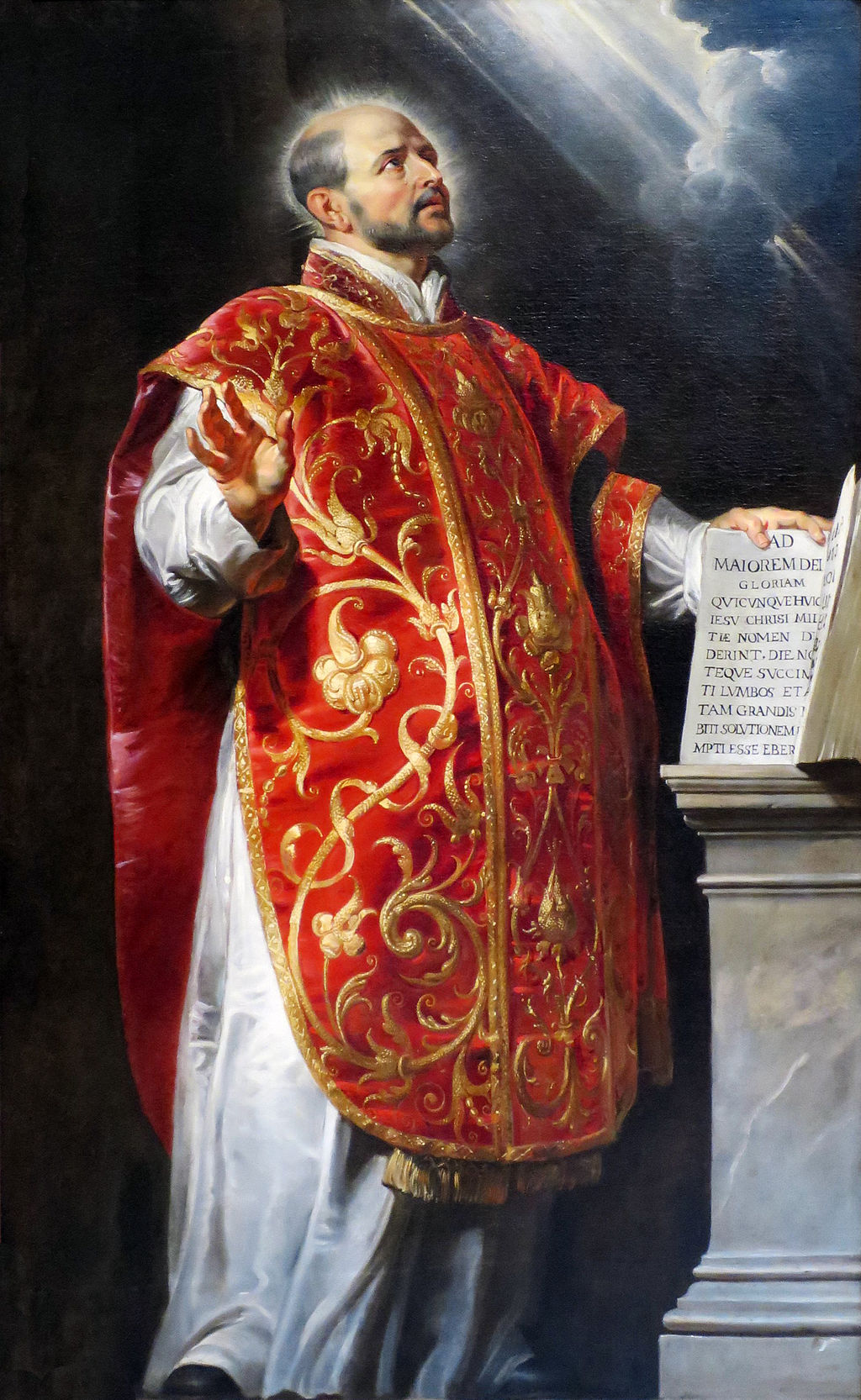
Image: Painting of Saint Ignatius of Loyola by Peter Paul Rubens (1577-1640), a public domain work of art in the U.S.A,

All rights reserved.

To SHARE on SOCIAL MEDIA: click on “Leave a comment” or “Comments” below (and this will bring up social media icons if they are not already present).

To LEAVE A COMMENT: click on “Leave a comment” or “Comments” below, and then scroll down to the box which says, “Leave Your Own Comment Here,” which is at the end of any comments already made. If the comment section is already present, merely scroll to the end of any comments already made.

Any ads following this note are by WordPress and not CatholicStrength.

THE INCALCULABLE POWER OF PRAYER

 cross-106416_1280 (1)

                               “Pray without ceasing” (1. Thes. 5:17)

     Mark these words as so true and so important that they should be engraved in your mind and in your heart and possibly even tattooed to your hand so that you don’t forget them: – the decline of supernatural life begins when you start neglecting prayer. When prayer is completely abandoned you have simply returned to “the world” for your comfort and repose. You were made for prayer, and the language of the soul is prayer. “Be still and know that I am God” (Psalm 46:10).
     But do we have time to “be still” and be in the presence of God, to talk to Him and to listen to Him, and to make our needs known to Him? As a flower needs water and sunshine, we need prayer. And so it is incalculably harmful to us when we consciously or unconsciously make the decision not to pray, and thus put up a barrier between ourselves and our true happiness: a personal relationship with our God and Eternal Father. Oh Holy Spirit, give me a renewed and zealous attention to prayer; give me the grace to see the incalculable power of prayer; help me to see with Saint Alphonsus de Ligouri that those who pray shall be saved (see CCC 2744).
     Therefore, we must be committed to prayer.  It is akin to spiritual suicide not to pray. Prayer should be the very foundation of our lives as we grow closer and closer to God. And if we are in need of a certain virtue, say, for example, patience, or chastity, or the grace to pray better, we must relentlessly ask God for this grace in prayer. “Ask and it will be given to you” (Matt. 7:7).
     Why is prayer so important, other than it being the very basis of your loving relationship with God? Here are two reasons:

               1. Prayer directs our attention away from the passing things of this world (that so distract us) and toward God: in Whom all our happiness consists. Prayer, then, is a profound remedy against worldliness, since it augments our union with God.

               2. In God’s Providential direction of the universe He has ordained that we should pray to Him, and He continually gives us actual graces to pray when we would rather not. Father Hardon comments:

“And what is the primary source of grace that we always have at our disposal? It is prayer. ***  Why? Because part of the divine plan, which is what providence means, is that we should obtain many of the things we need only by asking God to grant them.” [Thus], “we have no choice; either we pray or we do not get the divine light and strength we need.”

I know that there are good reasons for not missing American Idol, or Hannity, or the Lions, or the 10 PM news, or playing that video game upon which relies the world’s safety from terrorism, but rest assured that it is a great mismanagement of our time to neglect prayer. Oh Happy Day when we understand this!

Tom Mulcahy, M.A.

Sources: I am relying primarily on Father Weiss. On Page 83 of The Christian Life by the German Dominican, Father Albert M. Weiss, he talks about how “the decline of the supernatural life begins…with…the neglect of prayer.”
He explains that this loss can only be “renewed” by a “zealous attention to prayer.” On page 80 he talks about the “incalculable…power of prayer.” On Page 81 he discusses how prayer withdraws us from the world and “turns [us] wholly to God.” You can see, then, that I have used these words of Father Weiss in several places in this note. Are you looking for a remarkable spiritual book?: get his book! I am not picking on any particular TV show, but I am suggesting that television and other electronic media often distract us from prayer (which should be a priority).

To SHARE on SOCIAL MEDIA: click on “Leave a comment” or “Comments” below (and this will bring up social media icons if they are not already present).

To LEAVE A COMMENT: click on “Leave a comment” or “Comments” below, and then scroll down to the box which says, “Leave Your Own Comment Here,” which is at the end of any comments already made. If the comment section is already present, merely scroll to the end of any comments already made.

Any ads following this note are by WordPress and not CatholicStrength.

MAINTAINING CONTACT WITH THE BEAUTY OF NATURE DURING THE DEAD OF WINTER

winter-234721_1280

“The aesthetic value of creation cannot be overlooked. Our very contact with nature has a deep restorative power” (Saint Pope John Paul II)

Once again, winter is upon us here in Michigan. The trees are leafless and the amount of sunlight has drastically declined. By dinner time it seems that we are already engulfed in physical darkness. And as it gets colder it seems as if we spend most of our time indoors. Under all of these circumstances it probably is not that unusual that some of us begin to experience a type of mild depression or malaise known as “seasonal affective disorder” (a/k/a the winter blahs).

I believe it is important and helpful under these circumstances to maintain contact with the beauty of nature, and that such contact with God’s creation enhances our mental well-being and outlook.  Father Irala, in his popular book, Achieving Peace of Heart, tells us that “we must live beauty.” He maintains that we need to be “reeducated” to “receive the external world.” This priest tells us that we need to learn to let “beauty enter deep into us.” Please refer to my previous post

Contact With Nature is Very Healing and Very Necessary …

Now maintaining this essential and curative contact with nature is fairly easy in spring, summer and fall, but how do we carry it out in the dead of winter? Some people head down to Florida for a while!, but many of us have to endure the cold and dark winter season.

My basic recommendation is that we should become highly cognizant of the fact that we need to maintain contact with the beauty of nature during the dead of winter. Some people ski, or snow-mobile, or do other outside activities that place them directly in the beauty of winter. But many of us look at winter as something to endure, to get through, until finally the weather becomes more bearable. If, like me, you fall into this latter category, then you run the risk of being cut off from the mental well-being contact with nature provides. Thus, it is essential that we hibernating types take positive steps to maintain contact with nature during the winter months. Here are some ideas that may help.

The other day it was dark and only 12 degrees Fahrenheit as I stepped outside at 6 am to get into my car, but I stuck to a ritual I have of momentarily looking up at the sky to glance at the stars. I probably spent less than 25 seconds looking up at the beauty of the firmament (yes, some days there are no stars, but most days there are!), and I then said a short prayer praising God for His Infinite Beauty, and then I got into my car and turned the heat on! But there you go: even though it was very cold I made some minimal contact with the beauty of God’s creation.

Another ritual I utilize in the winter is to open the top half of an upstairs window and to peer out meditatively – as the cold air brushes up against my face – at the sky, or at an evergreen covered with snow, or merely at the breadth of the world outside as it presents itself. The point is that this simple exercise assures me of some contact with the beauty of nature in a palpable, less attenuated, manner. Keep in  mind that the sky is an eminent (though frequently overlooked) source of beauty. Today the sun was out, along with a beautiful blue sky and billowing white clouds. The sky – even in winter – can be a source of profound beauty, a reflection of God’s grandeur (and yes, I realize that there are many days when the sky is dreary and depressing, so we must take advantage of the good days!).

But most importantly: get outside! Snow is very beautiful. Look at the snow. Study its beauty. As Father Irala says, train yourself to receive in the influx of nature’s beauty. If you walk a trail in summer, why not give it a try in winter! And when the snow falls and lands like countless ice-cycles on the barren trees, making them shine like a festival of heavenly lights, you can say in those immortal words of the poet: “The world is charged with the grandeur of God.”

Glory be to God for winter!

Tom Mulcahy

P.S. Here is a very helpful link:

5 Reasons to Spend More Time Outside — Even When It’s Cold

To SHARE on SOCIAL MEDIA: click on “Leave a comment” or “Comments” below (and this will bring up social media icons if they are not already present).

To LEAVE A COMMENT: click on “Leave a comment” or “Comments” below, and then scroll down to the box which says, “Leave Your Own Comment Here,” which is at the end of any comments already made. If the comment section is already present, merely scroll to the end of any comments already made.


THE PURIFICATION AND HEALING OF BAD MEMORIES ACCORDING TO SAINT JOHN OF THE CROSS

 faith-441401_640

                     “For we are saved by hope” (Romans 8:24)

      Many people suffer ongoing emotional pain due to lingering bad memories that sometimes reach back even into childhood. We are looking here at the teaching of Saint John of the Cross regarding the purification of memory. Saint John of the Cross, a Doctor of the Church, is the Church’s greatest mystical theologian. Although he lived in the sixteenth century, this Saint is well known for his acute psychological insights into the human condition.
     Saint John of the Cross tells us that harmful memories are gradually purified and healed by the theological virtue of hope (a virtue infused into our soul at baptism). It is to be kept in mind that the exercise of the God-directed theological virtues of faith, hope and love constitutes the highest expression of human mental activity because these three supernatural virtues focus our attention on the source of all goodness and healing: God. It is thus that the exercise of the theological virtue of hope will be of profound value in healing harmful memories that depreciate our lives, and can even cause severe emotional suffering.
    Saint John of the Cross’ approach to the healing of memory involves the decision to let go of and forget the painful memory. Clearly by now you’ve replayed that harmful memory a thousand times in your head. Assuming the memory has not been repressed in a harmful manner, but rather that there has been time to bring the memory to the fore through productive therapy and dialogue, there comes a time then when we should allow the theological virtue of hope to gradually heal and replace (or greatly diminish) the memory. Consider a broken bone: there is a time for casting and physical therapy, but hopefully the bone will heal and the memory of the painful fracture will diminish. Saint John of the Cross suggests that the balm of grace-filled hope will accomplish this healing for your traumatic memory. As one Carmelite writer states: The psychotherapist, by relieving disturbing emotions attached to memories of earlier experiences, prepares the person indirectly to advance in prayer….” It is primarily through prayer that we exercise the virtue of hope in relation to the healing of memory.

     This road to the “inner reformation” of memory begins with the stark realization that the constant re-living of painful memories is an obstacle to hope and happiness. Saint John of the Cross states that the application of the virtue of hope “liberates us from a lot of sorrow, affliction and sadness” which he calls an “exceptional blessing” (AMC, III, 4). It is useful to consider, in this regard, that in modern cognitive psychology, known as Cognitive Behavioral Therapy (CBT), the identification and elimination of defective thinking patterns is considered essentially curative (see Muto, p.130).

     A great scholar of Saint John of the Cross impresses upon us the following considerations regarding memory and hope:

“Proneness to forget God causes our memory to be as if immersed in time, whose relation to eternity, to the benefits and promises of God, it no longer sees. This defect inclines our memory to see all things horizontally on the line of time that flees, of which the present alone is real, between the past that is gone and the future that is not yet. Forgetfulness of God prevents us from seeing that the present moment is also on a vertical line which attaches it to the single instant of immobile eternity, and that there is a divine manner of living the present moment in order that by merit it may enter into eternity. Whereas forgetfulness of God leaves us in this banal and horizontal view of things on the line of time which passes, the contemplation of God is like a vertical view of things which pass and of their bond with God who does not pass. To be immersed in time, is to forget the value of time, that is to say, its relation to eternity. By what virtue must this great defect of forgetfulness of God be cured? St. John of the Cross (18) answers that the memory which forgets God must be healed by the hope of eternal beatitude….” (Father Garrigou-LaGrange, The Three Ages of the Interior Life)

Our learning to hope in God is what purifies and heals bad memories. The more we are able to focus our prayerful attention on God in hope, the more we will gradually diminish the painful memories which try to tyrannize our minds. The more we fill the mind with God in a purer form of prayer – devoid of memories and images – the more we advance the purification of the memory. Saint John of the Cross gives us this advice:

“What we have to do, then, in order to live in the simple and perfect hope of God, whenever these forms, knowledge, and distinct images occur [including harmful memories], is not to fix our minds upon them but to turn immediately to God, emptying the memory of all such matters, in loving affection, without regarding or considering them more than suffices to enable us to understand and perform our obligations, if they have any reference thereto.”
(The Ascent of Mount Carmel, Bk. III, chap. 14)

Father Garrigou-LaGrange adds:

“Here we have truly the active purification of the memory which is too preoccupied with useless or dangerous memories. We should put this teaching into practice that our memory may no longer be, so to speak, immersed in ephemeral things, that it may no longer see them only on the horizontal line of fleeting time, but on the vertical line which attaches them to the single instant of immobile eternity.Thus, little by little the soul rises often to the thought of God.”

A PRACTICAL METHOD TO IMPLEMENT THIS ADVICE UTILIZING EUCHARISTIC ADORATION:

1. You see that you are being plagued by a bad memory which is causing you emotional turmoil and depreciative living.

2. You are going to let go of this memory, and its hold on you, by placing yourself directly in the infallible presence of Jesus Christ in Eucharistic Adoration for one hour (this adoration is an eminent use of the theological virtues of faith, hope and love).

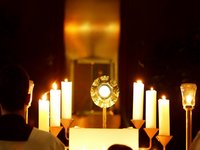
Jesus im Brotsakrament, über Ihm, der Überlieferung nach, ein Stück seines Kreuzes im Reliquiar.

3. It may be beneficial at the beginning of adoration to let your emotions run free for a few minutes through conversation with Jesus.

4. For the remainder of adoration you are going to place yourself in the presence of Jesus and simply let Him heal you. Thus, you will intentionally vacate your mind of the harmful memory and simply look lovingly in complete hope at Jesus. You are simply going to fix your mind and attention on Jesus, letting Him be present to you, sort of as if you were on the beach, forgetting yourself and everything else in the brilliant rays of the sun. You are simply going to let the healing rays of Jesus’ love fall gently upon you. At the end of adoration it would be appropriate to make a prayer of thanksgiving to Jesus for the graces received. 

5. Gradually, over time, as Eucharistic adoration becomes part of your life, Jesus will heal the harmful memory.

       “I abandoned and forgot myself/ Laying my face on my Beloved”    (Saint John of the Cross)

Thomas L. Mulcahy, M.A.

P.S. Nothing in this theological note is meant to be a substitute for good and necessary medical and professional care.

References: I am relying especially on Chapter 7 of Dr. Susan Muto’s book, John of the Cross for Today: The Ascent (Ave Maria Press), which is recommended for further detail regarding this topic of the purification of memory. Saint John of the Cross discusses in detail purification of memory in Book Three, Chapters 1 to 15 of The Ascent of Mt. Carmel (AMC). Dr. Ralph Martin has a CD on  Purification of the Memory. Keep in mind that St. John of  the Cross is talking about a complete purification – a complete overhaul – of memory, whereas in this note I have just addressed the specific area of harmful memories resulting from traumatic experiences. On the theological virtue of hope, see the Catechism of the Catholic Church, nos. 1817 – 1821. The closer we get to God, the more we walk by faith, hope and love. “How good it is,” says Pope Francis in The Joy of the Gospel, “to stand before a crucifix, or on our knees before the Blessed Sacrament, and simply to be in his presence!”(#264).

To SHARE on SOCIAL MEDIA: click on “Leave a comment” or “Comments” below (and this will bring up social media icons if they are not already present).

To LEAVE A COMMENT: click on “Leave a comment” or “Comments” below, and then scroll down to the box which says, “Leave Your Own Comment Here,” which is at the end of any comments already made. If the comment section is already present, merely scroll to the end of any comments already made.


NOTES REGARDING THE DOCTRINE OF MARY’S PERPETUAL VIRGINITY

 Raphael_Madonna_dell_Granduca

1.  CHURCH DOCTRINE
That Mary remained a virgin her entire life is a De Fide (required of the
faithful) doctrine of the Catholic Church.  See Documents of Vatican II
(LG57), Catechism of the Catholic Church, 499, The Mother of the
Redeemer, 39 (Encyclical Letter of Pope John Paul Il, 1987), and Ludwig
Ott, Fundamentals of Catholic Dogma, pages 203-206.
 
2. VIRGINITY FOR THE SAKE OF THE KINGDOM
Celibacy for the sake of the Kingdom is a radical feature of Christianity, and finds its biblical mandate at Matthew 19:12. Jesus, in fact, “is described” and “sees his own self identity” as that of the “celibate bridegroom” (article by Janet Smith; see also John 3:29 and Matthew 9:15). Paul presents celibacy as a highly favored state of life for believers saying, “I wish that all were as myself am [celibate].  But each has his own special gift from God….” (1 Cor. 7:7). Paul confirms the goodness of marriage at 1 Cor. 7:38 saying, “He who marries does well,” but then adds that “he who refrains from marriage will do better.” Mary embraced both marriage and celibacy, thus exemplifying in a unique way the sublime dignity of both vocations.
 
3.  MARY, SPOUSE OF THE HOLY SPIRIT
Mary is properly to be considered the spouse of the Holy Spirit since the Holy Spirit “overshadowed” her and was the formal cause of her virginal conception of Jesus (Luke 1:35). This is why her offspring, Jesus, “will be called the Son of God” (Luke 1:35), and this is also why Mary is properly called the Mother of God according to the decree of The Council of Ephesus in 431. Mary’s unique and “supernatural maternity” through the power of the Holy Spirit necessarily precludes her from intimate union with a man. Mary is a virgin because of her “undivided gift of herself” to God (Catechism of the Catholic Church, 506).
 
4.  MARY’S VOW OF VIRGINITY
The relevant verse is Luke 1:34: “How shall this be, seeing I do not know man.” These words of Mary to the Angel Gabriel at the Annunciation show that Mary did not intend to have conjugal relations with a man; otherwise, Mary surely would have known that conjugal relations with Joseph, her husband, could cause a pregnancy. Catholic theologian Stefano Manelli explains Mary’s strange response to the angel this way:
 
“Confronted by this [the angel Gabriel’s] wondrous announcement, however, the virgin finds herself embarrassed; not because of the sublime greatness of the majesty announced to her, but rather for the way in which such a maternity might be realized. The embarrassment would seem inexplicable because, on any reasonable grounds, she is precisely a woman in ideal conditions to conceive a son. She is the young spouse of Joseph – What young spouse would not be inclined to desire a beautiful son? It is obvious, therefore, and must be acknowledged that Mary’s difficulty stems from a precise commitment — vow or promise — “not to know man,” that is, to be and remain a virgin.  St. Augustine rightly says, that ‘Mary certainly would not have spoken those words If she had not vowed her virginity to Got” In fact, only by admitting Mary’s virginal consecration to God, can it be understood why she found herself facing an unsolvable dilemma: How to reconcile her virginal offering to God with the request of maternity on the part of God? How could she become a mother without betraying a promise of virginal consecration to God.”
(Stefano Manelli, All Generations Shall Call Me Blessed, pages 137-140)
 
5. DID JESUS HAVE BROTHERS?

Robert Payesko comments:

“It is often alleged too that such verses as Mark 6:3, “His brethren James and Joseph, and Judas and Simon,” and Matthew 13:55- 56, “his brethren James and Joseph, and Simon and Judas,” are evidence that Jesus had brothers and sisters. What is forgotten is that the Jewish expression for brothers and sisters applies to cousins and even to people in the same tribe. Although Lot was the son of Jjraharn’s brother Aran, he is described as Abraham’s “brother” (Genesis 14:14). Similarly, Jacob is referred to as the “brother” of his uncle Laban (Genesis 29:15). Similar examples are found throughout Scripture.  In any case, in Matthew 27:56, Mark 14:40 and John 19:25, James and Joseph are described as the sons of Mary, the wife of Cleophas— thus Scripture tells us that the “brethren” James and Joseph in Matthew 13:55-56 and Mark 6:3 are not blood brothers of Jesus. If James, the bishop of Jerusalem, was truly a son of Mary it would be impossible for the doctrine of the perpetual virginity of Mary to be affirmed in the early Church Nevertheless, such ancient writers as IrenaeusPolycarp and Ignatius all taught the doctrine as an article of faith.”
(Robert Payesko. The Truth about Mary, page 2-198).

 Section 500 of the Catechism of the Catholic Church states:

“Against this doctrine the objection is sometimes raised that the Bible mentions brothers and sisters of Jesus. The Church has always understood these passages as not referring to other children of the Virgin Mary. In fact James and Joseph, “brothers of Jesus,” are the sons of another Mary, a disciple of Christ, whom St. Matthew significantly calls “the other Mary.” They are close relations of Jesus, according to an Old Testament expression.”
 
 
6. MATTHEW 1:25: “UNTIL SHE BORE A SON”
The relevant verse is sometimes translated, “he [Joseph] had no relations with her [Mary] until she bore a son, whom he named Jesus.” The New American Bible translates the verse as follows: “He had no relations with her at anytime before she bore a son, whom he named Jesus,” This verse demonstrates that Joseph did not have sexual relations with Mary before Jesus’ birth, thus establishing the doctrine of Jesus’ virginal birth, The verse does not mean that Joseph had sexual relations with Mary after Jesus was born.

Dr. Scott Hahn comments:

“The Greek hoes [until] does not imply that Joseph and Mary had marital relations following Jesus’ birth. This conjunction is often used (translated ‘”to” or “till”) to indicate a select period of time, without implying change in the future (2 Sam 6:23 [LXX]; Jn 9:18; 1 Tim 413). Hers Matthew emphasizes only that Joseph had no involvement in Mary’s pregnancy before Jesus’ birth.”
(Scott HahnIgnatius Catholic Study Bible, Gospel of Matthew, page 18).
 

J. Laurericeau explains:

The semitic locution “until” makes no judgment about the future.
Thus, “Michal was childless until the clay of her death” (2 Sm 6:23)
[does not’t imply Michal became a mother after her death.]”
(Dictionary of Mary, page 485)
 
7. MARY EXCLUSIVELY REFERRED TO IN BIBLE AS JESUS’ MOTHER
Mary is never called the mother of anyone else except Jesus in the New Testament. The Gospels refer only to Jesus as Mary’s son (the verses where Jesus is referred to as Mary’s son include John 2:1, John 19:25, and Acts 1:14). Further, as Dr. Scott Hahn points out, it is unlikely that Jesus would have entrusted Mary to the Apostle John’s care at his crucifixion if Mary had other natural sons to care for her (John 19:26-27).
 
8. LUKE 2:7 “FIRSTBORN SON”

J. Laurencaau explains:

Luke says: “Mary gave birth to her firstborn son” (2:7). This makes allusion to the legal prescriptions concerning the first male child of a family, even if there were no other children.
(Dictionary of Mary, page 485)

 Dr. Scott Hahn comments:

[Luke 2:7 is] a legal term linked with a son’s social standing and rights of inheritance.  It does not imply that Mary had other children after Jesus, only that she had none before him.
(Scott HahnIgnatius Catholic Study Bible, Gospel of Luke, page 22)
 
9. THE CHURCH FATHERS
The Protoevangelium of James, written around A.D. 120, had as one of its principal aims to prove the perpetual virginity of Mary.  Origin (died 254) strongly defended Mary’s perpetual virginity but Tertullian (died 230), who was excommunicated, denied it.  Other early Church fathers affirming Mary’s perpetual virginity include Athanasius, Epiphanius, Jerome, Ambrose, Augustine and Cyril of Alexandria.  Reference: Mary: Ever Virgin (This Rock: February, 2002) and Ludwig Ott, Fundamentals of Catholic Dogma, pages 203-206.
 
10. EARLY DOCTRINAL DEVELOPMENT
Mary referred to as “perpetual virgin” by the Fifth General Council at Constantinople in 553.  The first doctrinal formulation of this belief takes place at the Lateran Synod of 649 under Pope Martin I where Mary is called “blessed ever-virginal and Immaculate Mary.”  Reference: Ludwig Ott, Fundamentals of Catholic Dogma, pages 203-206.

Tom Mulcahy, M.A.

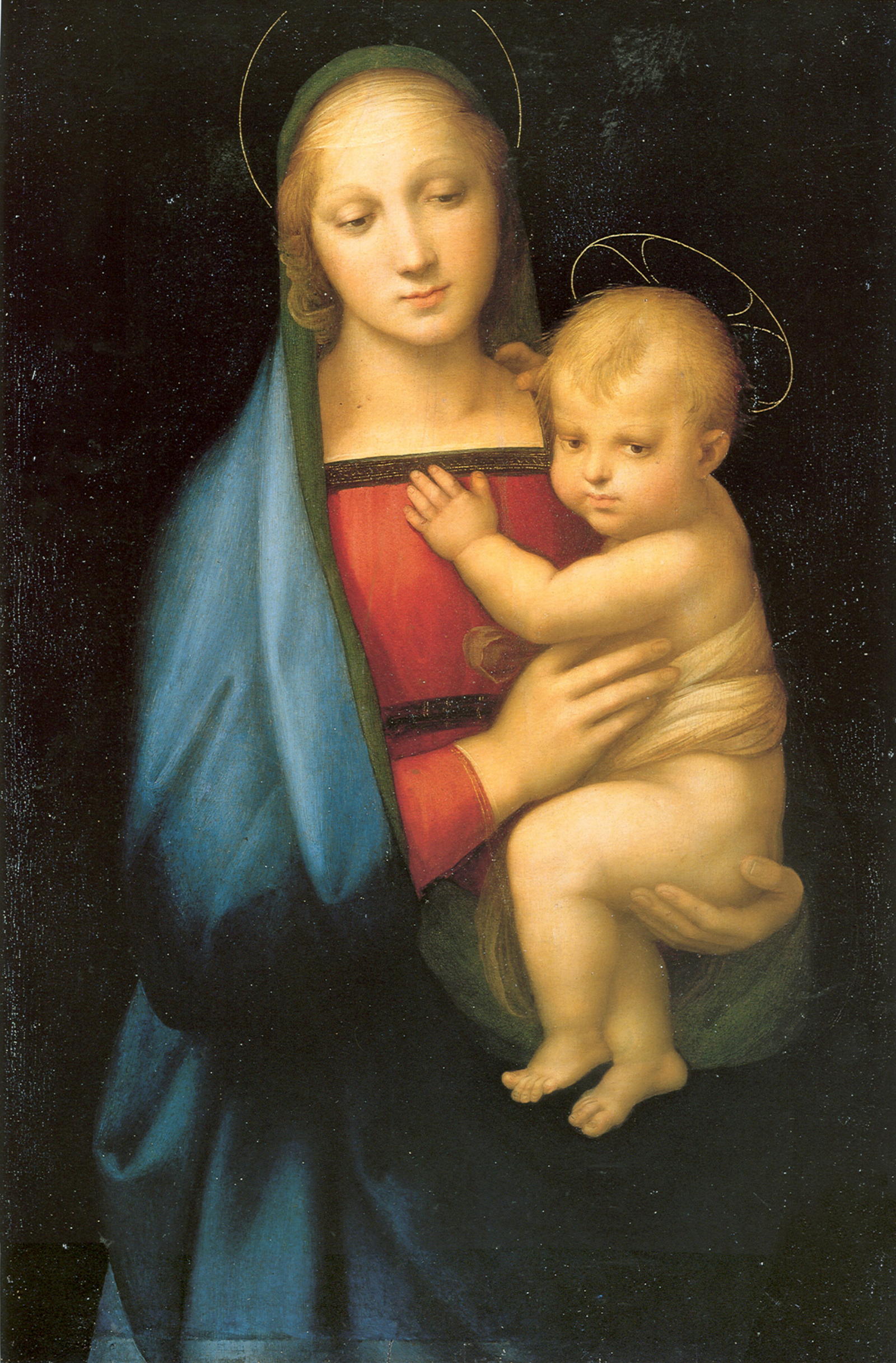
Image: Raphael, Granduca Madonna, 1505, Public Domain, U.S.A. (per Wikipedia).
All Rights Reserved.