Author: tomlirish

HARNESSING THE POWER OF JOHN 3:16 BY WAY OF A PERSONAL MEDITATION

(Jesus talking to Nicodemus in John, Chapter 3)

“For God so loved the world that he gave his his only-begotten Son,  that whoever believes in him should not perish but have eternal life.” (John 3:16)

“Here is gospel, good news indeed. Here is God’s love in giving his Son for the world. God so loved the world; so really, so richly. Behold and wonder, that the great God should love [us so much].” (Matthew Henry Bible Commentary on John 3:16)

Since John 3:16 is often considered the most powerful verse in the Bible, it only makes sense – at least once in our lives – to make it the subject of a profound and personal meditation. The purpose of this note, in fact, is to urge you to do so – to make time in your life for a John 3:16 meditation. Let the Holy Spirit convince you to make this meditation, and to enrich you by it (perhaps in a most incredible way).

Here is a format I propose for such a meditation.

1. Materials.  All you need to have with you is the verse itself (John 3:16) on a sheet of paper – nothing more. You are focusing only on this verse.

2. Location.  It is absolutely crucial you go somewhere special and quiet – ideally some place out in nature that places you in the majestic presence of God. Keep in mind that silence is a critical part of this meditation (interruptions need to be avoided). Even being alone in your parked car or room, especially when no one else is around, will work.

3. Body of Meditation (after having placed yourself in the presence of God, and having asked the Holy Spirit to make the meditation profitable to you).   A. Read John 3:16 slowly and silently as many times as you may want, letting the message and meaning of the verse enter into your heart. Go as slowly as you want.  B. Acknowledge in the depths of your heart God’s amazing love for you by sending his Son to save you.  C. Silently in your heart make any other considerations about this powerful verse that come to mind.  D. Wait silently upon the Holy Spirit to give you additional supernatural insight – grace filled insight – about this all-important verse in God’s word, and then spend time in silent, personal conversation with Jesus, sharing your heart with him and letting Him share his heart with you (receptive listening flows from being silently recollected in God’s presence).

4. Praise.  Acknowledge and adore Jesus as your Lord and Redeemer. It is permissible in meditation to use your imagination to visualize Jesus on the cross dying for the sins of the world, and to give him praise for loving you that much.

5. Thanksgiving.  Profoundly thank the Eternal Father for having sent his Son to save you.

6. Conclusion.  Resolve to make Jesus (even more) the center of your life in all that you do.

Scripture has an immense power, as the great spiritual writer F.W. Faber relates, to sanctify our souls and draw us closer to God.  John 3:16 is destined to do “a good work in your soul.”

Praise God!

Thomas L. Mulcahy

Image: Jesus and Nicodemus by William Brassey Hole (1846-1917). Public Domain, U.S.A. (at Wikipedia).

Reference: 3B above is verbatim from the commentary of The Ignatius Catholic Bible. Father Faber uses the expression, will “do a good work in your soul.” See also the following post which emphasizes that meditation provides a platform, or starting point, for deep and intimate conversation with God:

HOW TO MEDITATE AND DRAW CLOSER TO GOD | Catholic Strength

All rights reserved.

To SHARE on SOCIAL MEDIA: click on “Leave a comment” or “Comments” below (and this will bring up social media icons if they are not already present).

To LEAVE A COMMENT: click on “Leave a comment” or “Comments” below, and then scroll down to the box which says, “Leave Your Own Comment Here,” which is at the end of any comments already made. If the comment section is already present, merely scroll to the end of any comments already made.

Any ads following this note are by WordPress and not CatholicStrength.


NO ONE IS EVER DESERTED BY GOD IN THIS MORTAL LIFE


“[God] who desires all people to be saved and to come to the knowledge of the truth.” (1 Timothy 2:4)

“The Lord is not slow in keeping his promise, as some understand slowness. Instead he is patient with you, not wanting anyone to perish, but everyone to come to repentance.” (2 Peter 3:9)

God is just. Infinitely just. He is neither arbitrary or capricious. No one is lost by surprise. Everyone, at the end of life’s journey, will be able to tally up a gargantuan amount of graces sent by the Father of Mercy to save us. A bitter victory it will thus be, as F.W. Faber points out, if we manage to succeed in rejecting these graces.

How much grace God sends to someone estranged from Him is not subject to precise theological formulation.The starting point is the Infinite Goodness of God who is generous to every soul. The great Saint Alphonsus de Ligouri  quotes with complete approval Soto who said:

“I am absolutely certain, and I believe that all the Holy Doctors who were worthy of the name were always most positive, that no one was ever deserted by God is this mortal life”  (The Great Means of Salvation and of Perfection, p.149).

A more recent theologian, Father Garrigou-LaGrange says: Christ’s humanity communicates to us from minute to minute the actual grace of the present moment, as the air we breathe continually enters our lungs. *** Outside the sacraments, this activity of the Savior transmits the lights of faith to unbelievers who do not resist it.” 

Finally, Father Faber states: “Figures could not put down the number of graces  [God] has given and is hourly giving to us” (p. 142); Faber states that even a man in mortal sin, through faith and hope, receives “incessant crowds of…actual graces” (p. 250). At page 313 Faber states that “God is infinitely merciful to every soul,” and “no one ever has been lost…by surprise….”  ( The Creator and the Creature, TAN).

Tom Mulcahy, M.A.

Image: Divine Mercy Image. From Wikipedia: “Original painting of the Divine Mercy (by Eugeniusz Kazimirowski in 1934). This is the only painting which was done under the indications of Sister Faustina when she was still alive, unlike the painting by Adolf Hyła which was done in 1943 after Saint Faustina’s death in 1938 but still the most known.” AUTHOR: By HistoryisResearch, April 4, 2016. This file is licensed under the Creative Commons Attribution-Share Alike 4.0 International license.


P.S. The quote from Father Garrigou-LaGrange is from The Three Ages of the Interior Life. In his encyclical, Redemptoris Missio, Saint John Paul II says the following:

Salvation in Christ Is Offered to All 10. “The universality of salvation means that it is granted not only to those who explicitly believe in Christ and have entered the Church. Since salvation is offered to all, it must be made concretely available to all. But it is clear that today, as in the past, many people do not have an opportunity to come to know or accept the gospel revelation or to enter the Church. The social and cultural conditions in which they live do not permit this, and frequently they have been brought up in other religious traditions. For such people salvation in Christ is accessible by virtue of a grace which, while having a mysterious relationship to the Church, does not make them formally part of the Church but enlightens them in a way which is accommodated to their spiritual and material situation. This grace comes from Christ; it is the result of his Sacrifice and is communicated by the Holy Spirit. It enables each person to attain salvation through his or her free cooperation.”

All rights reserved.

To SHARE on SOCIAL MEDIA: click on “Leave a comment” or “Comments” below (and this will bring up social media icons if they are not already present).

To LEAVE A COMMENT: click on “Leave a comment” or “Comments” below, and then scroll down to the box which says, “Leave Your Own Comment Here,” which is at the end of any comments already made. If the comment section is already present, merely scroll to the end of any comments already made.

Any ads following this note are by WordPress and not CatholicStrength.

A TRUE AND AMAZING MIRACLE TOOK PLACE ON SAINT PATRICK’S DAY!


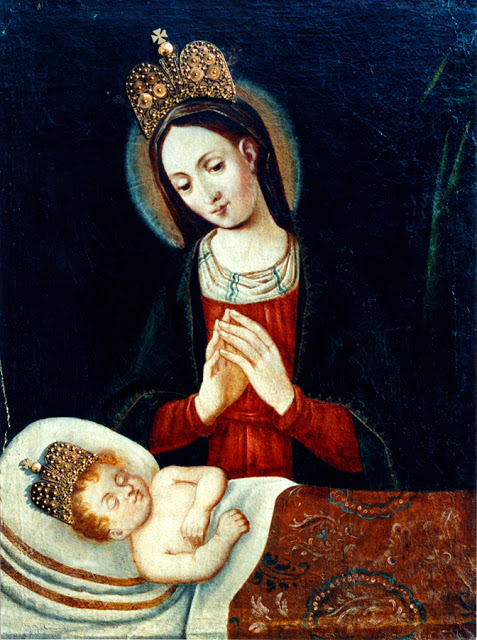
The beautiful picture you are looking at is known as “The Irish Madonna of Hungary.” The portrait itself is from Ireland, but it was brought to Hungary by an Irish priest, Bishop Lynch, who was fleeing English persecution in Ireland around the year 1652. Bishop Lynch worked for ten years among the faithful in Hungary, and just before he was about to return to Ireland he fell ill and died, bequeathing  on his deathbed the portrait in question to the Bishop of Gyor in Hungary who hung the painting in the Cathedral of Gyor. The awesome miracle I am about to discuss involves this picture.

The miracle in question did in fact occur on March 17, 1697 (St. Patrick’s Day) while “thousands were attending Holy Mass in the Cathedral of Gyor” (the year 1697 is highly relevant because in 1697 all priests were expelled from Ireland).

Suddenly “the eyes of the Madonna [in the picture above] began to shed tears and blood which ran down the canvas to the image of the sleeping Jesus. The Irish Madonna was weeping for her suffering children [in Ireland]. The people who had been attending [Mass], as well as those summoned to witness the miracle, took turns in gathering around the portrait while the priests repeatedly wiped the face of the Madonna with a linen cloth that is still preserved in the Cathedral. The miracle continued for more than three hours.”

Every lawyer knows the value of credible witnesses! Here then we see that this miracle was witnessed by a whole contingent of extremely credible witnesses. Joann Carroll Cruz relates the following: “Before long not only Catholics, but also Protestants and Jews flocked to see the miracle. Thousands witnessed the event, and many of these gave testimony of what they saw. A document signed by a hundred people bears the signatures of the governor of the city, its mayor, all its councilmen, the bishop, priests, Calvinist and Lutheran ministers as well as a Jewish rabbi. All volunteered their signatures to the document stating they had witnessed an undeniable miracle.”

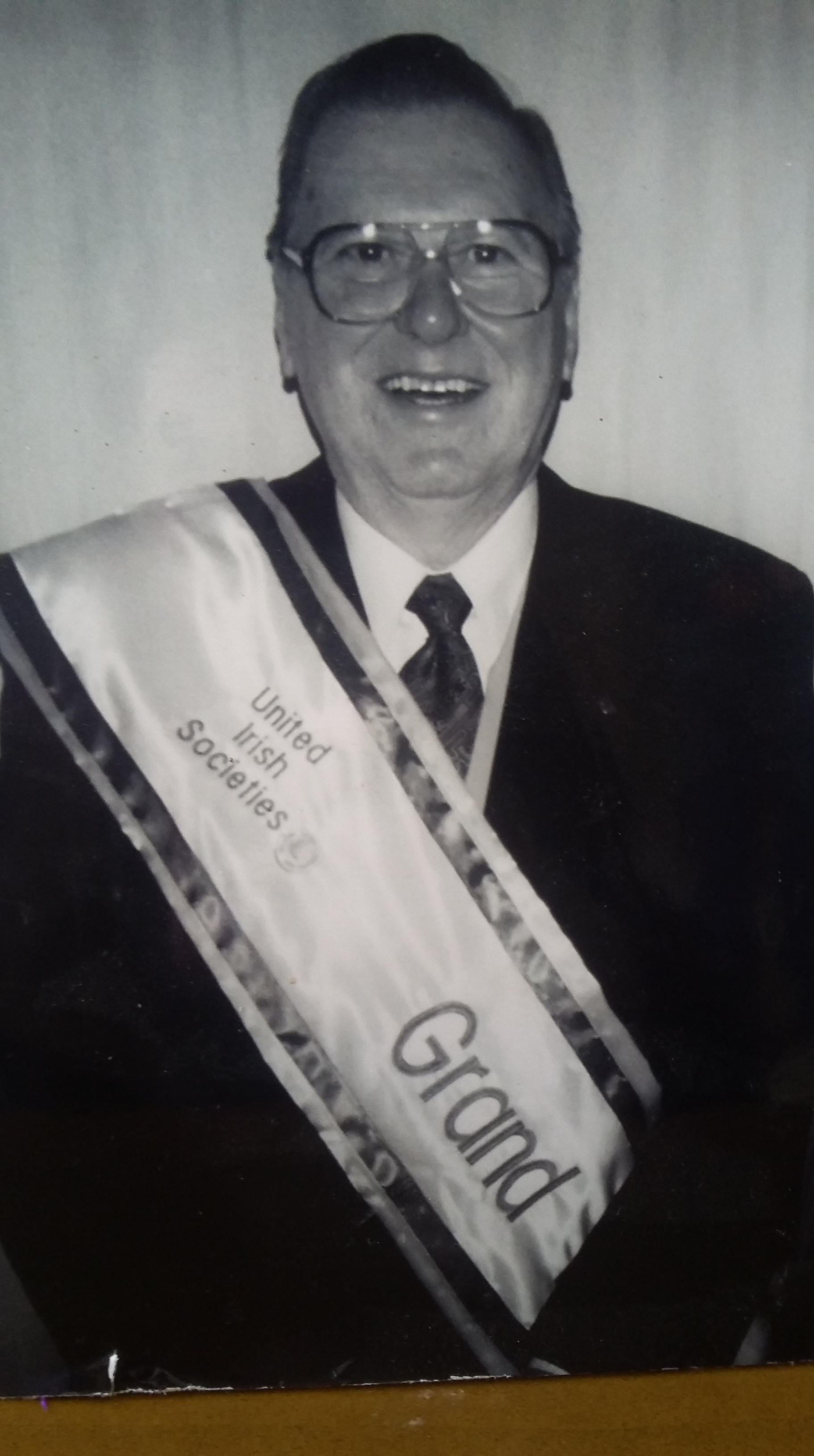
I would like to dedicate this post to the memory of Thomas Joseph Mulcahy, my Father, who was the Grand Marshall for the 2003 Saint Patrick’s Day Parade in Detroit (see photo below). Thanks Dad for your profound devotion to Irish culture and the Catholic faith. Our Lady of the Irish Madonna of Hungary, pray for Tom.

20160307_101656

Saint Patrick, Patron of Ireland, pray for us!

Thomas L. Mulcahy


Reference: For this note I am relying on pages 130-132 of Joan Carroll Cruz’s book, Miraculous Images of Our Lady (TAN), as edited. A short history of some of my Dad’s contributions to the Irish-American heritage are recorded in the book, Modern Journeys: The Irish in Detroit, published by the United Irish Societies.

All rights reserved.

To SHARE on SOCIAL MEDIA: click on “Leave a comment” or “Comments” below (and this will bring up social media icons if they are not already present).

To LEAVE A COMMENT: click on “Leave a comment” or “Comments” below, and then scroll down to the box which says, “Leave Your Own Comment Here,” which is at the end of any comments already made. If the comment section is already present, merely scroll to the end of any comments already made.

Any ads following this note are by WordPress and not CatholicStrength.

A SIMPLE, EFFECTIVE METHOD OF NIGHTLY EXAMINATION OF CONSCIENCE UTILIZING THE 1 CORINTHIANS 13 MEDITATION ON LOVE

“To have a gathering heart, a heart in which we know what happens, and here and there you can perform a practice as old as the Church, but good: the examination of conscience. Who of us, at night, at the end of the day, remains by himself, by herself, and asks the question: what happened today in my heart? What happened? What things have passed through my heart? If we don’t do this, we have truly failed to know how to watch and guard [our hearts] well.”  (Homily of Pope Francis)

Even though all the great spiritual writers speak of the vital importance importance of making a nightly examination of conscience, I sense from my own experience that this is one of the easiest spiritual practices to omit. Here is a method of examination of conscience I am proposing that you may find useful and even attractive since it simply utilizes 1 Corinthians 13 – a meditation on the virtue of charity –  as the blueprint for your nightly examination of conscience. And at the end of our lives, as Saint John of the Cross tells us, we will be judged by whether we loved.

1 Corinthians 13 is also attractive for a nightly examination of conscience because Scripture is attractive. Utilizing scripture for growth in holiness immerses us in the POWER of God’s own word, and without our even realizing it increases our love for God. And what could be more important to us than that!

METHOD OF NIGHTLY EXAMINATION OF CONSCIENCE USING THE 1 CORINTHIANS 13 MEDITATION ON LOVE

Preliminarily: Ask the Blessed Virgin Mary to make the examination profitable for you. Then place yourself  in the presence of God. Now, reflect on the following considerations about love applying them very specifically to your life for the day in question you have just finished living:

From 1 Cor. 13: 4-7, 13

 1.   Love is patient. 
Was I patient today? Did I commit any acts of  impatience?
2.   Love is kind. 
Was I kind to every person I met today? Did I fail in kindness?
3.   Love does not envy.
Did I envy something that somebody else has and I don’t? 
4.   Love does not boast.   
(The questions to ask yourself are thus self-evident).
5.   Love is not proud.
6.   Love does not dishonor others.
7.   Love is not self-seeking
8.   Love is not easily angered.
9.   Love does not keep a record of wrongs.
10. Love does not delight in evil but rejoices in the truth.
11. Love protects, always trusts, always hopes, always perseveres.
12. Love never fails.
13. And now these three remain: faith in God, hope in God and love of God and neighbor. But the greatest of these is love.


You probably keep a Bible by your bed, so you can simply open it up to 1 Corinthians 13 when you retire at night and read and reflect through it for your nightly examination of conscience. Notice how St. Paul tells us that “love does not delight in evil but rejoices in the truth”; it is important for us to examine whether the culture is in any way leading us away from the truth. Naturally, end your examination of conscience with a firm purpose of amendment and with a prayer of thanksgiving for the graces received from the examination.

Tom Mulcahy, M.A.

Note: Justin Fatica mentioned using 1 Corinthians 13 for an examination of conscience while I was at Catholic Familyland. For two profound discussions on the power of kindness, see Father  Faber’s famous essay on kindness in Spiritual Conferences, and Father Lovasik’s book, The Hidden Power of Kindness. “Love is kind.” Kindness is a powerful virtue.  “In the evening of life, we shall be judged on our love” (St. John of the Cross; see CCC 1022).

To SHARE on SOCIAL MEDIA: click on “Leave a comment” or “Comments” below (and this will bring up social media icons if they are not already present).

To LEAVE A COMMENT: click on “Leave a comment” or “Comments” below, and then scroll down to the box which says, “Leave Your Own Comment Here,” which is at the end of any comments already made. If the comment section is already present, merely scroll to the end of any comments already made.

All rights reserved.

Any ads following this note are by WordPress and not CatholicStrength.



THE HUGE “MITIGATING CIRCUMSTANCES” MISTAKE IN AMORIS LAETITIA

                     “I am the way and the truth and the life.” (John 14:6)

In Amoris Laetitia (no. 302), Section 2352 of the Catechism of the Catholic Church is cited in support of of the mitigating circumstance doctrine developed by Pope Francis in order to justify reception of the Holy Eucharist for Catholics who have been divorced and civilly remarried. Section 2352 of the Catechism of the Catholic Church, which pertains to the sin of masturbation, reads as follows:

“By masturbation is to be understood the deliberate stimulation of the genital organs in order to derive sexual pleasure. “Both the Magisterium of the Church, in the course of a constant tradition, and the moral sense of the faithful have been in no doubt and have firmly maintained that masturbation is an intrinsically and gravely disordered action.”138 “The deliberate use of the sexual faculty, for whatever reason, outside of marriage is essentially contrary to its purpose.” For here sexual pleasure is sought outside of “the sexual relationship which is demanded by the moral order and in which the total meaning of mutual self-giving and human procreation in the context of true love is achieved.”139

To form an equitable judgment about the subjects’ moral responsibility and to guide pastoral action, one must take into account the affective immaturity, force of acquired habit, conditions of anxiety or other psychological or social factors that lessen, if not even reduce to a minimum, moral culpability (Catechism of the Catholic Church, no. 2352). “

The Pope’s reliance on CCC 2352 is clearly misplaced. If we were to use the mitigating circumstances doctrine to allow people to stay in sin, rather than to overcome it, then we have completely misused the doctrine and have even shown a lack of confidence in God’s grace to assist the sinner. The hypothetical person in CCC 2352 acknowledges that masturbation is a sin, and that he wishes to break with that sin, but laments that the force of acquired habit has made overcoming the sin difficult (for which due allowance for mitigating circumstances is allowed). He therefore continues to seek God’s grace and mercy in order to deliver himself from this sin and to live chastely. Quite to the contrary, the divorced and remarried person in the Pope’s example does not wish to change his situation; he wishes to be granted the privilege of remaining in his objectively immoral situation and to receive the sacrament of the Eucharist in a manner which profoundly contradicts the teaching of Jesus regarding the indissolubility of marriage.

In the encyclical, The Splendor of Truth, Saint Pope John Paul II warned about the inherent danger of making one’s own weakness the criterion of truth and the tremendous confusion this type of “mercy” would cause in the church. He said:

“In this context, appropriate allowance is made both for God’s mercy towards the sinner who converts and for the understanding of human weakness. Such understanding never means compromising and falsifying the standard of good and evil in order to adapt it to particular circumstances” (no. 104).

“If acts are intrinsically evil, a good intention or particular circumstances can diminish their evil, but they cannot remove it. They remain ‘irremediably’ evil acts; per se and in themselves they are not capable of being ordered to God and to the good of the person. ‘As for acts which are themselves sins (cum iam opera ipsa peccata sunt), Saint Augustine writes, like theft, fornication, blasphemy, who would dare affirm that, by doing them for good motives (causis bonis), they would no longer be sins, or, what is even more absurd, that they would be sins that are justified? Consequently, circumstances or intentions can never transform an act intrinsically evil by virtue of its object into an act ‘subjectively’ good or defensible as a choice’ (no. 81).”

In the Apostolic Exhortation Familiaris Consortio ( no. 84) Pope John Paul II wrote that divorced and civilly remarried Catholics positively could not receive Holy Communion, for two very profound reasons:

“However, the church reaffirms her practice, which is based upon sacred scripture, of not admitting to eucharistic communion divorced persons who have remarried. They are unable to be admitted thereto from the fact that their state and condition of life objectively contradict that union of love between Christ and the church which is signified and effected by the eucharist. Besides this there is another special pastoral reason: If these people were admitted to the eucharist the faithful would be led into error and confusion regarding the church’s teaching about the indissolubility of marriage.”

Finally, in his Apostolic Exhortation, Reconciliation and Penance (a document highly relevant to the proper reception of Holy Communion), Pope John Paul II warned the Church against trying to create a theological category out of psychological considerations and mitigating circumstances, stating:

“But from a consideration of the psychological sphere one cannot proceed to the construction of a theological category, which is what the ‘fundamental option’ precisely is, understanding it in such a way that it objectively changes or casts doubt upon the traditional concept of mortal sin.

While every sincere and prudent attempt to clarify the psychological and theological mystery of sin is to be valued, the Church nevertheless has a duty to remind all scholars in this field of the need to be faithful to the word of God that teaches us also about sin. She likewise has to remind them of the risk of contributing to a further weakening of the sense of sin in the modern world (no.17).”

The mitigating circumstances doctrine cannot be used to justify keeping a person in his sinful condition (see CCC 1754 referenced below, which clearly confirms this). Pope John Paul II clearly warned us about trying to justify such an untenable position.

Thomas L. Mulcahy, M.A., J.D.

Reference: See also: CATECHISM OF THE CATHOLIC CHURCH, NO. 1754, which states:
“The circumstances, including the consequences, are secondary elements of a moral act. They contribute to increasing or diminishing the moral goodness or evil of human acts (for example, the amount of a theft). They can also diminish or increase the agent’s responsibility (such as acting out of a fear of death). Circumstances of themselves cannot change the moral quality of acts themselves; they can make neither good nor right an action that is in itself evil.”

To SHARE on SOCIAL MEDIA: click on “Leave a comment” or “Comments” below (and this will bring up social media icons if they are not already present).

To LEAVE A COMMENT: click on “Leave a comment” or “Comments” below, and then scroll down to the box which says, “Leave Your Own Comment Here,” which is at the end of any comments already made. If the comment section is already present, merely scroll to the end of any comments already made.

All rights reserved.

Any ads following this note are by WordPress and not CatholicStrength.

A BARE-BONES OUTLINE OF PROPHETIC EVENTS THAT COULD BE UNFOLDING AT THE PRESENT TIME

“And I say to thee: That thou art Peter; and upon this rock I will build my church, and the gates of hell shall not prevail against it.” (Matthew 16:18)

“Since the Ascension God’s plan has entered into its fulfillment. We are already at ‘the last hour’. ‘Already the final age of the world is with us, and the renewal of the world is irrevocably under way; it is even now anticipated in a certain real way, for the Church on earth is endowed already with a sanctity that is real but imperfect.’ Christ’s kingdom already manifests its presence through the miraculous signs that attend its proclamation by the Church” (Catechism of the Catholic Church, no. 670)

This is a speculative note. The author claims no special prophetic charism or expertise, and the outline presented here simply proceeds from his analysis of certain materials (in addition to the Bible) referenced in the note, along with the present circumstances that challenge the Church and the world. As the quote above from the Catechism states, “we are already at the last hour.”

A POSSIBLE OUTLINE OF PROPHETIC EVENTS WE MIGHT BE ENCOUNTERING PRESENTLY OR VERY SOON

1.Our key prophecy will be the first two secrets of Fatima, and we will see that the chastisement and period of peace made known in the Fatima prophecy coincide with the broad spectrum of Catholic prophecy at large.

2. We will also place weight on the following prophetic statement of Saint Pope John Paul II, which was made during a visit to the United States in 1976 when he was still a Cardinal, and reads:

“We are now standing in the face of the greatest historical confrontation humanity has gone through. I do not think that wide circles of American society or wide circles of the Christian community realize this fully. We are now facing the final confrontation between the Church and the anti-Church, of the Gospel versus the anti-Gospel.

“We must be prepared to undergo great trials in the not-too-distant future; trials that will require us to be ready to give up even our lives, and a total gift of self to Christ and for Christ. Through your prayers and mine, it is possible to alleviate this tribulation, but it is no longer possible to avert it. . . .How many times has the renewal of the Church been brought about in blood! It will not be different this time.” 

3. We will also note that Saint Louis de Montfort stated that the Virgin Mary (and specifically those consecrated to Mary) would play a special role in bringing forth the fulfillment of Jesus’ Kingdom in history (noting as well that scholars disagree on exactly how the Saint says this will take place). See Handbook of the Spirituality of St. Louis de Montfort, pages 345-365 on “End Times.” Another great and more recent Marian Saint, Maximilian Kolbe,  said the following:

“Modern times are dominated by Satan and will be more so in the future. The conflict with hell cannot be engaged by men, even the most clever. The lmmaculata alone has from God the promise of victory over Satan. However, assumed into heaven, the Mother of God now requires our cooperation. She seeks souls who will consecrate themselves entirely to her, who will become in her hands effective instruments for the defeat of Satan and the spreading of God’s kingdom upon earth.” (from EWTN website)

4. In his book, Catholic Prophecy: The Coming Chastisement Yves Dupont offers the following conclusion:

“I regard it as certain that there will be two different stages. The first stage will only be the beginning of sorrows [see Matt. 24:8], and it will be shortened for the sake of the elect, and the Gospel will then be preached throughout the world. This will be the period of peace under the Great Monarch, the period of conversion and general prosperity which we and our children may enjoy – in short, the period of peace promised by Our Lady of Fatima” (p.91).

5. Another great scholar of Catholic prophecy, Father Edward Conner, in his book Prophecy for Today, sees the general sequence of prophetic events unfolding in this manner:

A. “Before the Gospel is preached and accepted in all the world, there shall come world wars and insidious doctrines accompanied by widespread persecution.

B. This era shall be terminated by the the direct interference of God destroying the evil systems or persons responsible for the persecutions; and through the leadership of a great civil ruler and a great spiritual leader, a period of peace will come during which nations will hear and accept the true Faith [this period of peace coincides with the Fatima prophecy of a period of peace].”

C. A great apostasy will follow [and Antichrist will come, leading to the Second Coming of Jesus Christ and the end of the world as set forth in Holy Scripture].”

6. A seminal and very long book on Catholic prophecy published in 1996, Trial, Tribulation and Triumph, by Desmond A. Birch, generally agrees that there will be a minor chastisement (meaning not the final chastisement at the end of the world), a period of peace, a major chastisement (Antichrist), and then the Second Coming of Jesus Christ. As to the minor chastisement, which will be followed by a period of peace, these are the first three elements in his long chronology of how it will come about:(1) “At some point in the future, the corrupt faithless age we live in now will come to an end either through inner conversion of sufficient number of people who turn to prayer, sacrifice, and penance,—or there will be a chastisement. This would be a Minor Chastisement preceding the Age of Peace. St Louis de Montfort described this Age of Peace as the Age of Mary. (2) If this chastisement is not averted through conversion, the Latin Church will be afflicted by heresy and schism. (3) The chastising elements will come in two forms, (a) manmade and (b)Heaven-sent” (page 553). Following his description of this minor chastisement, Birch goes on to describe the period of peace which will result, and then the rise of Antichrist and the end of the world.

7. A key insight of Birch is that the minor chastisement prophesied at Fatima (if not averted by prayer and penance) will come by way of heresy and schism entering the Church.

8. The second secret of Fatima, given to the seers on July 13, 1917, coincides with the general prophetic understanding of a chastisement and then a coming period of peace. It states (as verbatim from the Vatican website) the following:

“You have seen hell [the children’s vision of hell is the first secret] where the souls of poor sinners go. To save them, God wishes to establish in the world devotion to my Immaculate Heart. If what I say to you is done, many souls will be saved and there will be peace. The war is going to end: but if people do not cease offending God, a worse one will break out during the Pontificate of Pius XI. When you see a night illumined by an unknown light, know that this is the great sign given you by God that he is about to punish the world for its crimes, by means of war, famine, and persecutions of the Church and of the Holy Father. To prevent this, I shall come to ask for the consecration of Russia to my Immaculate Heart, and the Communion of reparation on the First Saturdays. If my requests are heeded, Russia will be converted, and there will be peace; if not, she will spread her errors throughout the world, causing wars and persecutions of the Church. The good will be martyred; the Holy Father will have much to suffer; various nations will be annihilated. In the end, my Immaculate Heart will triumph. The Holy Father will consecrate Russia to me, and she shall be converted, and a period of peace will be granted to the world.”

9. Saint John Paul II was known as the “Fatima Pope,” devoting himself profoundly to the Fatima message following his having been shot and almost killed in St. Peter’s Square on May 13, 1981 (the anniversary of the first apparition of Mary at Fatima). Sister Lucia, the Fatima seer, confirmed that Pope John Paul II’s 1984 consecration of Russia to the Immaculate Heart of Mary had been “accepted by Heaven” (see Fatima for Today, p.260). On May 13, 1982, Pope John Paul II spoke the following words during a homily given in Fatima, Portugal:

“In the light of a mother’s love we understand the whole message of the Lady of Fátima. The greatest obstacle to man’s journey towards God is sin, perseverance in sin, and, finally, denial of God. The deliberate blotting out of God from the world of human thought. The detachment from him of the whole of man’s earthly activity. The rejection of God by man…. [He] reads it again with trepidation in his heart, because he sees how many people and societies—how many Christians—have gone in the opposite direction to the one indicated in the message of Fátima. Sin has thus made itself firmly at home in the world, and denial of God has become widespread in the ideologies, ideas and plans of human beings.”

10. Pope Benedict XVI suddenly resigned as Pope on February 28, 2013, the first Pope to resign since Pope Gregory XII in 1415.

11. On  March 13, 2013  Jorge Mario Bergoglio was elected Pope, becoming the 266th Pope, and the first Jesuit Pope. He took the papal name Francis. Apparently with the help of certain Cardinals, Pope Francis then embarked on an intense campaign to essentially change Catholic doctrine regarding the absolute impermissibility of  divorced and civilly remarried Catholics to receive the Holy Eucharist, a move which, in the opinion of some high-ranking clergy, could ultimately open up reception of the Holy Eucharist to people in other types of “irregular unions” (all of which would serve to ultimately undermine Catholic teaching regarding mortal sin because reception of the Eucharist is the summit of the Catholic life). When Pope Francis failed to obtain consensus at the Synod on the Family for the change he so earnestly desired, he nevertheless pushed his communion exception through in his Apostolic Exhortation, Amoris Laetitia, cleverly placing the key language for such an exception in the back of the document in the now infamous footnote 351. Although there has been a de facto schism in the Catholic Church for quite some time, Pope Francis’ bold move marked the first time a challenge to authentic Catholic teaching was undertaken at the highest level of the Church. There is now a great battle going on in the Church over Amoris Laetitia, and Pope Francis seems intent on bringing a new type of Catholic morality into existence, slowly, so as not to upset the faithful all at once (in general, this new morality –  in its fullest development – would grant those in “irregular” situations access to the Eucharist, which is an interpretation which has been proposed by some, and even Pope Francis mentioned that cohabiting couples may be in a “real marriage”). This is my sense, after careful evaluation, of where Amoris Laetitia is taking the Church; I am open to being shown where I may be wrong. My concern here is to protect the integrity of doctrine as passed on to the Church from Jesus and the apostles.

12. Based on the foregoing (relying on Desmond Birch’s insight) the conditional chastisement warned of by the Virgin Mary at Fatima is closely connected to the “the Latin Church [being] afflicted by heresy and schism.” We may have reached a pivotal point regarding the Fatima prophecy of a chastisement; it may be that such a chastisement is needed for the purification of the Church and the protection of the papacy, considering as well the great moral upheaval presently taking place in the world. Pope Benedict XVI once said, “We would be mistaken to think that Fatima’s prophetic mission is complete.”

13. It is not my job to suggest whether a particular teaching constitutes material or formal heresy. Rather, I feel called to point out that Amoris Laetitia is profoundly at odds with Saint John Paul II’s great encyclical on moral theology, Veritatis Splendor, and that the ultimate trajectory of Amoris Laetitia would lead to a dramatic reformulation of Catholic morality, allowing those in so-called “irregular unions” access to the fullness of the faith which the Eucharist is (thus essentially creating an end-run around the infallible doctrine of the Church that those in mortal sin are prohibited from receiving the Eucharist). In the end, then, the whole system of Catholic morality would be rendered optional.

14. “In the end my Immaculate Heart will triumph.” Pray the Rosary every day as Mary entreated us at Fatima. Pray for the Church.

Thomas L. Mulcahy, M.A.

P.S. To further understand the enormous implications to Catholic morality occasioned by Amoris Laetitia, please refer to my previous posts set forth below:

THE DARK CLOUDS OF EUCHARISTIC AMBIGUITY

THREE QUOTES FROM SAINT JOHN PAUL II THAT SHOULD HAVE PREVENTED THE AMORIS LAETITIA TRAIN WRECK

AMORIS LAETITIA, ST. THOMAS AQUINAS AND THE PROPER RECEPTION OF HOLY COMMUNION

To SHARE on SOCIAL MEDIA: click on “Leave a comment” or “Comments” below (and this will bring up social media icons if they are not already present).

To LEAVE A COMMENT: click on “Leave a comment” or “Comments” below, and then scroll down to the box which says, “Leave Your Own Comment Here,” which is at the end of any comments already made. If the comment section is already present, merely scroll to the end of any comments already made.

All rights reserved.

Any ads following this note are by WordPress and not CatholicStrength.
THE THREEFOLD CORRUPTION IN THE HUMAN HEART AND ITS REMEDY

 
 (1909 painting, The Worship of Mammon by Evelyn De Morgan)

“The heart is deceitful above all things, and incurable; who can know it? (Jeremiah 17:9)

“For everything in the world–the lust of the flesh, the lust of the eyes, and the pride of life–comes not from the Father but from the world.” (1 John 2:16)

Although we are made in the image and likeness of God (which is quite amazing if you think about it), our desire for spiritual and eternal goods has been greatly diminished by original sin and the threefold corruption it has worked into our hearts. This threefold corruption is specifically mentioned in the New Testament by Saint John as:

 1. The Concupiscence of the flesh

2. The Concupiscence of the eyes; and

3. The Pride of Life

(1 John 2:16) (see also CCC 405, “an inclination to evil that is called concupiscence”)

According to Father Garrigou-LaGrange these “three wounds ravage souls and bring death to them by turning them away from God” (p.208). Prior to original sin man enjoyed a threefold harmony:

1. Harmony between God and my soul

2. Harmony between my soul and my body; and

3. Harmony between my body and the goods of the world (p. 208)

Sin seriously damaged this threefold harmony and knocked everything out of whack! Now the body lusts against the spirit for forbidden gratifications and a life of ease and pleasure (concupiscence of the flesh), and our hearts are attracted to and desire an over-abundance of the world’s goods and delights (concupiscence of the eyes), and finally we unjustly see self rather than God as the highest good to be pursued (and this is PRIDE since God, not self, is the Infinite Good and our true end). (See The Spiritual Life by Father Tanquerey beginning at page 101 and Father Garrigou-LaGrange, pages 206-210)

What can we do to overcome the threefold corruption of concupiscence which so mars the threefold harmony which God intended for us? The solution is found in the practice of the three Evangelical Counsels of CHASTITY, POVERTY AND OBEDIENCE. Jesus Christ was “radically consecrated to God” and “separated from the spirit of the world” (p. 210). His perfect chastity restored the harmony lost by the concupiscence of the flesh; His perfect poverty and detachment from the things of this world restored the harmony lost by the concupiscence of the eyes; His perfect obedience to His Heavenly Father unto death restored the harmony lost by the Pride of Life (pages 210-213). Thus it is that a consecrated religious takes vows of Chastity (celibacy), Poverty and Obedience in order to imitate Jesus and restore the original harmony between God, man and the the goods of this world.

All Catholics can and should try to live by the spirit of the Evangelical counsels, practicing chastity according to their state in life, poverty through the practice of detachment and generosity, and obedience by fully honoring all of the teachings of the Catholic Church. By chastity we consecrate our bodies and hearts to God; by poverty we consecrate our goods to God; and by obedience we consecrate our intellect and will to God (p. 212). These three virtues of chastity, poverty and obedience are implicit in our Baptism, and are strengthened and fortified by the complimentary sacraments of Confession and Holy Communion. They should also be a special object of our prayers.

Tom Mulcahy, M.A.

Image: The Worship of Mammon by Evelyn De Morgan, circa 1909, at the Wikipedia article, “Greed,” Public Domain, U.S.A.

Reference: I have carved this short note entirely out of Father Garrigou-LaGrange’s treatise, The Three Ages of the Interior Life, Volume I, Chapter 13, “Perfection and the Evangelical Counsels,” pages 206-213. Consult same for a more in depth and adequate explanation.

To SHARE on SOCIAL MEDIA: click on “Leave a comment” or “Comments” below (and this will bring up social media icons if they are not already present).

To LEAVE A COMMENT: click on “Leave a comment” or “Comments” below, and then scroll down to the box which says, “Leave Your Own Comment Here,” which is at the end of any comments already made. If the comment section is already present, merely scroll to the end of any comments already made.

All rights reserved.

Any ads following this note are by WordPress and not CatholicStrength.
THREE QUOTES FROM SAINT JOHN PAUL II THAT SHOULD HAVE PREVENTED THE AMORIS LAETITIA TRAIN WRECK

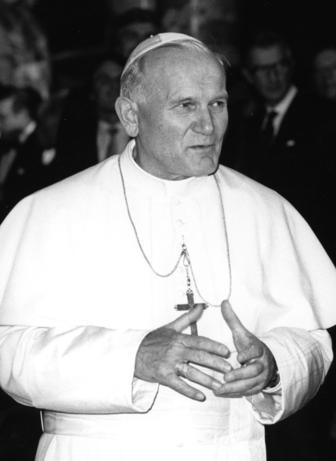
 Vom 15. bis 19. November 1980 besuchte Seine Heiligkeit Papst Johannes Paul II. die Bundesrepublik Deutschland. Auf Einladung von Bundespräsident Karl Carstens hat der Papst seinen pastoralen Besuch mit einem offiziellen in Bonn verbunden. Am 15. November gab der Bundespräsident einen Empfang zu Ehren Seiner Heiligkeit auf Schloß Augustusburg in Brühl bei Bonn. Dort führte Papst Johannes Paul II. auch ein Gespräch mit Bundeskanzler Helmut Schmidt. Gleichzeitig traf Bundesaußenminister Hans-Dietrich Genscher mit Kardinal-Staatssekretär Casaroli zusammen. Im Anschluß an den offiziellen Teil begab sich der Papst auf den Bonner Münsterplatz, um dort eine Ansprache zu halten. Ferner bestand der pastorale Teil aus Besuchen in Köln, Osnabrück, Mainz, Fulda, Altötting und München. In allen diesen Städten hielt Papst Johannes Paul II. die Heilige Messe. Eigentlicher Anlaß seines Aufenthaltes in der Bundesrepublik war der 700. Todestag von Albertus Magnus (1193-1280), dessen Grab der Papst in Köln besuchte. Bundespräsident Karl Carstens und Papst Johannes Paul II. auf Schloß Augustusburg in Brühl.

“Guard the truth that has been entrusted to you by the Holy Spirit….” (2 Timothy 1:14)

“The apostles entrusted the “Sacred deposit” of the faith (the depositum fidei), contained in Sacred Scripture and Tradition, to the whole of the Church….” (Catechism of the Catholic Church, no. 84)

Amoris Laetitia may be likened to a train that went off its tracks and therefore crashed. The Amoris Laetitia train wreck easily could have been avoided if Pope Francis had simply chosen to guard the truth handed down to him by the great Saint John Paul II, the very Pope who was canonized by Pope Francis on April 27, 2014. Here are the three quotes from Pope John Paul II that should have prevented Pope Francis (most especially in the controversial Chapter 8) from trying to refashion Catholic moral theology in a profoundly subjective and presumptive manner (if you are not familiar with this controversy, please refer to my previous post at the following link: https://catholicstrength.com/2017/02/19/amoris-laetitia-st-thomas-aquinas-and-the-proper-reception-of-holy-communion/).

Quote # 1

In the Apostolic Exhortation Familiaris Consortio ( no. 84) Pope John Paul II wrote that divorced and civilly remarried Catholics positively could not receive Holy Communion, for two very profound reasons:

“However, the church reaffirms her practice, which is based upon sacred scripture, of not admitting to eucharistic communion divorced persons who have remarried. They are unable to be admitted thereto from the fact that their state and condition of life objectively contradict that union of love between Christ and the church which is signified and effected by the eucharist. Besides this there is another special pastoral reason: If these people were admitted to the eucharist the faithful would be led into error and confusion regarding the church’s teaching about the indissolubility of marriage.”

Quote # 2

In the encyclical, The Splendor of Truth, Pope John Paul II warned about the inherent danger of making one’s own weakness the criterion of truth and the tremendous confusion this type of “mercy” would cause in the church:

“In this context, appropriate allowance is made both for God’s mercy towards the sinner who converts and for the understanding of human weakness. Such understanding never means compromising and falsifying the standard of good and evil in order to adapt it to particular circumstances. It is quite human for the sinner to acknowledge his weakness and to ask mercy for his failings; what is unacceptable is the attitude of one who makes his own weakness the criterion of the truth about the good, so that he can feel self-justified, without even the need to have recourse to God and his mercy. An attitude of this sort corrupts the morality of society as a whole, since it encourages doubt about the objectivity of the moral law in general and a rejection of the absoluteness of moral prohibitions regarding specific human acts, and it ends up by confusing all judgments about values.” (Veritatis Splendor, 104).

Quote # 3

Finally, in his Apostolic Exhortation, Reconciliation and Penance (a document highly relevant to the proper reception of Holy Communion), Pope John Paul II warned the Church against trying to create a theological category out of psychological considerations and mitigating circumstances, stating:

“But from a consideration of the psychological sphere one cannot proceed to the construction of a theological category, which is what the ‘fundamental option’ precisely is, understanding it in such a way that it objectively changes or casts doubt upon the traditional concept of mortal sin.

While every sincere and prudent attempt to clarify the psychological and theological mystery of sin is to be valued, the Church nevertheless has a duty to remind all scholars in this field of the need to be faithful to the word of God that teaches us also about sin. She likewise has to remind them of the risk of contributing to a further weakening of the sense of sin in the modern world (no.17).”

Conclusion: Pope Francis’ misstep was trusting too much in his own presumptive-leaning attitude towards God’s mercy (which casts doubt upon the clear and unchangeable teaching of the Church concerning mortal sin) rather than in the Sacred Tradition of the Church (based on Holy Scripture) which would have safeguarded the truth and avoided the scandal and confusion caused by Amoris Laetitia. There is still time to bring Amoris Laetitia (most especially the highly controversial Chapter 8) in line with the authentic teachings of the Church. Let us pray for a good ending to this difficult chapter in the Church’s history. Moreover, when a Pope goes off course it is clearly an obligation of faithful Catholics to respectfully and lovingly point it out for the greater good of the Church.

Tom Mulcahy, M.A.

Photo Attribution: The photograph of Pope John Paul II by Lothar Schaack, Nov. 15, 1980, under the Creative Commons Attribution-Share Alike 3.0 Germany license. Attribution: Bundesarchiv, B 145 Bild-F059404-0019 / Schaack, Lothar / CC-BY-SA (at Wikipedia).

P.S. We see, then, that the direction of Amoris Laetitia is fundamentally at odds with Saint Pope John Paul II’s great encyclical on moral theology, Veritatis Splendor, wherein he states: Each of us knows how important is the teaching which represents the central theme of this Encyclical and which is today being restated with the authority of the Successor of Peter. Each of us can see the seriousness of what is involved, not only for individuials but also for the whole of society, with the reaffirmation of the universality and immutability of the moral commandments, particularly those which prohibit always and without exception intrinsically evil acts” (n. 115). Amoris Laetitia and Veritatis Splendor are not in harmony with each other. It is going to be very difficult for Catholics to preach about sin if the Church creates a mitigating exception to every ongoing immoral situation; and this is the profound difficulty with Amoris Laetitia that Pope John Paul II warned about (which empties the Gospel of its saving power).

To SHARE on SOCIAL MEDIA: click on “Leave a comment” or “Comments” below (and this will bring up social media icons if they are not already present).

To LEAVE A COMMENT: click on “Leave a comment” or “Comments” below, and then scroll down to the box which says, “Leave Your Own Comment Here,” which is at the end of any comments already made. If the comment section is already present, merely scroll to the end of any comments already made.

All rights reserved.

Any ads following this note are by WordPress and not CatholicStrength.
THE HOLY SPIRIT CONVINCES US OF SIN

 Holy_Spirit_as_Dove_(detail)

AN UNDOUBTING FAITH IN HELL

 fire-586043_1920

“The devil’s worst and most fatal preparation for the coming of Antichrist is the weakening of men’s belief in eternal punishment” (F.W. Faber)

I came across some very powerful notes of Father F.W. Faber (an acclaimed “master in mystical theology” according to Catholic Encyclopedia) from the second to last homily he ever preached (which was during Lent).  He first preached about the importance of penance and then he mentioned three grand helps in the spiritual battle for our souls.

With respect to these “three grand helps,” Father Faber lays incredible importance on the third one – faith in hell (and this was in 1863). His point is that loss of belief in hell leads to laxity and spiritual death. Thus, a great safeguard against going to hell is belief in its existence, and that is his point. What’s interesting is that Jesus did not avoid telling us about hell. The key point: faith in hell is a sure deterrent from going there. When Saint Faustina was shown hell, she mentioned that so many of its occupants hadn’t believed in hell (Diary, 741).

Here is the note (by Faber):

“I would urge upon you the three grand helps, and not helps only, but facilities also, of penance. 

 1.     Continual remembrance of our sins. 

 2.    Continual remembrance of His [Jesus’] Passion. 

 3.    Continual remembrance of an undoubting faith in Hell.”


With respect to the third point, Father Faber states:

“The devil’s worst and most fatal preparation for the coming of Antichrist is the weakening of men s belief in eternal punishment. Were they the last words I  might ever say to you, nothing should I wish to say to you with more emphasis than this, that next to the thought of the Precious Blood there is no thought in all your faith more precious or more needful for you than the thought of Eternal Punishment” (Fourth Sunday in Lent, 1863; this was the last occasion but one on which Father Faber preached; from: Notes on Doctrinal and Spiritual Subjects, p.23).

These profound thoughts of a very great spiritual writer deserve a moment’s meditation.

Tom Mulcahy, M.A. 

P.S. It is well known that the great mystic, St. Teresa of Avila, experienced a terrifying vision of hell from which she emerged with great supernatural zeal for the salvation of souls.

All rights reserved.

To SHARE on SOCIAL MEDIA: click on “Leave a comment” or “Comments” below (and this will bring up social media icons if they are not already present).

To LEAVE A COMMENT: click on “Leave a comment” or “Comments” below, and then scroll down to the box which says, “Leave Your Own Comment Here,” which is at the end of any comments already made. If the comment section is already present, merely scroll to the end of any comments already made.

Any ads following this note are by WordPress and not CatholicStrength.