Author: tomlirish

FROM 1942 UNTIL 1955 THIS SAINTLY WOMAN LIVED ON THE EUCHARIST ALONE

 Alexandrina_de_Balazar

“Just as the living Father sent me and I live because of the Father, so the one who feeds on me will live because of me” (John 6:57)

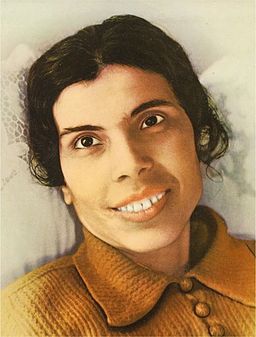
I bring to your attention Blessed Alexandrina da Costa (pictured above). She lived exclusively on the Eucharist for 13 years and was beatified by Pope John Paul II on April 26, 2004, now himself a Saint! To understand the incredible magnitude of this Eucharistic miracle, consider for a moment that a human being would be lucky to survive even one week without water.

There is a beautiful book about her by Francis Johnston in which is revealed the revelation she received that many people would become “ardently Eucharistic” through devotion to her. Please note that she was placed in a hospital for forty days and under intense observation was observed to keep her Eucharistic fast, living only on the Bread of Life, which was her sustenance (the official report of Dr. Araujo “confirmed the prodigy as ‘scientifically inexplicable,’ [and stated] it is absolutely certain that during forty days of being bedridden in hospital [Alexandrina] did not eat or drink….”).

She died in 1955. The manner in which she predicted the supernatural decomposition of her body was observed to have occurred, and no doubt this sped up the process of her rapid beatification. Here below is a short Vatican summary of her life, which I have edited for this post.

“Alexandrina Maria da Costa was born on 30 March 1904 in Balasar, Portugal. She received a solid Christian education from her mother and her sister, Deolinda, and her lively, well-mannered nature made her likeable to everyone.

Her unusual physical strength and stamina also enabled her to do long hours of heavy farm work in the fields, thus helping the family income.

When Alexandrina was 14, something happened that left a permanent imprint on her, both physically and spiritually: it gave her a face-to-face look at the horror and consequences of sin.

On Holy Saturday of 1918, while Alexandrina, Deolinda and a young apprentice were busily sewing, three men violently entered their home and attempted to sexually violate them. To preserve her purity, Alexandrina jumped from a window, falling four metres to the ground.

Her injuries were many, and the doctors diagnosed her condition as “irreversible”:  it was predicted the paralysis she suffered would only get worse.

Until age 19, Alexandrina was still able to “drag herself” to church where, hunched over, she would remain in prayer, to the great amazement of the parishioners. With her paralysis and pain worsening, however, she was forced to remain immobile, and from 14 April 1925 until her death – approximately 30 years – she would remain bedridden, completely paralyzed.

Alexandrina continued to ask the Blessed Mother for the grace of a miraculous healing, promising to become a missionary if she were healed.

Little by little, however, God helped her to see that suffering was her vocation and that she had a special call to be the Lord’s “victim”. The more Alexandrina “understood” that this was her mission, the more willingly she embraced it.

She said:  “Our Lady has given me an even greater grace:  first, abandonment; then, complete conformity to God’s will; finally, the thirst for suffering”.

And so it was that from 3 October 1938 until 24 March 1942, Alexandrina lived the three-hour “passion” of Jesus every Friday, having received the mystical grace to live in body and soul Christ’s suffering in his final hours. During these three hours, her paralysis was “overcome”, and she would relive the Stations of the Cross, her movements and gestures accompanied by excruciating physical and spiritual pain. She was also diabolically assaulted and tormented with temptations against the faith and with injuries inflicted on her body.

On 27 March 1942, a new phase began for Alexandrina which would continue for 13 years and seven months until her death. She received no nourishment of any kind except the Holy Eucharist, at one point weighing as few as 33 kilos (approximately 73 pounds).

Medical doctors remained baffled by this phenomenon and began to conduct various tests on Alexandrina, acting in a very cold and hostile way towards her. This increased her suffering and humiliation, but she remembered the words that Jesus himself spoke to her one day:  “You will very rarely receive consolation… I want that while your heart is filled with suffering, on your lips there is a smile”.

As a “testimony” to the mission to which God had called her, Alexandrina desired the following words written on her tombstone:  “Sinners, if the dust of my body can be of help to save you, come close, walk over it, kick it around until it disappears. But never sin again:  do not offend Jesus anymore! Sinners, how much I want to tell you…. Do not risk losing Jesus for all eternity, for he is so good. Enough with sin. Love Jesus, love him!”.

Alexandrina died on 13 October 1955. Her last words: “I am happy, because I am going to Heaven.’”

The supernatural confirmations of the Catholic faith – and here quite a recent one concerning this humble child of God- are really quite remarkable and surely should enkindle in our hearts a great desire for the Eucharist, the great Sacrament of Eternal Life.

Tom Mulcahy, M.A.

Ref. The book I am relying on is: Alexandrina: The Agony and The Glory by Francis Johnson (TAN). Photo: Public Domain, U.S.A. Here is a link to the full Vatican biographical homily concerning Blessed Alexandrina (given by Pope John Paul II):

Alexandrina Maria da Costa – Vatican.va

 All rights reserved.

To SHARE on SOCIAL MEDIA: click on “Leave a comment” or “Comments” below (and this will bring up social media icons if they are not already present).

To LEAVE A COMMENT: click on “Leave a comment” or “Comments” below, and then scroll down to the box which says, “Leave Your Own Comment Here,” which is at the end of any comments already made. If the comment section is already present, merely scroll to the end of any comments already made.

Any ads following this note are by WordPress and not CatholicStrength.
THE PROFOUND INFLUENCE OF CONSECRATION TO MARY IMMACULATE IN THE LIVES OF SAINTS JOHN PAUL II AND MOTHER TERESA OF CALCUTTA

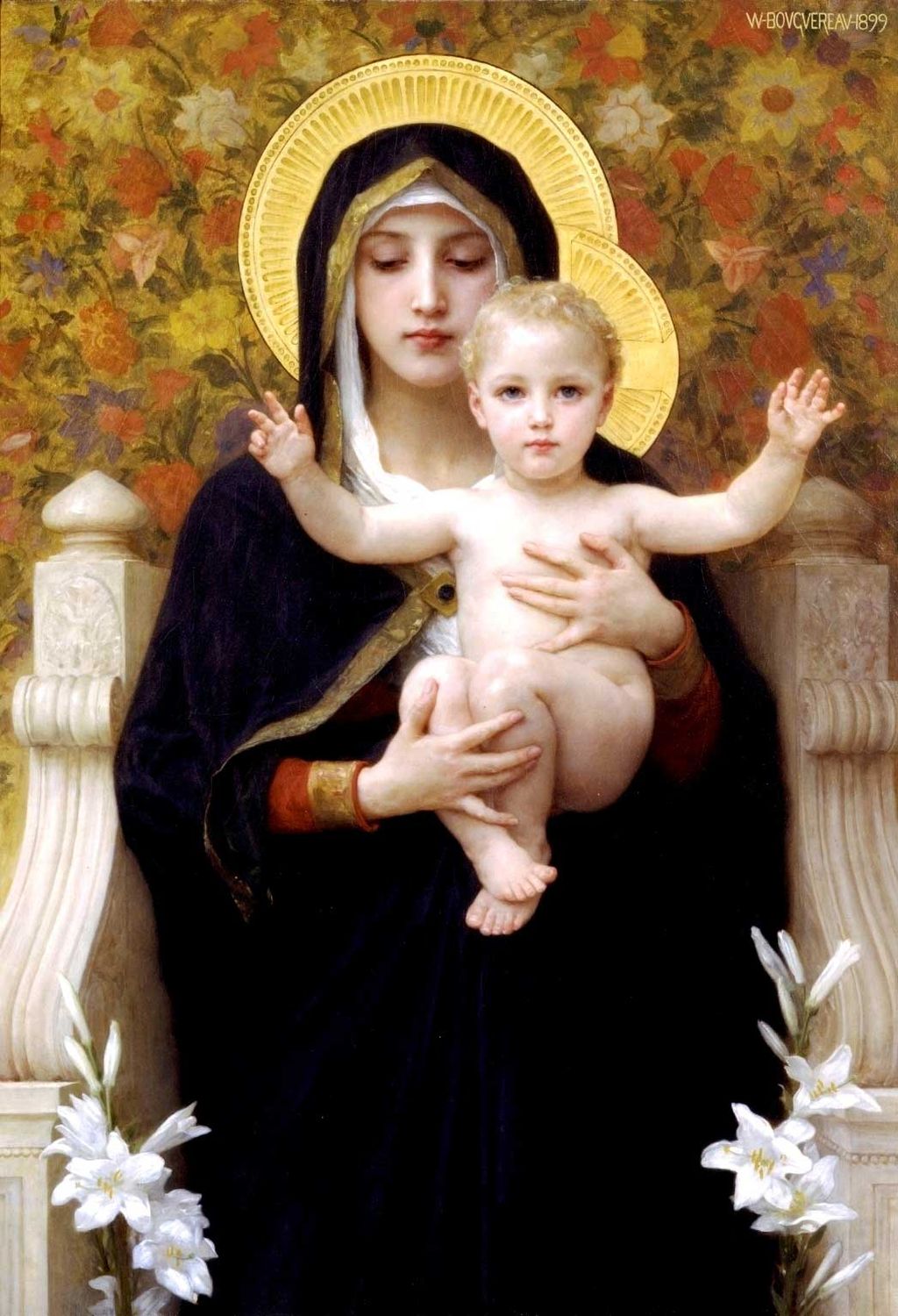
1024px-La_Vierge_au_lys

 “…there are Catholics who do not see clearly enough the necessity of having recourse to Mary that they may attain to intimacy with the Savior” (The Three Ages of the Interior Life, Volume I, page 119, by Father Garrigou-LaGrange)

Very important spiritual lessons can be learned from studying the lives of the saints. Indeed, studying the lives of the saints, and how they grew in holiness, is one of the most important things we can do in the spiritual life. This concept of imitating the lives of the saints is expressed in the New Testament by Saint Paul when he says at 1 Cor. 4:16, “I urge you, then, be imitators of me.” The saints show us how to imitate Christ.

In  my own lifetime it is hard to think of two people who drew closer to Jesus Christ than Saint Pope John Paul II and Saint Mother Teresa of Calcutta. And if the greatness of a saint is judged, in part, by the souls they led to Jesus and salvation, then the influence of Mother Teresa and John Paul II is truly staggering. What then are we to make of the meteoric rise to Beatification and then Canonization of both Saint John Paul II and Saint Mother Teresa of Calcutta (I understand that their Beatifications were two of the fastest ever in the history of the modern church, and Mother Teresa was canonized on September 4, 2016 by Pope Francis)? Our examination of their lives discloses a profoundly important fact; namely, that both of these canonized Saints were molded in the “school of Mary,” having consecrated their lives to the Blessed Virgin.

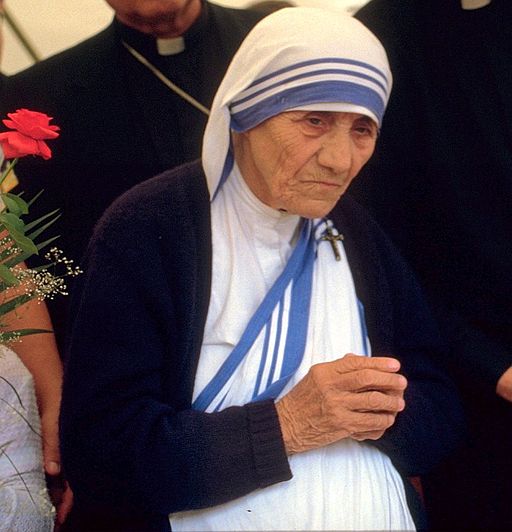
512px-MotherTeresa_094

A profound lesson to be learned from examining the lives of Saint John Paul II and Saint Mother Teresa of Calcutta is thus that devotion to Mary – and even more so, consecration – is a powerful aid to growing closer to Jesus Christ. Both John Paul II and Mother Teresa were profoundly consecrated to the Blessed Virgin Mary, both according to the method proposed by Saint Louis DeMontfort in True Devotion to Mary. Father Joseph Langford has written about Mother Teresa’s mystical relationship with Mary in an awesome book entitled, Mother Teresa: In the Shadow of Our Lady. In that book Father Langford describes in detail the nature of Mother Teresa’s profound consecration to Mary.

As to Pope John Paul II, he pointed to his consecration to Mary as a turning point in his life, saying:

‘The reading of this book (True Devotion to Mary) was a decisive turning-point in my life. I say “turning-point,” but in fact it was a long inner journey. . . – This “perfect devotion” is indispensable to anyone who means to give himself without reserve to Christ and to the work of redemption.’

A book explaining Saint John Paul II’s consecration to Mary is Totus Tuus: John Paul II’s Program of Marian Consecration and Entrustment by Father Arthur B. Calkins.

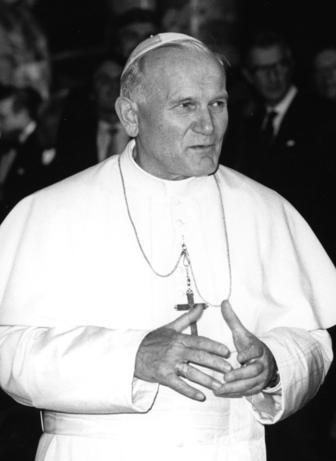
Vom 15. bis 19. November 1980 besuchte Seine Heiligkeit Papst Johannes Paul II. die Bundesrepublik Deutschland. Auf Einladung von Bundespräsident Karl Carstens hat der Papst seinen pastoralen Besuch mit einem offiziellen in Bonn verbunden. Am 15. November gab der Bundespräsident einen Empfang zu Ehren Seiner Heiligkeit auf Schloß Augustusburg in Brühl bei Bonn. Dort führte Papst Johannes Paul II. auch ein Gespräch mit Bundeskanzler Helmut Schmidt. Gleichzeitig traf Bundesaußenminister Hans-Dietrich Genscher mit Kardinal-Staatssekretär Casaroli zusammen. Im Anschluß an den offiziellen Teil begab sich der Papst auf den Bonner Münsterplatz, um dort eine Ansprache zu halten. Ferner bestand der pastorale Teil aus Besuchen in Köln, Osnabrück, Mainz, Fulda, Altötting und München. In allen diesen Städten hielt Papst Johannes Paul II. die Heilige Messe. Eigentlicher Anlaß seines Aufenthaltes in der Bundesrepublik war der 700. Todestag von Albertus Magnus (1193-1280), dessen Grab der Papst in Köln besuchte. Bundespräsident Karl Carstens und Papst Johannes Paul II. auf Schloß Augustusburg in Brühl.

I am currently reading Father Edmund’s biography of Saint Paul of the Cross, the founder of the Passionists, an order of priests dedicated to the love of Jesus crucified. Saint Paul of the Cross was an extraordinary man who practiced the most austere penances and was raised to a very high level of mystical union with God (“the transforming union”) by the relatively early age of around thirty years old. And as with all the saints, the Blessed Virgin played a critical role in his spiritual development and was also instrumental in helping him to establish his new order of priests.

An even more modern saint is Saint Faustina Kowalska, the “visionary of Divine Mercy” to whom Jesus appeared and through whom He established the Divine Mercy devotion. If you read her diary, the tremendous scope of her devotion to Mary becomes obvious and palpable. In her diary (79) she wrote this beautiful prayer of consecration to the Virgin Mary:

O Mary, my Mother and my Lady, I offer You my soul, my body, my life and my death, and all that will Follow it. I place everything in Your hands. O my Mother, cover my soul with Your virginal mantle and grant me the grace of purity of heart, soul and body. Defend me with Your power against all enemies, and especially against those who hide their malice behind the mask of virtue. O lovely lily! You are for me a mirror, O my Mother!

The lesson to be learned, then, is that devotion to Mary is an “essential” component of our faith in Jesus Christ, and that the lives of the saints prove – truly beyond any doubt – that devotion to the Mother of God leads to greater union with Jesus Christ. In our own time, this point is demonstrated in a remarkable manner by Saint John Paul II and Saint Mother Teresa of Calcutta. Thus, in the Vatican II Decree on the Apostolate of the Laity, we are told:

“All should devoutly venerate [Mary] and commend their life and apostolate to her maternal care.”

Tom Mulcahy, M.A.

References: Chapter V of Growth In Holiness by Father Faber; Chapter VI, The Influence of Mary Mediatrix, in Volume I of The Three Ages of the Interior Life; and True Devotion to Mary by Saint Louis DeMontfort. If you are interested in making the total consecration to Jesus through Mary, I recommend the book, Preparation for Total Consecration, put out by The Apostolate for Family Consecration (or Preparation for Total Consecration by Montfort Publications).

Images: The Virgin of the Lilies, Public Domain, U.S.A. (at Wikipedia). The photo Of Pope John Paul II is by Lothar Schaack, November 15, 1980, under a Creative Commons Attribution-Noncommercial license (found at Wikipedia). The photo of Mother Teresa is by Turelio, July 13, 1986 under a Creative CommonsAttribution-Share Alike 2.0 Germany license (found at Wikipedia).

To SHARE on SOCIAL MEDIA: click on “Leave a comment” or “Comments” below (and this will bring up social media icons if they are not already present).

To LEAVE A COMMENT: click on “Leave a comment” or “Comments” below, and then scroll down to the box which says, “Leave Your Own Comment Here,” which is at the end of any comments already made. If the comment section is already present, merely scroll to the end of any comments already made.

All rights reserved.

Any ads following this note are by WordPress and not CatholicStrength.
 

SAINT MOTHER TERESA’S FIRST HOLY COMMUNION CHANGED HER LIFE


SMALL RESURRECTIONS AND BEAUTIFUL PIGEON FEATHERS


“For ever since the world was created, people have seen the earth and sky. Through everything God made, they can clearly see his invisible qualities–his eternal power and divine nature.” (Romans 1:20)

 “…unless a grain of wheat falls to the ground and dies, it remains just a grain of wheat…. (John 12:24)

Christians often view resurrection as an event that will occur down the road – after death – in that future time beyond time. We see the relevance of resurrection as something that happened in the past to Jesus, and as something we hope will happen to us in the future. The purpose of this note is to focus on death and resurrection, not as future events, but as events that are part of the very fabric of our daily lives. The seeds of eternal life are sown during our time on earth, so that time is the medium through which eternity must force its way into our hearts and souls. Christianity is a religion that requires a resurrection in one’s life before death if there is to be a resurrection to eternal life after death. Using an example from literature,I hope to shed some light on how, during the course of our lives, we encounter death and resurrection as first-hand experiences which draw us closer to God.

John Updike’s short story, Pigeon Feathers, presents a striking example of a person who undergoes a death and resurrection experience in the very context of trying to understand the meaning of death. In Updike’s story, David, at age 14, suddenly finds himself doubting his childhood faith at a time when the turbulence of a move to a new home has him feeling displaced and insecure. To strengthen his childhood belief in life after death, which he finds under attack after browsing through a book skeptical of Jesus’ resurrection, he turns to his parents for guidance and support. To his own surprise, David finds out that his parents’ faith in the claims of Christianity is not altogether that strong. In fact, David discovers, his father is practically an atheist!

Still, David holds out hope that his minister, Reverend Dopson, will confirm that each person’s soul is immortal. But far from providing David with consolation, Dopson shatters David’s security in life after death by suggesting that after death, “I suppose you could say that our souls are asleep.”

Panicked and depressed about his parents’ and his minister’s “submission to death,” David takes a rifle out to the family barn to shoot some pigeons. With “splinters of light” shining through the darkness of the barn, the barn becomes almost a micro-universe for David to work out his struggles with the issues of life and death. David then proceeds to the task of retrieving the dead pigeons he has shot in order to bury them.

David had never seen a pigeon up close before. An examination of some of the dead pigeons up close produced a resurrection in his life. Updike movingly describes David’s resurrection experience:

“The feathers were more wonderful than dog’s hair, for each filament was shaped within the shape of the feather, and the feathers in turn were trimmed to fit a  pattern that flowed without error across the bird’s body…and across the surface of the infinitely adjusted yet somehow effortless mechanics of the feathers played idle designs of color, no two alike, designs executed, it seems, in a controlled rapture, with a joy that hung level in the air above and behind him. Yet these birds breed into  the millions and were exterminated as pests. Into the fragrant open earth he dropped one broadly banded in slate shades of blue, and on top of it another, mottled all over in rhymes of lilac and grey. The next was almost wholly, white, but for a salmon glaze at its throat. As he fitted the last two, still pliant, on the top, and stood up, crusty coverings were lifted from him, and with a feminine slipping sensation along his nerves that seemed to give the air hands, he was robed in this certainty: That the God who had lavished such craft upon these worthless birds would not destroy his whole Creation by refusing to let David live forever.”

David had to die to his childhood faith in order to be reborn into a deeper, more mature faith.  He had to take control over his own faith life rather than living it vicariously through his parents or his minister. He had to shoot down his childhood faith in order to see how precious and costly that faith was to him. The wonderful form, symmetry and beauty of the pigeon feathers revealed to David the majestic presence of a loving God. David discovered in a moment of time a transcendent truth: that God loved him with an everlasting love.

The deaths we die and the resurrections we experience in our daily lives are the events which shape who we are and what we are to become for all eternity. Whether it is a teenager in despair (like David) discovering God’s presence, or an addict finally falling to his knees to invoke God’s help, these are the kinds of experiences in life which radically draw us closer or further away from God. In the final analysis the person of Jesus helps us to understand that our desire for permanency is not an illusion. God “vindicated” Jesus in history by raising him from the dead. And by trusting in God, like Jesus, God will also open to us the door to eternal life.

Tom Mulcahy, M.A.

To SHARE on SOCIAL MEDIA: click on “Leave a comment” or “Comments” below (and this will bring up social media icons if they are not already present).

To LEAVE A COMMENT: click on “Leave a comment” or “Comments” below, and then scroll down to the box which says, “Leave Your Own Comment Here,” which is at the end of any comments already made. If the comment section is already present, merely scroll to the end of any comments already made.

All rights reserved.

Any ads following this note are by WordPress and not CatholicStrength.
HOLY CONFESSION WAS ESTABLISHED BY THE RESURRECTED CHRIST

A METAPHYSICAL REFLECTION ON THE IMPORTANCE OF BASEBALL


The National Pastime is once again in full swing (if you live in the U.S.A.), and the true fan of baseball is the contemplative, who has a super-discursive appreciation for the “game.” Ergo, I present this metaphysical reflection on the meaning of baseball…

Baseball is ritual. Ritual relies on rules. Within the rules there is an opportunity for transcendence. As the fan sits there with a beer in his hand he can witness the limitations of his finite life temporarily suspended, as he sees the trajectory of a tiny ball sail over the confining wall, and he stands up and says, “OUTTA  HERE.” Did I say that the purpose of ritual is to create an opportunity for transcendence? A home run is a clear affirmation of a human being’s desire for transcendence. So now you see the inner-theological relevance of baseball, for God IS pure transcendence; God is the Eternal Grand slam! Every home run is an affirmation of our desire for ultimate meaning, transcending time and place, towards a mystery we can access only through faith and love. Get in the game.

“Batter up!”

Tom

References: Aristotle on Baseball. I once had a professor at Notre Dame who wrote a paper, “A Metaphysical Delineation on the Importance of Poetry,” so I have borrowed from his title.

Practice tip: If you’re spending a lot of time watching baseball games on TV, listening to the over-analysis of balls and strikes that goes on today, try praying the Rosary as you watch the game. You can easily pray and meditate on the mysteries of the Rosary while keeping an eye on the game at the same time. Five decades of the Rosary will only take a few innings, so give the Rosary your primary attention for those innings. This practice of praying the Rosary while you watch the game will pay many spiritual dividends for you.

To SHARE on SOCIAL MEDIA: click on “Leave a comment” or “Comments” below (and this will bring up social media icons if they are not already present).

To LEAVE A COMMENT: click on “Leave a comment” or “Comments” below, and then scroll down to the box which says, “Leave Your Own Comment Here,” which is at the end of any comments already made. If the comment section is already present, merely scroll to the end of any comments already made.

All rights reserved.

Any ads following this post are from WordPress and not this blog.

THE GOSPEL CANNOT BE PREACHED AS IF MORAL TRANSFORMATION IS OPTIONAL


“And if your right hand causes you to sin, cut it off and throw it away. For it is better that you lose one of your members than that your whole body go into hell.” (Matthew 5:30)  

“For this is the will of God, your sanctification….” (1 Thes. 4:3)

The moral imperative of the Gospel is not optional; it is fundamental. In the preaching of Jesus conversion leads to a break with sin – as in Zacchaeus’ professed act of repentance and promised restitution, as in Jesus instructing the woman caught in adultery to sin no more, as in Jesus directly confronting the woman at the well about her immoral relationship. I have been reading Scripture for a long time now: who would dare to deny its urgent message to break with sin! Jesus says, “If your right eye causes you to stumble, gouge it out and throw it away. It is better for you to lose one part of your body than for your whole body to be thrown into hell” (Matthew 5:29). We are not allowed to invent a play Gospel where we become comfortable with sin. “Cheap grace is the deadly enemy of the Church.” Jesus preached about sin as a very serious matter, and so have all the Catholic Saints.

Morality is not a consolation prize in the Catholic Church…a sort of additional benefit you get if you want to apply for it. No, Catholic morality is the very heart and soul of the Gospel, indeed, it is the very joy of the Gospel. The Gospel is a profound call to repent, to break with sin, to accept new life in Christ.

In the preaching of Jesus the critical importance of morality is emphasized from the beginning of his ministry. Jesus may very well have met people “where they are,” in some sense of that phrase, but only to point them in the direction of living profoundly by the moral Gospel. Thus, in his famous Sermon on the Mount (Matt. 5-7), preached at the commencement of his ministry, Jesus lays out a “manifesto” which is “a compendium of the moral code of Christianity” (Catholic Bible Dictionary, page 828). “He teaches on anger, adultery, marriage and divorce, oaths, retaliation, love for enemies, and alms-giving” (Id at 828). The fundamental importance of the moral life is firmly established – sometimes very dramatically –  in the preaching of Jesus. The beatitudes themselves represent the very highest moral perfection attainable in this life.

The Gospel is a call to holiness which will ultimately result in your complete and utter sanctification in Heaven. Therefore, there is no Gospel without the moral Gospel. To preach the Gospel is to preach holiness of life in imitation of Jesus and the Saints. To peach the Gospel is to preach a break with sin and a new life of grace in Christ. To preach the Gospel is to lead sinners to repentance. When we first hear someone preaching the Gospel, what do we hear: “Repent, for the Kingdom of God is at hand” (Mark 1: 2-4).

The modern tendency to preach the Gospel without reference to its moral demands will only lead to an “obscuring of the moral sense” (Saint Pope John Paul II,Veritatis Splendor, 106). Saint John Paul II teaches us that the “New Evangelization” must include the presentation of the moral Gospel. The Pope stated:

“Evangelization — and therefore the “new evangelization” — also involves the proclamation and presentation of morality. Jesus himself, even as he preached the Kingdom of God and its saving love, called people to faith and conversion (cf. Mk1:15). And when Peter, with the other Apostles, proclaimed the Resurrection of Jesus of Nazareth from the dead, he held out a new life to be lived, a “way” to be followed, for those who would be disciples of the Risen One (cf. Acts 2:37-41; 3:17-20). Just as it does in proclaiming the truths of faith, and even more so in presenting the foundations and content of Christian morality, the new evangelization will show its authenticity and unleash all its missionary force when it is carried out through the gift not only of the word proclaimed but also of the word lived. In particular,the life of holiness which is resplendent in so many members of the People of God, humble and often unseen, constitutes the simplest and most attractive way to perceive at once the beauty of truth, the liberating force of God’s love, and the value of unconditional fidelity to all the demands of the Lord’s law, even in the most difficult situations. For this reason, the Church, as a wise teacher of morality, has always invited believers to seek and to find in the Saints, and above all in the Virgin Mother of God “full of grace” and “all-holy”, the model, the strength and the joy needed to live a life in accordance with God’s commandments and the Beatitudes of the Gospel.” (Veritatis Splendor, 107)

 Saint John Paul II also reminded us that God’s Mercy is given to us to forgive, not justify, sin.

“In this context, appropriate allowance is made both for God’s mercy towards the sinner who converts and for the understanding of human weakness. Such understanding never means compromising and falsifying the standard of good and evil in order to adapt it to particular circumstances. It is quite human for the sinner to acknowledge his weakness and to ask mercy for his failings; what is unacceptable is the attitude of one who makes his own weakness the criterion of the truth about the good, so that he can feel self-justified, without even the need to have recourse to God and his mercy. An attitude of this sort corrupts the morality of society as a whole, since it encourages doubt about the objectivity of the moral law in general and a rejection of the absoluteness of moral prohibitions regarding specific human acts, and it ends up by confusing all judgments about values.” (Veritatis Splendor, 104).

Our children deserve to hear the full Gospel – that is to say they deserve to hear the Gospel preached without neutering its moral imperative. There is no Gospel without the moral Gospel because Jesus came to save us from sin.

“Here is a trustworthy saying that deserves full acceptance: Christ Jesus came into the world to save sinners….” (1 Timothy 1:15).

Tom Mulcahy, M.A.

Note: The panoply of virtues and gifts given to us in baptism, which flow from sanctifying grace, are supernatural strengths with which to lead a moral life.

Reference: I had a Professor who once said: “There is no Gospel without the moral Gospel.”

To SHARE on SOCIAL MEDIA: click on “Leave a comment” or “Comments” below (and this will bring up social media icons if they are not already present).

To LEAVE A COMMENT: click on “Leave a comment” or “Comments” below, and then scroll down to the box which says, “Leave Your Own Comment Here,” which is at the end of any comments already made. If the comment section is already present, merely scroll to the end of any comments already made.

All rights reserved.

Any ads following this post are from WordPress and not this blog.


AN INTENSE, POWERFUL LIGHT MAY HAVE CAUSED THE IMAGE OF A CRUCIFIED MAN ON THE SHROUD OF TURIN


“Then Simon Peter came along behind him and went straight into the tomb. He saw the strips of linen lying there…. “(John 20:6)

The renowned Catholic historian, Warren H. Carroll, who died in 2011, clearly believed in the supernatural origin of the Shroud of Turin. Professor Carroll was especially impressed by the scholarship of Ian Wilson regarding the historical continuity and preservation of the Shroud (see Vol. 1 of the six volume A History of Christendom, where Professor Carroll refers on a number of occasions to the Shroud of Turin in a very favorable manner).

But in this note I simply intend to bring to the reader’s attention a very concise summary of two major scientific studies that help to validate the authenticity of the Shroud of Turin – remembering, of course, that faith is a supernatural virtue, certainly not opposed to science, but not dependent upon scientific verification of a purported relic.

1. The STURP in-depth scientific examination of the Shroud of Turin (1978)

The “primary goal” of the the Shroud of Turin Research Project, Inc., (STURP) “was to determine the scientific properties of the image on the Shroud of Turin, and what might have caused it.” STURP “consisted of a team of American scientists and researchers that spent over two years preparing a series of tests that would gather a vast amount of Shroud data in a relatively short period of time. In October of 1978 the STURP team spent 120 continuous hours conducting their examination of the Shroud. To this day, scientists around the world use the data gathered by STURP for their Shroud research” (source: shroud.coman excellent site on the Shroud of Turin).

According to a National Geographic article on the Shroud of Turin, “the U.S.-led Shroud of Turin Research Project (STURP), …was granted an unprecedented five days of continuous access to the shroud itself in 1978. The project’s 33 members ran the gamut of scientific disciplines, and their credentials included high-level posts at 20 major research institutions. They arrived in Turin with seven tons of equipment and worked in shifts 24 hours a day. An associate team of European scientists acted as expert observers” (from Why Shroud of Turin Secrets Continue to Elude Science by Frank Viviano, April 17, 2015, available online).

The National Geographic article further states: “Their analyses found no sign of artificial pigments. ‘The Shroud image is that of a real human form of a scourged, crucified man. It is not the product of an artist,’ the project’s 1981 report declared. ‘The blood stains are composed of hemoglobin and also give a positive test for serum albumin.’ But the report also conceded that no combination of ‘physical, chemical, biological or medical circumstances’ could adequately account for the image. The Shroud of Turin, the STURP team concluded, ‘remains now, as it has in the past, a mystery.’”

The main findings of the STURP scientific study of the Shroud of Turin are summarized nicely by physicist Paolo Di Lazzaro:

“The Shroud is not a painting, no pigment, any directionality, not a scorch. The image encodes cloth to body  distance, and it is present in both contact and non contact areas. The image is superficial, no more than 0.6 microns thick (work by others has shown 0.2 microns ). Invisible halos surround blood. Blood went on before image (no image beneath blood). The blood stains contain hemoglobin and serum albumin. Calcium and strontium and iron are uniformly present on the Shroud in small quantities (Paolo Di Lazzaro, ATSI 2014 Bari).”

Here is the official summary of STURP’s conclusions courtesy of a link provided by shroud.comSummary of STURP’s Conclusions.

2. The Five Year Study of the Shroud of Turin by the National Agency for New Technologies (2011)

In December of 2011 ABC News reported (in an article available online) that a recently concluded study by a group of Italian scientists “refuted the popular notion that [the Shroud of Turin] was faked during the Middle Ages. Experts at Italy’s National Agency for New Technologies, Energy and Sustainable Development have concluded in a report that the famed purported burial cloth of Jesus Christ could not have been faked.”

ABC News reported that “the Italian researchers, who conducted dozens of hours of tests with X-rays and ultraviolet lights, said that no laser existed to date that could replicate the singular nature of markings on the shroud. They also said that the kind of markings on the cloth could not have come from direct contact of the body with the linen. The Italian scientists said the  marks could only have been made by ‘a short and intense burst of VUV directional radiation.’ ”

According to the National Geographic article mentioned above, “the National Agency for New Technologies, Energy and Sustainable Economic Development (ENEA) conducted five years of experiments, using state-of-the-art excimer lasers to train short bursts of ultraviolet light on raw linen, in an effort to simulate the image’s coloration” and “published its findings in 2011.”

Relying on quotes from physicist Paolo Di Lazzaro of ENEA, the National Geographic article continues (as placed in italics), stating: The ultraviolet light necessary to [simulate the image] “exceeds the maximum power released by all ultraviolet light sources available today,” says Di Lazzaro. It would require “pulses having durations shorter than one forty-billionth of a second, and intensities on the order of several billion watts.” If the most advanced technologies available in the 21st century could not produce a facsimile of the shroud image, he reasons, how could it have been executed by a medieval forger?

For believers, the radiation thesis suggests that a “divine light” in the tomb might have seared the crucified form of Jesus Christ onto the shroud. “One could look at hypotheses outside the realm of science, a sort of miracle,” says Di Lazzaro. “But a miracle cannot be investigated by the scientific method” (end of article).

Here is a link to The ENEA team report, which published its findings in 2011 (scroll and click on the word “published”).

CONCLUSION:

Based on the two in-depth scientific investigations outlined above, namely, the STURP study and the ENEA study, it certainly does not appear that the image on the Shroud of Turin was made by human hands. The supernatural origin of this great relic of the Church cannot be ruled out, and even appears now to be the most likely explanation of this scientifically inexplicable image which is claimed to be the burial cloth of Jesus Christ (for an informative video on the Shroud, see the link below).

Thomas L. Mulcahy, M.A.

Image: At Wikipedia (Turin plasch.jpg), Public Domain, U.S.A.

An informative video on The Shroud of Turin (click on the following link): 15 Minute Video: Russ Breault explains his take on the Shroud of Turin.  From Shroudstory.com

To SHARE on SOCIAL MEDIA: click on “Leave a comment” or “Comments” below (and this will bring up social media icons if they are not already present).

To LEAVE A COMMENT: click on “Leave a comment” or “Comments” below, and then scroll down to the box which says, “Leave Your Own Comment Here,” which is at the end of any comments already made. If the comment section is already present, merely scroll to the end of any comments already made.

All rights reserved.

Any ads following this note are by WordPress and not CatholicStrength.

HAVE YOU MET THE RISEN CHRIST?


                           Behold, I make all things new” (Revelation 21:15)

JESUS’ RESURRECTION: CREDIBLE WITNESSES ARE HELPFUL!

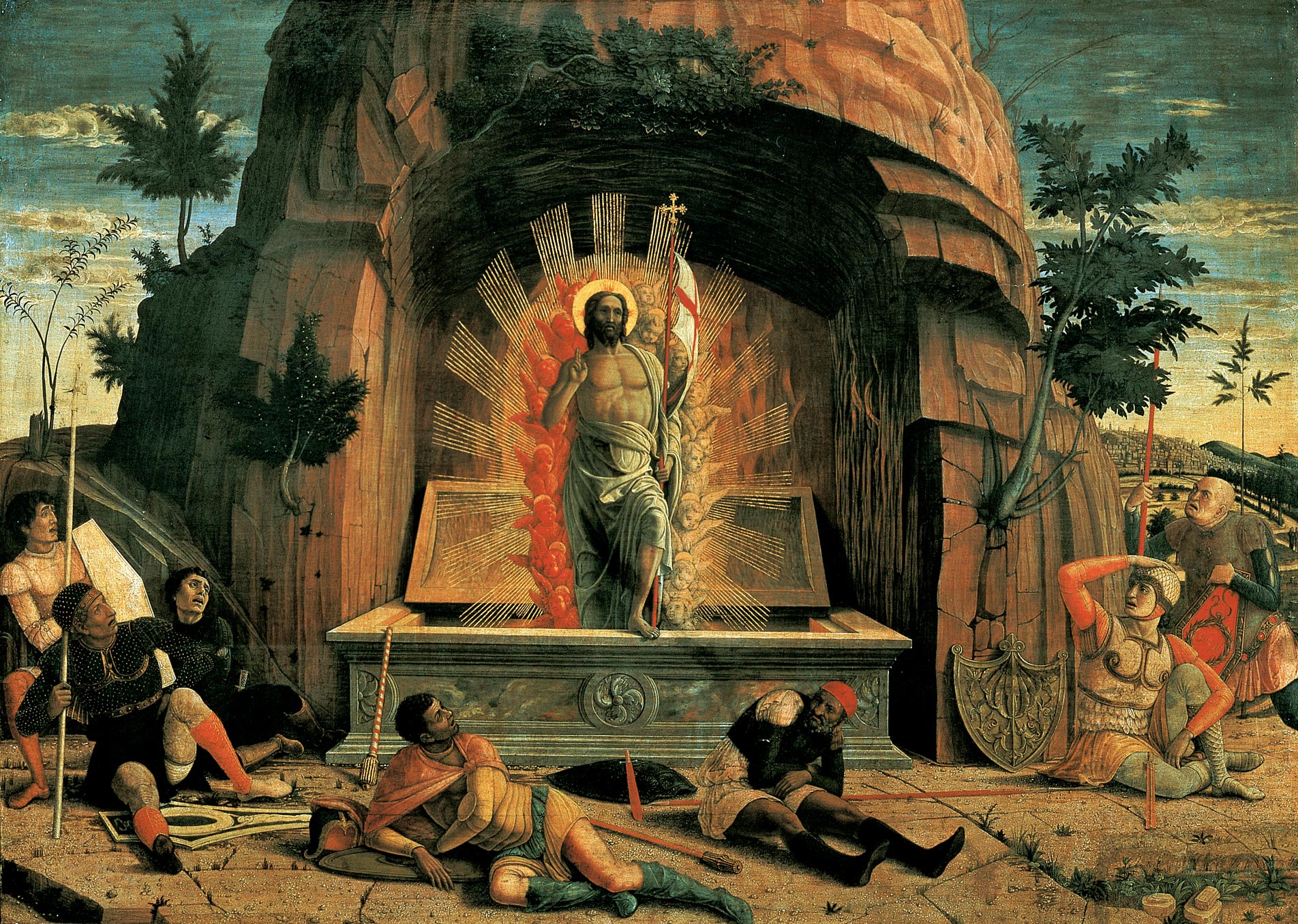
 Mantegna,_Andrea_-_La_Résurrection_-_1457-1459
 

               “God raised this Jesus; of this we are all witnesses.” (Acts 2:32)

It’s a very embarrassing moment for a lawyer trying a case in front of a jury when the judge says, “Please call your next Witness,” and that next witness hasn’t shown up. Witnesses are very important, and this concept of “witness” has a definite place in Christianity.

In 2 Peter 1:16 the concept of witness is elaborated upon by the apostle, who says:

For we did not follow cleverly devised stories when we told you about the coming of our Lord Jesus Christ in power, but we were eyewitnesses of his majesty.” (2 Peter 1: 16)
 
And at John 21:24 another apostle – obviously John – signs his affidavit of authenticity at the end of his Gospel by stating:
 
“This is the disciple who testifies to these things and who wrote them down. We know that his testimony is true.” (John 21: 24-25)
 

The Catechism of the Catholic Church tells us that the Resurrection of Jesus Christ was a real and historical event: “The mystery of Christ’s resurrection is a real event, with manifestations that were historically verified, as the New Testament bears witness” (CCC 639). Clearly there are aspects of our Lord’s Resurrection which transcend the limitations of time and space – still the event itself was witnessed in history and dramatically changed the lives of those who witnessed it. Peter, speaking on the day of Pentecost, says:God raised this Jesus; of this we are all witnesses” (Acts 2:32)

Relying on his apostolic credentials, Saint Paul writes powerfully about the historical reliability of  Jesus’ Resurrection in 1 Corinthians 15, stating: 

“For I delivered to you as of first importance what I also received, that Christ died for our sins according to the Scriptures, and that He was buried, and that He was raised on the third day according to the Scriptures, and that He appeared to Cephas, then to the twelve. After that, he appeared to more than five hundred of the brothers and sisters at the same time, most of whom are still living, though some have fallen asleep. Then he appeared to James, then to all the apostles, and last of all, as to one untimely born, He appeared to me also.”  (1 Cor. 15: 3-8)

The Apostle speaks here of the living tradition of the Resurrection which he had learned after his conversion at the gates of Damascus” (CCC 639). In this famous passage (just quoted above) Paul mentions 500 hundred witnesses to Jesus’ resurrection, and he further adds that some of these witnesses have died, which means that most are still alive and can provide corroborating testimony! Five hundred witnesses would make for a long trial!

The great Biblical scholar C.H. Dodd comments on this concept of witness as it pertains to the resurrection. He states: “The main weight [regarding the truth of Jesus’ Resurrection] … is placed on the testimony that Jesus was ‘seen’ alive after death, by a number of his followers….” (The Founder of Christianity, page 167). Dodd adds: Something had happened to these men, which they could describe only by saying they had ‘seen the Lord’. This is not an appeal to any generalized ‘Christian experience’. It refers to a particular series of occurrences, unique in character, unrepeatable, and confined to a limited period” (p.168). Dodd therefore concludes:

“[For] the original witnesses [the resurrection of Jesus was] an immediate, intuitive certainty. They were dead sure they had met with Jesus, and there was no more to be said about it….Now they were new men in a new world, confident, courageous, enterprising, the leaders of a movement which made an immediate impact and went forward with an astonishing impetus.” (p. 170)
 
Almost all of these apostles went on to convincingly confirm that they witnessed the resurrected Jesus with the witness – the Greek word “martyr” literally means witness – of their own lives, which is a most powerful testimony. Who are we today – some 2000 years later – but the living beneficiaries and stewards of the most important testimony ever given: “CHRIST IS RISEN! ALLELUIA!
 
Tom Mulcahy, J.D.
 
References: The Founder of Christianity by C.H. Dodd, The Catechism of the Catholic Church, and The Ignatius Catholic Bible Study on 1 Corinthians 15. Image: (Public Domain, U.S.A.). Image: The Resurrection by Andrea Mantegna, 1459 (Public Domain, U.S.A.).

All rights reserved.

To SHARE on SOCIAL MEDIA: click on “Leave a comment” or “Comments” below (and this will bring up social media icons if they are not already present).

To LEAVE A COMMENT: click on “Leave a comment” or “Comments” below, and then scroll down to the box which says, “Leave Your Own Comment Here,” which is at the end of any comments already made. If the comment section is already present, merely scroll to the end of any comments already made.

Any ads following this note are by WordPress and not CatholicStrength.